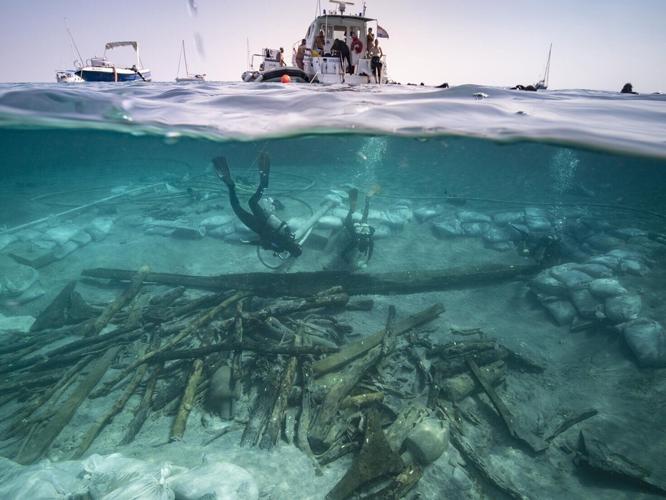
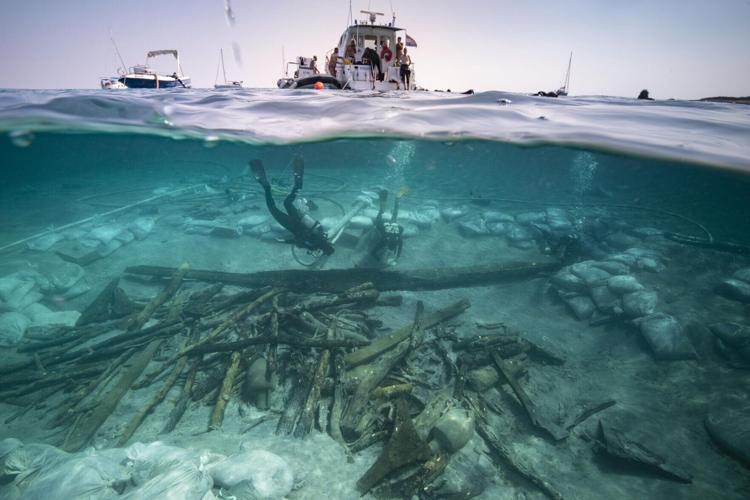
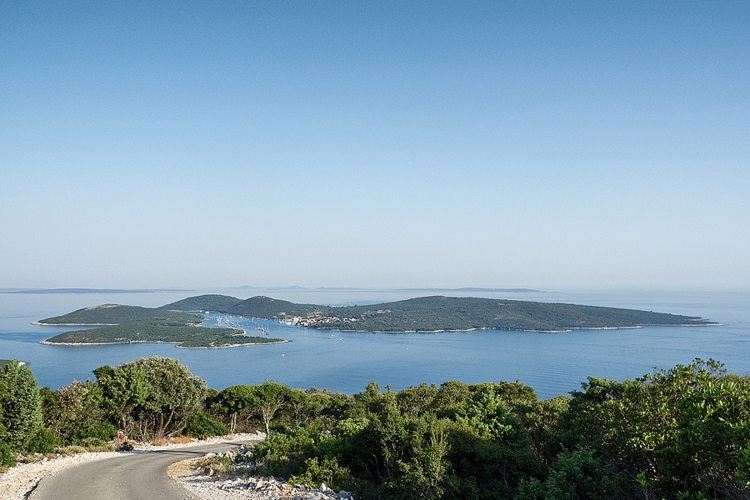
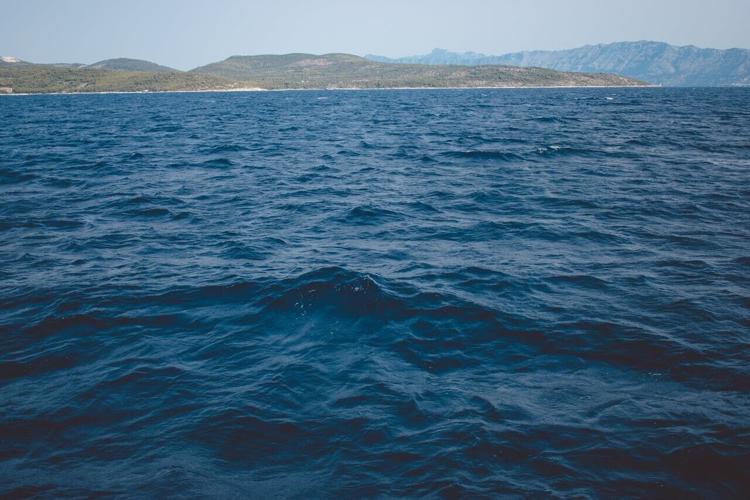
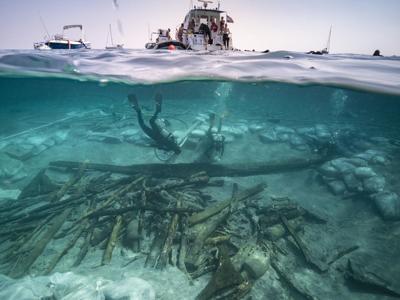

View of the excavation of the bow area of the Ilovik-Paržine 1 shipwreck. In the foreground, the cargo of logs and amphoras can be seen.Archaeologists are working near the structure of the bow complex. (Adriboats / L. Damelet, CNRS / CCJ via SWNS)
By Stephen Beech
Forensic analysis of a Roman shipwreck has revealed a remarkable history of repairs to the vessel throughout the Adriatic over 2,000 years ago.
Researchers looked at pollen trapped in the waterproofing layers of the long sunken Roman Republic ship to find proof that it may have been patched up successively at different locations.
Ever since humans first embarked on sea voyages, they needed to ensure their boats were waterproof, resistant to salty seawater, and could withstand microorganisms.
But until less than 100 years ago the study of non-wood materials used to build ships was overlooked.
Even today little work has been conducted on materials used for waterproofing.
For the new study, French and Croatian researchers examined the protective coating of the Roman shipwreck Ilovik–Paržine 1.
It sank around 2,200 years ago in the bay of Paržine, off Ilovik Island, in what is now Croatia.
Armelle Charrié, an archaeometrist at the Laboratory of Mass Spectrometry of Interactions and Systems in Strasbourg, said: "In archaeology little attention is paid to organic waterproofing materials.
"Yet they are essential for navigation at sea or on rivers and are true witnesses of past naval technologies.

Roberta F.
"Studying the coatings, we found two different kinds on this vessel: one made of pine tar, also called pitch, and the other of a mixture of pine tar and beeswax.
"Analysis of pollen in the coating made it possible to identify the plant taxa present in the immediate environment during the construction or repairs of the ship."
Since the wreck was discovered in 2016 the ship and its cargo have been examined several times.
But the new study is the first to combine pollen and molecular analyses to characterise the ship's coating and vegetation present during its production and application on the hull.
The work is a collaboration between the Department for Underwater Archaeology of the Croatian Conservation Institute and researchers from Aix-Marseille University in France.
Charrié said: "Some regions throughout the Adriatic have particular characteristics that led local populations to develop a specific shipbuilding style.
"Only studies like ours offer an overview into these traditions which bear witness to genuine know-how and diverse traditions."
To examine the coatings, the research team conducted structural, molecular, and pollen analyses using techniques that identify and quantify unknown components in an organic mixture such as mass spectrometry.





Using 10 coating samples, the researchers identified the biological origin of natural substances used for the ship's coating by molecular analysis.
The "molecular fingerprint" analysis showed molecules characteristic of pine trees, indicating that the main component of all coating samples was heated coniferous resin or coniferous tar, also called pitch.
But one sample showed that at least some of the coating was made from a different composition of materials, namely beeswax and tar.
The mixture – known to Greek shipbuilders as zopissa – improves the adhesive's flexibility and is easier to apply when hot.
The researchers explained that pitch is adhesive by nature and can trap and preserve pollen from the surrounding landscapes.

(Photo by Vitalii Dobrianskyi via Pexels)
Analysing those traces and their respective abundances allowed the team to narrow down possible regions where the pitch could have been produced and re-applied during refurbishments.
They discovered that pollen from coating samples from the Ilovik–Paržine 1 reflected a "high diversity" of environments.
The identified landscapes included those characteristic of the Mediterranean and Adriatic coasts and valleys, with forests of holly oak and pine as well as matorral – a kind of Mediterranean shrubland – where olive and hazel trees grow.
The researchers said the presence of alder and ash points to vegetation growing close to river- and seashores, which can be found near the coast or in the nearby hinterland.
Fir and beech were present in small proportions, too. That vegetation is found in mountainous regions and typical of the north-eastern coastal regions of the Adriatic Sea where the mountain ranges of Istria and Dalmatia are not far.
The team's findings, published in the journal Frontiers in Materials, also indicated that the ship likely underwent four to five distinct batches of coatings.
The ship's stern and central part was covered by the same coating, whereas three batches at the bow were distinct from one another.
That, too, could indicate that the ship was patched up successively using materials sourced from various locations throughout the Mediterranean, according to the research team.
Previous research using the ship's ballast identified Brundisium – today Brindisi – on the south-eastern coast of Italy as where the ship was built.
Pollen analysis also suggests that some of the coatings were applied close to there.
But other coating layers could have been applied on the north-eastern Adriatic coast, where the shipwreck was discovered.
Charrié added: "While it seems obvious that ships sailing long distances need repairs, it's simply not easy to demonstrate this.
"Pollen has been very useful in identifying different coatings where the molecular profiles were identical."

(0) comments
Welcome to the discussion.
Log In
Keep it Clean. Please avoid obscene, vulgar, lewd, racist or sexually-oriented language.
PLEASE TURN OFF YOUR CAPS LOCK.
Don't Threaten. Threats of harming another person will not be tolerated.
Be Truthful. Don't knowingly lie about anyone or anything.
Be Nice. No racism, sexism or any sort of -ism that is degrading to another person.
Be Proactive. Use the 'Report' link on each comment to let us know of abusive posts.
Share with Us. We'd love to hear eyewitness accounts, the history behind an article.