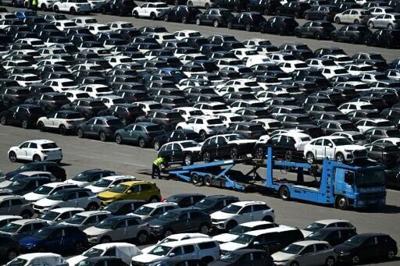
Germany's economy has struggled in recent years in the face of high production costs at home, increasingly fierce Chinese competition and growing global trade tensions fired by US President Donald Trump
Germany's economy has struggled in recent years in the face of high production costs at home, increasingly fierce Chinese competition and growing global trade tensions fired by US President Donald Trump
Germany's government on Wednesday put forward a sweeping package of corporate tax breaks aimed at boosting investment and pulling Europe's largest economy out of the doldrums.
"It's important to send a clear signal in support of our country's economic strength and competitiveness," Finance Minister Lars Klingbeil said at a press conference.
Klingbeil he said he hoped the package, worth a cumulative 45.8 billion euros ($52.2 billion), could be pushed through parliament by the end of the month.
Under the plans, Germany's corporate tax rate would fall by one percent a year from 2028 to reach 10 percent, down from 15 percent.
Companies would also be able to deduct 30 percent of the cost of new machinery and equipment from their tax bill between 2025 and 2027, and electric company cars would receive preferential tax treatment.
Economy Minister Katherina Reiche said in a statement the plans would send an important "signal" to firms that Germany was open for business.
"Germany is back," she said. "Today's cabinet decision means we are going for growth and increased competitiveness, and more measures will come."
Germany's economy has struggled in recent years in the face of high production costs at home, increasingly fierce Chinese competition and growing global trade tensions fired by US President Donald Trump.
The new government under conservative Chancellor Friedrich Merz has already set out plans for a 500-billion-euro infrastructure fund in a bid to put the economy back on the right track.
But analysts have warned that money alone will not be enough to restart Germany's economic motor without structural reforms.
Commenting on an earlier outline of the tax plan, Deutsche Bank economist Robin Winkler said the deductions would provide "a welcome short-term stimulus for the manufacturing sector" without being a silver bullet.
"Its impact on facilitating the broader structural transformation of the German economy is likely to be limited," he said in a research note.
Some of Germany's regional governments -- which would have to approve the plans in the parliament's upper house -- have voiced concern at the cost, with 28 billion euros in lost revenue forecast for them between 2025 and 2029.
"These billions in investments will go up in smoke if the states and municipalities see holes in their core budgets," Anke Rehlinger, the leader of the Saarland region, said in an interview with news website T-Online.
Keep it Clean. Please avoid obscene, vulgar, lewd,
racist or sexually-oriented language. PLEASE TURN OFF YOUR CAPS LOCK. Don't Threaten. Threats of harming another
person will not be tolerated. Be Truthful. Don't knowingly lie about anyone
or anything. Be Nice. No racism, sexism or any sort of -ism
that is degrading to another person. Be Proactive. Use the 'Report' link on
each comment to let us know of abusive posts. Share with Us. We'd love to hear eyewitness
accounts, the history behind an article.







(0) comments
Welcome to the discussion.
Log In
Keep it Clean. Please avoid obscene, vulgar, lewd, racist or sexually-oriented language.
PLEASE TURN OFF YOUR CAPS LOCK.
Don't Threaten. Threats of harming another person will not be tolerated.
Be Truthful. Don't knowingly lie about anyone or anything.
Be Nice. No racism, sexism or any sort of -ism that is degrading to another person.
Be Proactive. Use the 'Report' link on each comment to let us know of abusive posts.
Share with Us. We'd love to hear eyewitness accounts, the history behind an article.