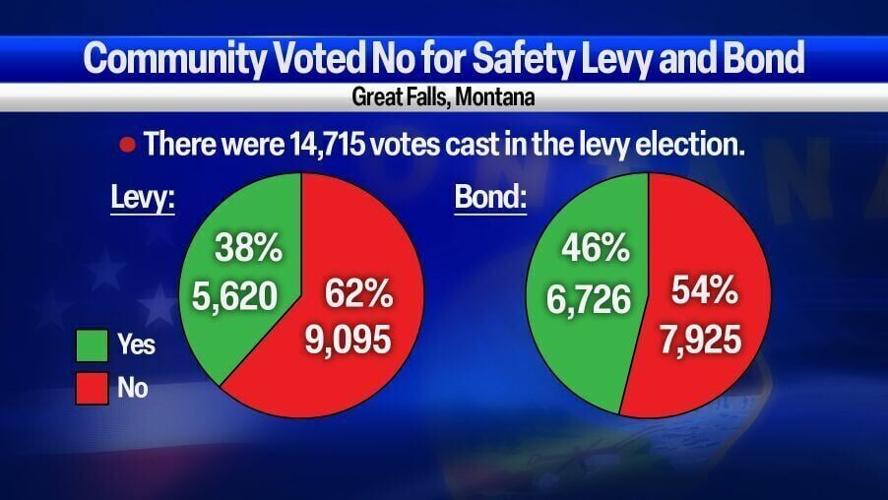
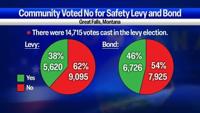
GREAT FALLS, Mont. - Last fall, the over 50% of voters voted no to a proposed public safety levy and bond in Great Falls.
Now, the city commission is looking to form a public safety advisory committee to see how they can re-address public safety in the Electric City.
"We're 50 years behind with a public safety bond and levy," said Cory Reeves, the mayor of Great Falls.
The biggest thing the city is saying, is just because the people voted no, doesn't mean the need goes away.
"The challenges didn't end. But we need to do a better job with the ask. We feel like the community didn't understand that we're in a crisis mode. We didn't do a good job right. We failed. So when you fail, what do you do? You quit or you learn from your mistakes," said Joe McKenney, a commissioner and member of the public safety advisory committee.
It was 1969 the last time voters passed public safety funding in Great Falls.
Since 1969, the city has grown 44%, the Great Falls Police Department say in the last year or so seizures from fentanyl are up 148%, and Great Falls Fire Rescue says over 40% of the city is outside industry standards of fire and emergency services.






So, the job of the public safety advisory committee is to look at how and why the public safety levy failed and come to city commissioners with more creative ideas on how to address public safety moving forward.
"I'm really hoping that this advisory council will come together, give us some brainstorming ideas. How do we sell our message? How do we get the public engaged? How do we get people to understand the needs that really this community is facing?," said Reeves.
The advisory committee will be made up of 10 people; two city commissioners, two neighborhood council members, two state legislators, and 4 community activists (two for and two against the past public safety levy and bond).
The members suggested for the committee are Sandra Guynn, Mike Parcel, Wendy McKamey, Jeni Dodd, George Nikolakakos, Aaron Weissman, Tony Rosales, Thad Reiste, Joe McKenney and Shannon Wilson.
"So the, the first steps are going to be education. We can't assume they know what I know going through the crime task force and the last city council. So they don't know what I know. So the first task, first meeting or two at least are going to be education. How did we get to where we're at? Why do we have this need? They've got to understand the history. And then once they understand the history, then they have to understand our needs. Then once they understand our needs, then they can understand our options to meet those needs," said McKenney.
The goal is to have suggestions to the city commission by labor day.
(0) comments
Welcome to the discussion.
Log In
Keep it Clean. Please avoid obscene, vulgar, lewd, racist or sexually-oriented language.
PLEASE TURN OFF YOUR CAPS LOCK.
Don't Threaten. Threats of harming another person will not be tolerated.
Be Truthful. Don't knowingly lie about anyone or anything.
Be Nice. No racism, sexism or any sort of -ism that is degrading to another person.
Be Proactive. Use the 'Report' link on each comment to let us know of abusive posts.
Share with Us. We'd love to hear eyewitness accounts, the history behind an article.