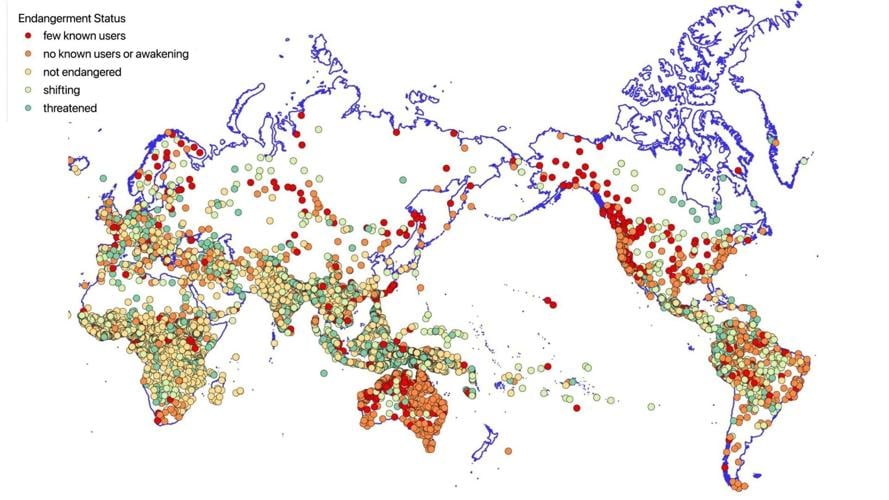







Contemporary languages and endangerment status. (Claire Bowern via SWNS)
By Stephen Beech
Thousands more different languages were spoken in the past than today, according to new research.
Humanity experienced a "golden age" of linguistic diversity when tens of thousands of languages were spoken worldwide between 1,000 and 3,000 years, say scientists.
A long decline that continues to the present began well before European colonial expansion, according to the findings published in the journal Science.
The research team estimates that between about 4,500 and 6,200 languages were spoken at the beginning of the Holocene period, about 12,000 years ago — fewer than the roughly 7,500 languages spoken and signed today.

Hittite language example, known only from ancient sources and no longer spoken. Tablet fragment. Invocations to Hattic deities; CTH 733. Hittite. Clay. YBC 16173. (Klaus Wagensonner via SWNS)
As the global human population grew, language diversity also increased.
Models suggest that tens of thousands of languages may have existed between 1,000 and 3,000 years ago.
The decline in linguistic diversity appears to have begun with the expansion of large states and empires, long before modern European colonialism.
The languages spoken today represent a "small and historically" biased sample of past linguistic diversity.
An international team of researchers from the United States, Germany and Spain reconstructed plausible trajectories of global language diversity across the last 12,000 years.
Marcus Hamilton, of the University of Texas at San Antonio, said: "This paper presents an innovative approach to understanding the dynamics of human cultural diversity in the past, addressing one of the central yet least accessible questions in the human sciences.
"Progress has been limited not by a lack of theoretical interest but by the exceptional difficulty of observing the relevant dynamics empirically."
He explained that direct evidence for the number of languages is almost entirely absent before the appearance of writing about 6,000 years ago, and remains fragmentary until quite recently.
The researchers combined ethnographic information, estimates of prehistoric population size, and statistical and social-computational modeling.
They began with ethnographic data from 171 hunter-gatherer and fisher societies whose traditional subsistence and mobility had not been transformed by contact with food-producing populations.
The data allowed the researchers to estimate the likely distribution of ethnolinguistic group sizes near the beginning of the Holocene.
The researchers then combined the estimates with reconstructions suggesting that the global human population 12,000 years ago was between about 4.4 million and 7 million.
Assuming that ethnolinguistic groups at that time generally corresponded to distinct languages, the models produced an early-Holocene estimate centered on about 4,500 to 6,200 languages, although broader plausible estimates ranged from about 3,300 to 7,800.

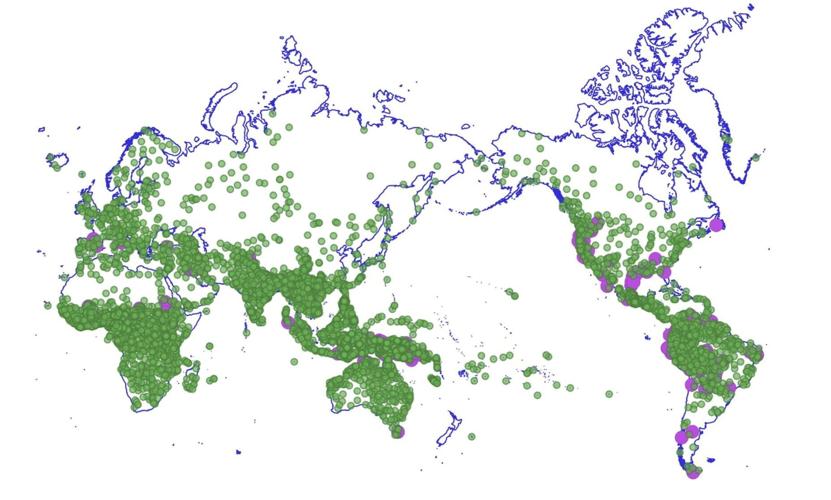
Contemporary languages; with language isolates highlighted in pink. (Claire Bowern via SWNS)
Russell Gray, from the Max Planck Institute for Evolutionary Anthropology in Germany, said: "One of the first surprises was that the world immediately before agriculture was probably not exceptionally rich in languages.






" There were most likely fewer languages than there are today.
"Linguistic diversity then grew alongside the human population for thousands of years."
Agriculture, technological innovation and more stable food production allowed the global population to expand dramatically.
At the same time, societies became larger, meaning that progressively more people could share the same language.
The researchers modeled thousands of possible trajectories connecting estimates at the beginning of the Holocene with the present.
The models allowed the number of people per language to increase over time, while incorporating independent reconstructions of global population growth.

Chandan Chaurasia
Although the precise trajectory remains uncertain, the models consistently produced a striking general pattern.
Language diversity increased over most of the Holocene and typically peaked between 1,000 and 3,000 years ago.
Many trajectories imply an approximately 10-fold increase from early-Holocene levels, placing the peak number of languages in the tens of thousands.
Claire Bowern, of Yale University, said: "The most unexpected result is how recent the peak appears to have been.
"The period of greatest linguistic diversity may have occurred not in the remote Paleolithic, but during the era of expanding states and early empires",
The research team describes the period as a linguistic "golden age" which has largely escaped previous discussion because most surviving historical records were produced by the expanding societies whose languages eventually became dominant.
But the linguistic golden age was followed by a rapid decline, particularly during the last two millennia.
The findings challenge the view that the present language-endangerment crisis began only with European colonial expansion about 500 years ago.

Jos Zwaan
The model does not identify which particular empires, regions or historical events caused the global decline.
Rather, it shows that a very large reduction in linguistic diversity must have taken place before the present.
The findings suggest that languages associated with expanding populations were disproportionately likely to survive, while the languages of absorbed, displaced or declining populations disappeared.
Study lead author Damian Blasi said: "The languages we see today are the survivors of a massive and highly selective historical bottleneck."
Blasi, a researcher at the Catalan Institution for Research and Advanced Studies (ICREA) and Harvard University, added: "A linguistic feature may be common not because it is inherently superior, but because it happened to be carried by populations that expanded.
"Extinction may have shaped linguistic diversity much more profoundly than we previously appreciated."

(0) comments
Welcome to the discussion.
Log In
Keep it Clean. Please avoid obscene, vulgar, lewd, racist or sexually-oriented language.
PLEASE TURN OFF YOUR CAPS LOCK.
Don't Threaten. Threats of harming another person will not be tolerated.
Be Truthful. Don't knowingly lie about anyone or anything.
Be Nice. No racism, sexism or any sort of -ism that is degrading to another person.
Be Proactive. Use the 'Report' link on each comment to let us know of abusive posts.
Share with Us. We'd love to hear eyewitness accounts, the history behind an article.