Some towns never got the memo to modernize, and International Day for Monuments and Sites on April 18 gives them their moment. Across the United States, historic towns are attracting visitors with walkable streets, preserved buildings and living history across public areas and daily routines, not just inside exhibits.
Cultural tourism in the U.S. was valued at about $455 billion in 2025 and is projected to reach $955 billion by 2035. That growth aligns with rising demand for towns with a distinct local identity, where planning rules and conservation keep key areas easy to explore without a detailed itinerary.
St. Augustine invites slow wandering
Heritage tourism accounts for about 33.2% of travel demand across the country, with visitors seeking places where history remains part of daily surroundings. St. Augustine fits that pattern, offering access to local development through preserved streets, buildings and public spaces. Founded in 1565, it is widely recognized as the oldest continuously inhabited European-established city in the U.S.
Narrow streets and small courtyards bring key sites into close reach. A central plaza is the focal point of the area, while Castillo de San Marcos and the nearby waterfront sit along routes used throughout the day. Shops, cafes and inns operate inside historic structures, keeping activity tied to the original layout.
Santa Fe’s adobe architecture defines daily life
Santa Fe dates to 1610 and ranks among the oldest cities in the U.S., with its built environment still guiding how the city looks and functions. Pueblo-style adobe structures dominate the skyline, and local building rules require new construction to follow the same approach, maintaining a consistent appearance.
Santa Fe Plaza remains the center of activity, where markets and vendors gather. Activity continues in this shared area instead of being separated into designated zones. Native American and Spanish influences appear across food, art and small businesses, giving the city a distinct cultural presence.
The Boston Freedom Trail links historic sites
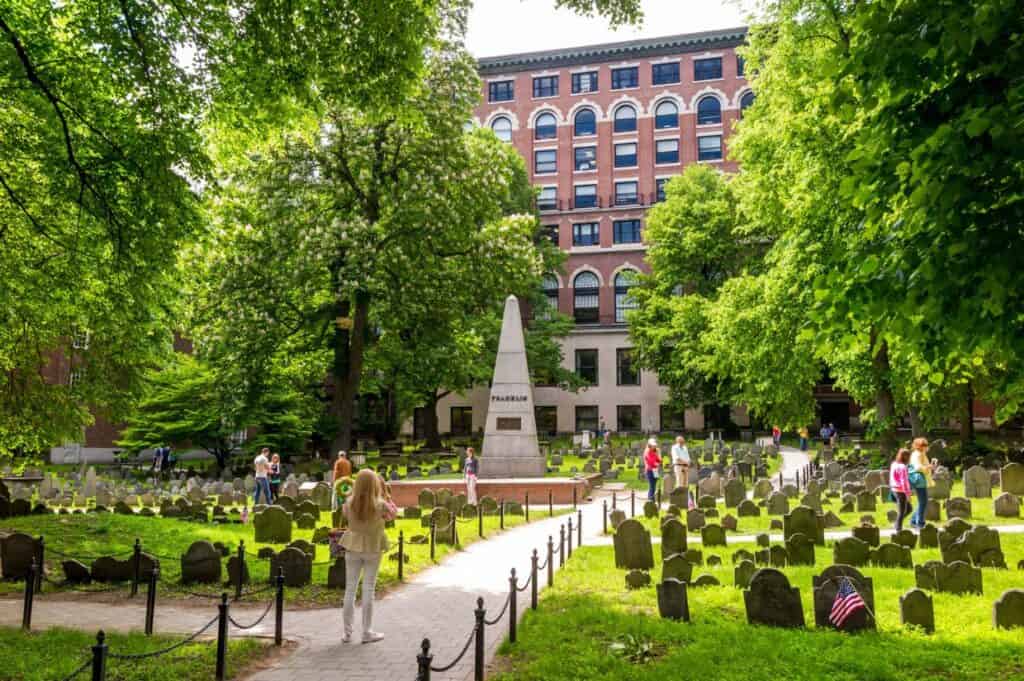
Boston holds a central place in early American history, with many key locations connected through a single route. The Freedom Trail runs for about 2.5 miles, defined by a red-brick line that guides visitors through the city.
The path connects 16 historic stops, including churches, meeting houses and burial grounds. It passes through active neighborhoods, where residents and visitors use the same streets. Clear markings make the route easy to follow without a guide, allowing visitors to move between sites at their own pace.
Newport preserves a compact colonial setting
Newport, founded in 1639, holds a high number of early buildings within a compact area that is easy to cover on foot. The downtown and harbor district keep key sites within close distance, with streets that allow visitors to move between locations in just a few hours. The layout stays tied to the waterfront, so harbor views remain visible across much of the setting.
Buildings from different periods stand next to each other, creating a clear sense of the city’s development over time. Colonial homes share blocks with later Gilded Age structures, while small inns, shops and restaurants continue to operate within these same streets.
Philadelphia keeps landmarks within reach
Founded in 1682, Philadelphia plays a central role in the nation’s early history, with key sites grouped within a defined area. Independence Hall and the Liberty Bell serve as focal points of the district, with several major landmarks located within a few blocks.
Brick sidewalks and preserved buildings line the area around Independence Mall, where museums and historic homes sit within easy reach. Visitors can move between these sites without leaving the district, which also connects directly to nearby neighborhoods and keeps the area part of the city’s daily flow.
Charleston pairs history with hospitality






Charleston has applied preservation rules since 1931, which keep building height and design consistent across the district. These standards help maintain a setting that supports longer visits without major changes to the original layout.
Many historic homes now operate as inns, restaurants and small hotels, placing lodging within the same streets that define the city’s past. The waterfront, markets and residential blocks sit within short distances of one another, so visitors can move easily between key spots. This setup keeps daily activity within a compact area and supports overnight stays without the need to travel far.
Savannah slows the pace naturally
Built on a 1733 city plan, Savannah features 22 public squares arranged across the district. These tree-lined spaces break up the street grid and create regular stopping points as visitors move through the area.
Homes, churches and small businesses surround each square, keeping activity centered in these shared areas. Movement flows from one square to the next rather than along long uninterrupted streets, guiding how visitors experience the city and keeping exploration steady.
New Orleans’ French Quarter shows a layered culture
New Orleans carries French and Spanish influences that remain visible within a defined district. The French Quarter continues as a protected historic area, where the original layout and building styles remain in place.
Narrow streets run through blocks lined with balconies, courtyards and historic facades. Shops, restaurants and residences share the same streets, keeping activity concentrated in one area. Live music and steady foot traffic continue through the day and into the evening, adding to the flow of people.
San Antonio missions preserve the colonial system
Developed under Spanish colonial rule and founded in 1718, San Antonio retains that history across a connected group of sites. San Antonio Missions National Historical Park includes four preserved missions set along the river. Each mission includes a stone church and surrounding grounds that remain intact and open to visitors. These sites received UNESCO World Heritage designation in 2015, placing them among recognized cultural landmarks.
Walking and biking paths run alongside the San Antonio River, linking the missions and allowing visitors to travel between them without driving. The distance between sites supports a half-day or full-day visit.
Colonial Williamsburg recreates 18th-century life
With a large-scale setting of restored and reconstructed 18th-century structures, Colonial Williamsburg stands apart from towns that have developed continuously over time. Interpreters carry out trades and daily routines inside these buildings, placing activity within the same spaces used during the period.
Streets limit modern traffic, allowing uninterrupted movement on foot through a shared layout of homes, workshops and public buildings. Visitors move through the district without a fixed path, choosing where to stop and how long to stay while keeping each part of daily life within close reach.
Historic American towns balance access and protection
Historic districts that remain active place the past and present side by side, and International Day for Monuments and Sites brings added responsibility as more visitors are drawn to them. That responsibility falls on both travelers and the cities and organizations that manage these sites. Visitors should respect the places they move through, while local authorities must balance tourism with long-term protections that keep these places open, maintained and relevant.
Zuzana Paar, a co-founder of Food Drink Life, is a seasoned traveler and writer who has explored 62 countries and lived in St. Lucia, Dubai, Vienna, Doha and Slovakia. Her work has been featured on Fox News, New York Daily News, MSN and more; she has also appeared live on Chicago’s WGN Bob Sirott Radio Show. When she’s not discovering new destinations, she shares travel tips and insider insights to help others experience the world in a unique and unforgettable way.
The post Historic American towns where the past still feels close at hand appeared first on Food Drink Life.
(0) comments
Welcome to the discussion.
Log In
Keep it Clean. Please avoid obscene, vulgar, lewd, racist or sexually-oriented language.
PLEASE TURN OFF YOUR CAPS LOCK.
Don't Threaten. Threats of harming another person will not be tolerated.
Be Truthful. Don't knowingly lie about anyone or anything.
Be Nice. No racism, sexism or any sort of -ism that is degrading to another person.
Be Proactive. Use the 'Report' link on each comment to let us know of abusive posts.
Share with Us. We'd love to hear eyewitness accounts, the history behind an article.