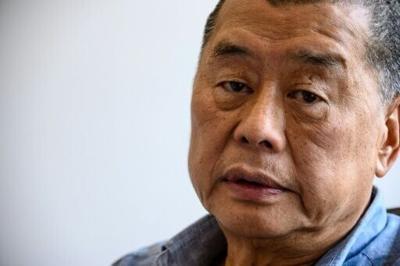
Hong Kong pro-democracy media tycoon Jimmy Lai will be sentenced on Monday following his national security trial, a court website showed.
The 78-year-old founder of the now-defunct Apple Daily newspaper was found guilty in December of foreign collusion under the city's sweeping national security law, which Beijing imposed following huge and sometimes violent pro-democracy protests in 2019.
He was also found guilty of one count of seditious publication, and could face life in prison.
Global leaders including US President Donald Trump and British Prime Minister Keir Starmer have called for Lai's release, while rights groups say his trial is a death knell for press freedom in Hong Kong.
Lai, a British citizen, has been behind bars since 2020, and multiple Western nations, including the United States and Britain, have called for his release.
- 'Grave nature' -
Defence lawyers conceded in January the "grave nature" of the case, which found Lai guilty of calling for foreign sanctions.
He will be sentenced alongside eight co-defendants on Monday, including six Apple Daily executives.
All defendants except Lai pleaded guilty, while some testified against him, which would entitle them to shorter sentences, the lawyers said last month.
The judges wrote in their 856-page verdict in December that Lai "harboured his resentment and hatred of (China) for many of his adult years" and sought the "downfall of the Chinese Communist Party".
Prosecutors cited 161 items Apple Daily published in their case against Lai.
Those items were deemed seditious under a colonial-era law because they "excited disaffection" against the government.






Lai maintained that he never sought to influence other countries' foreign policies, saying Apple Daily represented Hongkongers' core values, including "rule of law, freedom, pursuit of democracy".
- International outcry -
Lai's case has sparked condemnation internationally from journalism rights groups to global leaders.
Britain's Starmer, who visited Beijing in January, raised Lai's case with China's leader Xi Jinping, noting that the two did not see eye-to-eye on the issue.
UK-China relations plummeted in 2020 after Beijing imposed the sweeping national security law on Hong Kong, which severely curtailed freedoms in the former British colony.
Following Lai's conviction, Trump also said he had asked Xi to consider Lai's release.
"He's an older man, and he's not well. So I did put that request out. We'll see what happens," he told reporters at the time.
Meanwhile, the European Union said the conviction was "emblematic of the erosion of democracy and fundamental freedoms in Hong Kong since the imposition of the National Security Law".
Amnesty International added that the conviction marked a "death knell for press freedom in Hong Kong", while the Committee to Protect Journalists called it a "sham".
Beijing has hit back at international criticism it says amounts to a "smearing of the judicial system in Hong Kong", while Hong Kong's government says Lai's case "has nothing to do with freedom of speech and of the press".
Collusion offences "of a grave nature" can be punished by a prison term of between 10 years and life, while sedition comes with a maximum of two years.
twa/dhw/lb



(0) comments
Welcome to the discussion.
Log In
Keep it Clean. Please avoid obscene, vulgar, lewd, racist or sexually-oriented language.
PLEASE TURN OFF YOUR CAPS LOCK.
Don't Threaten. Threats of harming another person will not be tolerated.
Be Truthful. Don't knowingly lie about anyone or anything.
Be Nice. No racism, sexism or any sort of -ism that is degrading to another person.
Be Proactive. Use the 'Report' link on each comment to let us know of abusive posts.
Share with Us. We'd love to hear eyewitness accounts, the history behind an article.