How Long Does It Take To Save for a Home in Every U.S. City?
For much of the past decade, a 20% down payment was enough to make homeownership feasible in most U.S. cities—typically requiring around six years of saving. That standard no longer holds: as mortgage rates and home prices have surged, the gap between what buyers can afford and what homes cost has widened dramatically. While these housing affordability challenges exist nationwide, some areas give potential buyers shorter savings timelines than others. A new analysis from Upgraded Points examines how long it would take the typical household to save for a home in cities across the U.S., based on current home prices, mortgage rates, incomes, and other housing-related costs.
How Long Does It Take To Save for a Home in Every U.S. City?
Updated

Photo Credit: Insta photos
The data used in this analysis comes from a combination of sources: the Zillow Home Value Index (ZHVI), the U.S. Census Bureau’s 2023 American Community Survey (ACS), Freddie Mac’s Primary Mortgage Market Survey, and the U.S. Bureau of Labor Statistics Consumer Price Index. Home price and mortgage rate data are from the first quarter of 2025, while income and housing cost data come from the 2023 ACS — the most recent available — and have been inflation-adjusted to 2025 dollars.
To determine how long it would take a typical household to save for a home in each location, the following assumptions were made:
- Buyers are assumed to earn the median household income for their area. They allocate no more than 30% of their gross income to total housing costs, which include mortgage payments, insurance, property taxes, utilities, and homeowner association (HOA) fees where applicable.
- Buyers are assumed to purchase a median-priced home in their area. The required down payment is calculated as the greater of 20% of the home price or the difference between the home price and the maximum mortgage loan amount the buyer can afford, based on the 30% income constraint and a mortgage rate of 6.83%.
- To save for the down payment, buyers save 10% of their gross income. Savings are assumed to grow at a 5% annual rate of return.
Only cities and states with complete data from all sources were included in the final analysis. Locations with a margin of error greater than 10% on any estimate were excluded. To improve comparability of estimates, cities were grouped by population size into 3 cohorts: small (fewer than 100,000 residents), midsize (100,000 to 349,999), and large (350,000 or more).
For complete results, see How Long Does It Take To Save for a Home in Every U.S. City? on Upgraded Points.
How Long Does It Take To Save for a Home in Every U.S. City?

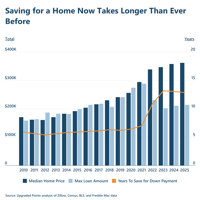
For much of the past decade, homebuyers could expect to save for a down payment in about 6 years. From 2010 to 2021, most buyers could afford the monthly costs of a median-priced home with a 20% down payment — a common standard that reflected how much people typically put down, even if they qualified for a larger loan.
This benchmark held relatively stable because, despite rising home prices, declining mortgage rates and steady income growth allowed buyers to borrow more. However, that changed abruptly starting in 2022. As mortgage rates spiked, the maximum loan affordable under the standard 30% housing-cost-to-income rule plummeted, even as home prices continued to rise. For the first time, the required down payment to bridge the gap between what homes cost and what people could afford exceeded 20% — reaching over 40% by 2023.
In 2025, the typical American household earning the median income of approximately $82,000 could reasonably afford a mortgage of up to $213,145. With the median home price now at $361,293, this leaves a gap of $148,148 — requiring a down payment of 41%. Assuming the household saves 10% of its income and earns a 5% average return, it would take 12.8 years to save that amount — more than double the time required just a few years ago.
How Long Does It Take To Save for a Home in Every U.S. City?

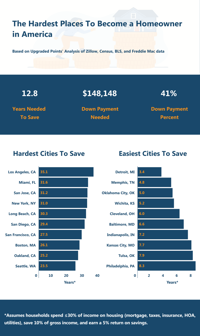
Housing affordability challenges are especially acute in some of the nation’s largest coastal cities. In Los Angeles, a household earning the median income of $85,249 can afford a mortgage of just $171,809. With a median home price of $986,145, that leaves a down payment requirement of over $814,000, or 82.6% of the purchase price. At a 10% savings rate and a 5% return, it would take more than 35 years to save that amount.
In Miami, the situation is similarly difficult. A median-income household earning $62,998 can afford a $107,994 loan, which covers only a small fraction of the city's $591,524 median home price. The resulting down payment of $483,530 (82% of the purchase price) would take over 31 years to save.
San Jose, California, also ranks among the least affordable markets, requiring more than 31 years of down payment savings. Despite having some of the highest household incomes in the country ($150,166), buyers in San Jose can still only afford to borrow $407,502 of the $1.5 million median home price. This leaves a required down payment of over $1.1 million or 73.4% of the purchase price.
In contrast to these high-cost coastal cities, several locations in the Midwest and South remain relatively affordable for the typical household. In Detroit, a median-income household would need just 3.4 years to save for a down payment. In Memphis, Tennessee, the timeline is slightly longer at 4.8 years, while in Oklahoma City, it would take about 5 years.
Across these less expensive cities, median household incomes range from approximately $42,000 to $71,000, while home prices fall between $77,000 and $202,000. Buyers in these markets still qualify for mortgages that cover most of the home’s price, so 20% down payments are attainable.
How Long Does It Take To Save for a Home in Every U.S. City?

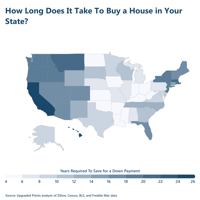
At the state level, long saving timelines are common in coastal and mountain states, while much of the South and Midwest remains more affordable.
Hawaii and California top the list, where the typical household would need more than 25 years to save for a home. In Hawaii, the median home price is $843,723, compared to a median income of $104,291, resulting in a 25.9-year savings timeline. In California, the median home costs $791,738, while household income stands at $102,187, requiring 25.6 years of saving.
Other high-cost states include Massachusetts (20.6 years), Montana (20.5), Washington (19.8), Oregon (19.6), and New York (19.4) — all with median home prices well above the national level. These states are concentrated along the West Coast and in the Northeast, where home values have climbed sharply in recent years.
Meanwhile, states with the shortest saving timelines are primarily in the Midwest and South. West Virginia leads at just 4.8 years, followed by Iowa (5.0) and Kansas (5.3). In these markets, home prices are around $230,000 or less, and even modest incomes can support the purchase of a median-priced home with a 20% down payment.
For a complete breakdown of the data broken out by city and state, see the original report on Upgraded Points: How Long Does It Take To Save for a Home in Every U.S. City?


(0) comments
Welcome to the discussion.
Log In
Keep it Clean. Please avoid obscene, vulgar, lewd, racist or sexually-oriented language.
PLEASE TURN OFF YOUR CAPS LOCK.
Don't Threaten. Threats of harming another person will not be tolerated.
Be Truthful. Don't knowingly lie about anyone or anything.
Be Nice. No racism, sexism or any sort of -ism that is degrading to another person.
Be Proactive. Use the 'Report' link on each comment to let us know of abusive posts.
Share with Us. We'd love to hear eyewitness accounts, the history behind an article.