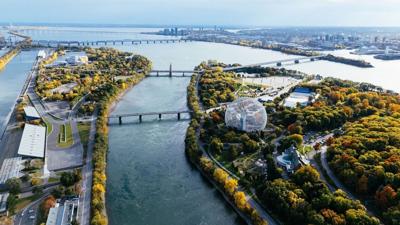

Helicopter flight view of the Formula 1 Circuit Gilles Villeneuve in Montreal. Quebec, Canada
As the engines ignite for the 2026 Canadian Grand Prix, the city of Montreal prepares for what luxury travel expert Olivia Ferney calls "the moment Montreal collectively loses its mind in the best possible way."
This year, the stakes are higher. The legendary Circuit Gilles Villeneuve debuts a new Sprint format from May 21–24, adding live sessions and "considerably more reasons to justify the full weekend stay," according to Ferney. But for the modern traveler, surviving race week requires more than just a seat in the grandstands. It requires a tactical map for luxury, weather, and the inevitable gridlock of an island circuit.
The Evolution of the Paddock
While F1 has always been a playground for the wealthy—thanks to Bernie Ecclestone’s era of high-finance power players—the demographic is changing yet again. "The bar for what counts as a ‘premium’ Formula One weekend has moved significantly," says Jennifer Brisman, CEO of VOW. "Drive to Survive brought in a broader audience and many are coming in with luxury travel expectations rather than traditional motorsport expectations."
Guy Harrison-Murray, CEO of P3 Jets, notes that demand has increased materially. "Growth is largely driven by expanding North American interest," he explains. "Clients increasingly expect more than race access—they want a full weekend experience including social positioning, dining access, and curated off-track programming.”
Trackside Strategy
For the serious traveler, Ferney insists the Paddock Club remains the only ticket worth discussing. Sitting directly above the pit lane, it offers "unobstructed views of every strategic decision made over the weekend... and the very real possibility of brushing shoulders with people whose names are on the cars below."
If the Paddock Club is full, Ferney suggests private suites, which offer sheltered dining and—crucially for Montreal’s variable climate—television feeds in air-conditioned comfort.
However, even the most elite guests must contend with Montreal’s famously fickle May weather. Joe Koval, senior meteorologist at The Weather Channel, advises fans to use the app in real time throughout the grand prix. "The 15-minute precipitation timeline gives precise, minute-by-minute rain timing," Koval says.
Beyond just checking for rain, Koval suggests monitoring the "Feels Like" temperature and the hourly UV index, which can spike to 8 or 9 by 11:00 AM, even if the air feels crisp. "The pro move is animating the Future Radar at lunch," Koval says. This allows fans to project storm movement six hours out, identify dry windows for food runs, or determine whether a cell is a passing band or a system worth waiting out in a suite.
But even with the best tech, the four-day event can become a marathon of exhaustion if mismanaged. Brisman notes that first-time attendees often "try to pack too much into the weekend." To avoid the burnout that comes with the city's frantic energy, she advocates for a more surgical approach: "A better approach is to prioritize a few key moments and leave buffer room, especially given how dynamic timing and crowd flow can be on the ground at Circuit Gilles Villeneuve."
The ‘Metro or Bust’ Reality





This buffer room becomes most critical during the commute to Île Notre-Dame. "Use the metro. It is the only consistently reliable option," warns Harrison-Murray. Driving or relying on ride-shares is often a losing game due to bridge restrictions and surge pricing that can skyrocket after the checkered flag.
Henri Chelhot, CEO of FlightHub, notes that vehicle access is heavily restricted and "door-to-track timing is almost always longer than maps suggest," advising fans to arrive at the Jean-Drapeau station at least 90 minutes before the race. On race day, the Yellow Line reaches capacity early; by late morning, trains are often full before they even reach downtown hubs.
For the exit, seasoned veterans avoid the soul-crushing queue for the return train entirely. "The insider move is to walk off the island via the Concorde Bridge," says Chelhot. "The bridge is about 25–30 minutes to downtown, often faster than waiting for the metro, and once you're back on the mainland, taxis and ride-shares are much easier to grab at normal prices."
Ultimate Home Base
In a city of world-class hotels, your choice depends on your social speed. The Ritz-Carlton Montréal is the undisputed choice for those seeking a discreet, UHNW environment. The Four Seasons Hotel Montreal becomes race week’s social epicenter for a younger, high-visibility crowd and, as Ferney puts it, has “the kind of service that makes the outside world feel genuinely optional.”
Fairmont The Queen Elizabeth is where you can find "iconic Montreal grandeur with a world-class spa," according to Ferney. Its location is its secret weapon—situated directly above Gare Centrale, it’s the perfect pivot point for the weekend’s final act from the race to the rails.
Regardless of the vibe, one must eat. Ferney warns that the city’s culinary "triumvirate"—Joe Beef, Toqué!, and Hotel Nelligan’s rooftop—requires reservations "before your flights are booked." At Joe Beef, the lobster spaghetti and bone marrow are legendary, but the reservation list is the hardest to crack in the city. "Book your hotel and your table the moment you decide to go," cautions Ferney, "not the moment you buy your race tickets."
Location-wise, “Golden Square Mile suits traditional luxury; Old Montreal suits social, nightlife-driven stays,” shares Whitney Ashby, Managing Director, PorterLifestyle.
Old Montreal is the center of activity, according to Harrison-Murray. “Streets are closed, restaurants expand onto patios, and the area turns into an open-air F1 festival with watch parties, activations, and supercars lining the streets. This is where most of the off-track energy concentrates."
The Great Escape
After the roar of the Sprint and the Sunday podium, the savvy traveler departs the frenzy. From Gare Centrale, located just beneath the Queen Elizabeth, fans can board a VIA Rail Business Class train for a three-hour journey to Quebec City.
The destination is Fairmont Le Château Frontenac, a historic property that stands in stark contrast to the high-tech chaos of the pit lane. The "Moment of Escape" experience within the Moment Spa replaces the frenetic energy of the pit lane with the muted scent of eucalyptus and the silence of the St. Lawrence. It’s the ultimate recovery from days of grandstands and 120-decibel engines.
As Brisman notes, the most successful attendees are those who avoid overly rigid schedules. In the end, the value isn’t just the ticket – it’s the access, hospitality, and overall experience built around it. “For first-time attendees, that’s often the biggest surprise: the ticket itself is usually the smallest piece of what they’re actually paying for.”

(0) comments
Welcome to the discussion.
Log In
Keep it Clean. Please avoid obscene, vulgar, lewd, racist or sexually-oriented language.
PLEASE TURN OFF YOUR CAPS LOCK.
Don't Threaten. Threats of harming another person will not be tolerated.
Be Truthful. Don't knowingly lie about anyone or anything.
Be Nice. No racism, sexism or any sort of -ism that is degrading to another person.
Be Proactive. Use the 'Report' link on each comment to let us know of abusive posts.
Share with Us. We'd love to hear eyewitness accounts, the history behind an article.