An Italian restaurant can expose itself in under 30 seconds, usually with a menu choice that makes every nonna roll her eyes in unison. Those small choices often reveal whether a kitchen follows Italian tradition or just wears the costume, from pasta paired with the wrong sauce to dishes weighed down with unnecessary extras. Knowing what to watch for helps diners spot authentic Italian cooking and skip places just playing Italian dress-up.
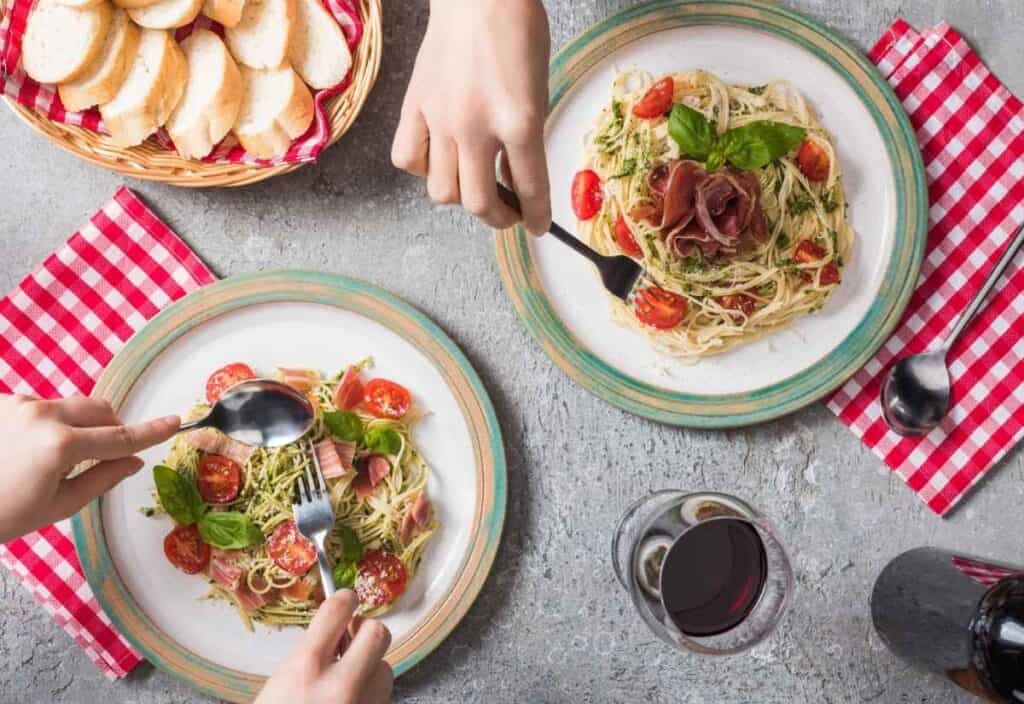
To spot authentic Italian restaurants, diners can also look for clues hiding in the menu layout and the confidence behind it. Mixed regional specialties and staff uncertainty reveal a kitchen attempting to cover too much of Italy and hoping for the best.
Garlic bread raises flags
Italian restaurants operate worldwide, but many rely on familiar symbols rather than traditional food practices. Orazio Salvini, founder of Real Italian Restaurants, warns that some places use Italian names and decor to suggest authenticity while serving dishes that miss the mark. One of the clearest giveaways often shows up before the meal even starts: garlic bread.
As Salvini puts it, “This dish simply doesn’t exist in Italy in the form that many diners from across the world have come to expect. What Italians actually eat is bruschetta: toasted bread rubbed with garlic and topped with good olive oil, sometimes with fresh tomatoes added.” In Italy, bread supports the meal rather than competes with it, with an emphasis on the flavor of the wheat instead of heavy toppings.
Traditional tables tend to feature straightforward bread choices served alongside food rather than promoted as a main attraction. Plain crusty loaves, focaccia, pane pugliese and ciabatta are common, often paired with olive oil or balsamic instead of butter.
Tradition shows in ingredients
Ingredient choices often reveal whether a restaurant follows Italian tradition or adapts dishes for broader appeal, and classic pasta recipes provide some of the clearest cues. Carbonara, for example, follows a strict Italian approach that centers on eggs, cured pork, hard sheep’s milk cheese and black pepper. When cream, chicken, peas or mushrooms appear on the plate, the dish moves away from its traditional form and toward a version shaped to meet outside expectations.
The same principle applies to how kitchens use cheese, especially with seafood. Italian cooks avoid adding grated cheese to pasta with fish or shellfish because it overwhelms the natural flavor of the seafood. If a server automatically offers Parmesan with every pasta dish without exception, including seafood options, it suggests the restaurant is not following Italian norms.
Focused menus matter
Menu size can give a quick read on whether an Italian restaurant values tradition or volume. “Real Italian dishes focus on simplicity, quality and regional traditions, which don’t match up to the overloaded dishes that imitation places serve,” Salvini says. That mindset favors a narrow selection prepared well rather than a menu built to cover every possible craving.






Genuine Italian restaurants usually keep menus concise and adjust them as ingredients come into season. When a menu lists dozens of pastas, pizzas and meat dishes year-round, it often points to a kitchen relying on convenience rather than daily preparation. Authentic Italian cooking depends on what is fresh and available, which naturally limits how much appears at one time.
Mixed regions raise doubts
Regional focus provides another clear sign of authenticity. Italian cooking grows out of place, with each region developing its own techniques, ingredients and signature dishes. Restaurants grounded in that tradition usually concentrate on one area rather than trying to represent the entire country on a single menu.
Concerns arise when menus freely mix specialties from far-flung regions without a clear point of view. Pairings such as long pasta, short pasta and filled pasta, all served with unrelated sauces, suggest shortcuts, not intention. In Italian kitchens, pasta shapes match specific sauces for practical and regional reasons. When those pairings feel random, it often points to a menu built for broad appeal instead of regional practice.
Clueless service signals trouble
Knowledgeable service often separates genuine Italian restaurants from those built on surface cues. In well-run kitchens such as Caffé Milano in Rhode Island, servers understand the food and wine well enough to guide diners with confidence. They can explain what goes into each dish, describe preparation methods and suggest pairings that match the meal rather than defaulting to guesswork.
A red flag appears when staff seem unsure about ingredients or struggle to answer basic menu questions. That gap usually means they have not been trained on what the kitchen serves or have not tasted the food themselves. Beyond authenticity, this lack of clarity can create real issues for diners with allergies or food restrictions, since vague answers about ingredients put safety at risk.
Quality over quantity
Finding a real Italian restaurant often comes down to noticing where restraint shows up on the plate and on the menu. Kitchens that favor fewer dishes, clear regional roots and well-trained service are more likely to be run by Italian families or chefs trained in Italy, where simplicity means confidence rather than limitation. Choosing those places does more than satisfy an Italian food craving; it offers a closer look at how Italian cuisine actually works, one built on ingredients, balance and respect for tradition.
Jennifer Allen is a retired professional chef and long-time writer. Her work appears in dozens of publications, including MSN, Yahoo, The Washington Post and The Seattle Times. These days, she’s busy in the kitchen developing recipes and traveling the world, and you can find all her best creations at Cook What You Love.
The post How to spot a real Italian restaurant before the first bite appeared first on Food Drink Life.



(0) comments
Welcome to the discussion.
Log In
Keep it Clean. Please avoid obscene, vulgar, lewd, racist or sexually-oriented language.
PLEASE TURN OFF YOUR CAPS LOCK.
Don't Threaten. Threats of harming another person will not be tolerated.
Be Truthful. Don't knowingly lie about anyone or anything.
Be Nice. No racism, sexism or any sort of -ism that is degrading to another person.
Be Proactive. Use the 'Report' link on each comment to let us know of abusive posts.
Share with Us. We'd love to hear eyewitness accounts, the history behind an article.