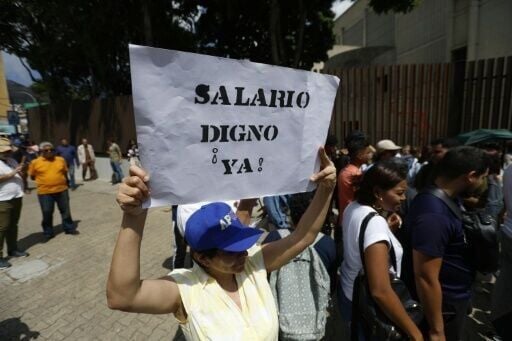
Supporters and opponents of Venezuela's government protested on Monday for better salaries and pensions, marching separately although united in their demand for a decent income.
The monthly minimum wage in Venezuela is 35 US cents -- the same as the state pension, in a country whose gross domestic product is reeling.
The government hands out discretionary bonuses as a supplement, but it's not nearly enough to make ends meet in Venezuela, where GDP dropped 80 percent in a decade and millions emigrated in search of a better life.
The Latin American country's leaders have promised an oil-led economic boom following the ouster of long-term leader Nicolas Maduro.
"We fight for wages, democracy, and freedom!" professors chanted at a rally outside the Supreme Court, which is weighing a case filed by Central University of Venezuela (UCV) staff against the state for insufficient wages.
"If oil income is going to increase, it must be invested in all workers," Gregorio Alfonzo, president of the UCV professors' association, said at the march.
Venezuela's interim president Delcy Rodriguez, who stepped into Maduro's shoes after his toppling in a deadly American military operation a month ago, has made deals on oil and other topics with US President Donald Trump's administration.
Last week, lawmakers passed reforms to reopen Venezuela's nationalized hydrocarbons industry to private players, a move immediately reciprocated with a loosening of US sanctions.
Promising better days ahead for her long-suffering compatriots, Rodriguez has ploughed $300 million from a first US sale of Venezuelan crude into shoring up the country's ailing currency, the bolivar.
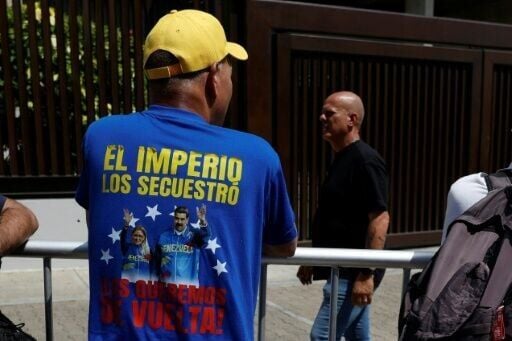
At a separate demonstration, which also gathered outside the Supreme Court, pro-regime workers called for Maduro's release from a New York jail cell, where he is awaiting trial on drug-trafficking charges.
But they also submitted a 10-point plan for the urgent improvement of workers' financial plight.
"We have the opportunity, through negotiations with oil companies, the reform of the Hydrocarbons Law, and a renewed national dialogue, to achieve economic recovery and wage growth," said their representative, Oliver Rivas.
Police separated the two groups to prevent any confrontation, which was limited to an exchange of slogans.
Keep it Clean. Please avoid obscene, vulgar, lewd,
racist or sexually-oriented language. PLEASE TURN OFF YOUR CAPS LOCK. Don't Threaten. Threats of harming another
person will not be tolerated. Be Truthful. Don't knowingly lie about anyone
or anything. Be Nice. No racism, sexism or any sort of -ism
that is degrading to another person. Be Proactive. Use the 'Report' link on
each comment to let us know of abusive posts. Share with Us. We'd love to hear eyewitness
accounts, the history behind an article.








(0) comments
Welcome to the discussion.
Log In
Keep it Clean. Please avoid obscene, vulgar, lewd, racist or sexually-oriented language.
PLEASE TURN OFF YOUR CAPS LOCK.
Don't Threaten. Threats of harming another person will not be tolerated.
Be Truthful. Don't knowingly lie about anyone or anything.
Be Nice. No racism, sexism or any sort of -ism that is degrading to another person.
Be Proactive. Use the 'Report' link on each comment to let us know of abusive posts.
Share with Us. We'd love to hear eyewitness accounts, the history behind an article.