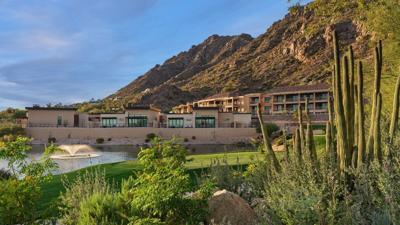
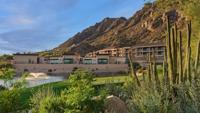

Image Credit: The Phoenician
Privacy has become the new high-stakes currency in global travel, fueling a shift toward ‘hushpitality’ that is projected to more than double the size of the luxury villa market by 2033. Leading this evolution, desert icons like The Phoenician are trading traditional occupancy for low-density, standalone residences that domesticate the resort experience.
By debuting eight standalone villas at its Canyon Suites enclave in January, the Scottsdale landmark is offering the space of a residence with the service of a flagship hotel.
“Guests increasingly sought spacious residences for multi-generational travel, longer stays, and celebratory gatherings—complete with full kitchens and outdoor living,” said Kevin Kelly, managing director of The Phoenician and Canyon Suites and Villas.
A recent report by Market Intelo shows the global luxury villa rental market could grow from $24.8 billion in 2024 to $56.2 billion by 2033, as more visitors opt for standalone accommodations that support longer stays and multiple generations. Laura McMurchie of Experience Scottsdale notes that preferences in luxury travel are shifting towards greater personalization and discretion.
“Travelers are looking for exclusive access and customized experiences. It’s not as much about over-the-top opulence as it is about personalization,” says McMurchie. “Quiet luxury is more popular now; privacy and discretion trump flashy.”
Residential Space, Full-Service Stay
While the architecture of the villas trend emphasizes solitude, its true luxury lies in what Kanku Michelson, a luxury travel advisor at Dilworth Travel, calls ‘the best of both worlds.’ The ability to retreat to a 3,450-square-foot sanctuary while maintaining access to a resort's 'upbeat atmosphere' solves the isolation problem often found in independent rentals.
The Phoenician is quite an expansive footprint, even by Scottsdale standards. The resort sits on 250 acres at the base of Camelback Mountain and hosts 643 guest rooms, including the main hotel, the more secluded Canyon Suites, and the new villas.
The property was originally built by Charles Keating for nearly $300 million in the late 1980s, a staggering sum at the time that contributed to its reputation as an ultra-luxe desert icon.
“The Phoenician has always been a crown jewel in the Scottsdale area’s resort portfolio, and they are always evolving in our competitive market,” shares McMurchie. A three-story spa opened in 2018, adding 37,000 square feet, 24 treatment rooms, and a rooftop pool, alongside an 18-hole championship golf course managed by Troon.
The January debut of the Canyon Suites villas is the latest investment across the property. Eight free-standing luxury units include a personal golf cart for navigating the property and a dedicated Canyon Ambassador to serve as a concierge.
While the original Phoenician may have been about showing wealth, the new accommodations are about experiencing privacy. The 2-, 3-, and 4-bedroom layouts feature wings that provide internal seclusion for multigenerational families or executive retreats within the same villa—separate sleeping quarters connected by a massive, high-design social hearth that is the kitchen and living area.
“Given its wide range of offerings and its vibrant resort atmosphere, the Phoenician is especially well-
suited for families, multi-generational travelers, and milestone celebrations, where accommodating many different types is especially important,” shares Michelson.





This pivot toward low-density detachment aligns with wider trends. The 2026 Virtuoso Luxe Report confirms that 45% of advisors have seen a surge in requests for 'ultraluxe' experiences—specifically, exclusive-use, private spaces. By limiting this enclave to just eight, the resort trades traditional occupancy for the high-demand currency of 'Hushpitality.'
This ethos is physically manifested through a 'resort-within-a-resort' layout. Architecturally, the villas are centered around a pool complex entirely separate from the main Canyon Suites hub. By buffering the residences with their own dedicated cabanas and exclusive food service, the design creates a self-contained ecosystem that honors the guest’s desire for total insulation without sacrificing resort-level amenities.
Unlike the verticality of the main hotel, these are single-story, free-standing structures. This low profile preserves the sightlines of Camelback Mountain for all guests and creates a village feel within the Canyon Suites portion of the property.
The Wellness Reset
At The Phoenician Spa, the traditional pampering model is being replaced by a more rigorous, intentional approach to recovery. While the massage remains the most requested service, Kelly notes a clear pivot toward longer, restorative body therapies.
“We’re seeing a clear evolution in guest preferences toward more immersive, wellness-focused experiences,” says Kelly. “Guests are increasingly seeking stays that go beyond traditional spa visits, favoring wellness-driven itineraries that allow for a more intentional and extended reset.”
This evolution lines up with a massive surge in the global wellness economy, which reached a peak of $6.8 trillion in 2024 and is projected to grow nearly 8% annually through 2029, according to the Global Wellness Institute. Hilton’s 2026 Trends Report indicates that 72% of travelers plan to take time off specifically for wellness-focused trips.
To meet this, the resort has introduced bi-monthly programming tied to the lunar cycle and dedicated Wellness Weekends. Looking ahead, the resort is exploring innovative technologies to support nervous system regulation to deliver “measurable, lasting well-being” for its guests.
The Cactus League Catalyst
While wellness lends an internal reset, the Cactus League provides external social gravity. In Scottsdale, luxury travel is inextricably linked to Spring Training, a period where the villas face their ultimate seasonal stress test.
During the spring circuit, the property’s new residences are an ideal primary hub for affluent guests escaping colder climates to follow teams at nearby Scottsdale Stadium (Giants), Sloan Park (Cubs), and Salt River Fields (Diamondbacks/Rockies). Spring training compresses demand into a short window, as visitors plan entire trips around the league's game schedules.
“Spring Training is a key demand driver for us, and we are sold out during this time,” Kelly says. “The Villas in particular have seen exceptional interest, attracting guests from across the country who are traveling to follow their teams while enjoying a more private, residential-style stay.”
For these travelers combining spring break with baseball, the villa solves the logistical friction of group itineraries. Ultimately, the success of the standalone model at The Phoenician suggests it’s more than a fleeting trend.
“We’re seeing the strongest demand from families and multi-generational groups,” Kelly notes, adding that the response from returning guests has been “incredibly emotional,” with many struck by the “sense of complete escape the Villas provide.”
(0) comments
Welcome to the discussion.
Log In
Keep it Clean. Please avoid obscene, vulgar, lewd, racist or sexually-oriented language.
PLEASE TURN OFF YOUR CAPS LOCK.
Don't Threaten. Threats of harming another person will not be tolerated.
Be Truthful. Don't knowingly lie about anyone or anything.
Be Nice. No racism, sexism or any sort of -ism that is degrading to another person.
Be Proactive. Use the 'Report' link on each comment to let us know of abusive posts.
Share with Us. We'd love to hear eyewitness accounts, the history behind an article.