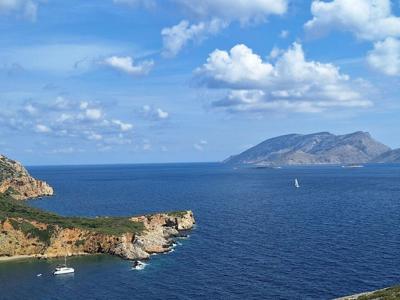

A quiet cove on Alonissos looks out across the blue waters of the Sporades. Image Credit: Sylvia Athanasopoulou
Nearly 38 million international travelers visited Greece in 2025. Five regions accounted for 83% of those visits. Virtuoso ranked it the third most sought-after global destination for 2026, behind only Italy and Japan.
But Greece has far more room on the map than its most famous stops suggest. Travelers willing to deviate from the usual itinerary can find quieter options surprisingly close to the places everyone already knows.
Santorini and Mykonos are Greece’s best-known island names, but they are only part of the country’s tourism map. Intrepid Travel’s Sylvia Athanasopoulou sees growing interest in trips that trade some of the headline islands' intensity for more space and a slower pace.
“They want that same Greek island magic — beautiful beaches, great food, small villages and time on the water — but with a little more space to actually enjoy it.”
When the Alternative Is Another Island
For travelers who still want an island trip, Alonissos shows a less familiar side of Greece than the Cyclades. Alonissos belongs to the Sporades northeast of Evia. Intrepid Travel included the island on its 2027 Not Hot List of destinations receiving fewer visitors than comparable tourism heavyweights.
Clear coves and small beaches fringe Alonissos; day boats cut across the waters of the National Marine Park of Alonissos and Northern Sporades, one of Europe’s largest marine conservation areas.
That relative anonymity is part of Alonissos’ appeal, but it also creates a risk: too much attention could recreate the same tourism pressure travelers are trying to escape.
“For me, the challenge is how you share these places without turning them into the next Santorini,” said Athanasopoulou. “If we promote somewhere simply because it’s ‘undiscovered,’ we can quickly create the very tourism pressure we’re trying to avoid.”
Athanasopoulou argues that smaller groups, shoulder-season travel and locally owned businesses can spread tourism more evenly without simply shifting the pressure elsewhere.
Same Island, Different Base
Finding more breathing room in Greece does not always mean choosing a different destination. Sometimes it comes down to where you stay.
Oia may have the caldera views that fill Instagram feeds, but its narrow lanes can become shoulder-to-shoulder as visitors gather with their selfie sticks around sunset. Mesaria gave me something Oia could not: bakeries, cafés and neighborhood life right outside NOŪS Santorini's entrance.
The property itself felt more like a full resort than a boutique Santorini hotel. Its enormous outdoor pool is one of the largest I have ever cooled off in under the Greek sun, with enough space that it never felt busy.
My suite had plenty of room for a family and opened onto a private terrace with its own plunge pool, perfect for cooling off after a day exploring the island. The spa was built for slow afternoons rather than quick treatments between sightseeing stops.
The hotel also arranges drivers around the island, and Oia is straightforward for drop-offs and pickups. That made it easy to stay in Mesaria without sacrificing time in Santorini’s best-known village.
Lucie Kittel, founder of Domino Travel, was not speaking about NOŪS specifically, but her advice mirrored my own experience staying outside Oia.
“I don’t necessarily try to steer clients away from the classics, but I do encourage them… if they’re open to a different experience,” said Kittel. “That can mean staying outside Oia in Santorini.”
A Residential Base
Most first-time visitors gravitate toward neighborhoods near the Acropolis and the historic center.
In central Athens, café tables crowd the sidewalks, souvenir shops line the streets and tour groups stream through the city from morning into the evening. About 10 miles north, old trees shade Kifisia’s broad streets. Boutiques, cafés and restaurants share the neighborhood with large private homes.
Semiramis Hotel adds a jolt of contemporary design through saturated color, curved furniture and modern art. Karim Rashid designed the 51-room hotel, and its candy-colored interiors and retro pool make it feel almost playful compared with the more classical look of central Athens.
Breakfast includes an extensive hot and continental buffet, from lighter continental options to a full cooked breakfast before a day in Athens. Upstairs, the largest suites had far more space than I expected in the city, plus private terraces large enough to actually use rather than simply step onto.
Semiramis is ideal for travelers drawn to design, dining and a more residential part of the city. Metro Line 1 connects Kifisia directly to Monastiraki, so you can easily visit the Acropolis and historic center in a day.
Kefalari Square is only a few blocks away, so an afternoon of shopping can roll naturally into dinner nearby.
Where the Road Leads in the Peloponnese







“The Peloponnese requires a slightly different approach,” said Eugenia Pereira, founder of Bliss Travel. “It is not a destination that can be summarized by one famous view or one iconic experience.”
Nafplio, Greece’s first capital after independence, has a compact old town of neoclassical mansions, stone lanes and waterfront cafés beneath the Palamidi fortress. The Peloponnese is best explored by car, linking ancient theaters, Byzantine ruins, vineyards, olive groves and mountain towns across the peninsula.
About 30 minutes from Nafplio, Epidaurus is known for its remarkably preserved ancient theater. Mycenae, farther inland, traces the Bronze Age civilization associated with Agamemnon. Ancient Olympia lies on the peninsula's western side, home of the original Olympic Games.
“There is an extraordinary concentration of history and culture that you can experience alongside landscapes and local life,” Pereira said.
The distances require a car and several days. A route can take you through Byzantine Mystras, mountain villages in Arcadia, wineries, olive estates, and some of the country’s most important archaeological sites.
Mystras climbs almost 1,000 feet above the lower gate, past Byzantine churches, monasteries and palace ruins. Centuries of footsteps have polished the cobblestones smooth.
Near Mystras, Euphoria Retreat gives road-trippers a wellness stop after several days of driving and sightseeing. The four-story spa rises against hills covered in scrub pine and olive trees, and the scent of orange and thyme carries across the property. Inside, sunlight drops through skylights onto a spiral staircase. The indoor pool wraps around a silver sphere that descends nearly 13 feet below the surface. Swim inside, and marine sounds, including dolphins, echo underwater.
I spent many afternoons moving between the pool, Finnish sauna, cold plunge and heated-tile loungers in the tepidarium. A salt grotto lined with amber-lit blocks proved almost too relaxing: I fell asleep during the 20-minute session and woke to a spa attendant gently telling me my time was up.
The region also shows why Pereira cautions against trying to cram every famous Greek stop into one vacation.
“I would encourage them not to feel that they must see ‘all Greece’ on their first visit,” she said. “One of the biggest mistakes can be trying to fit Athens, Santorini, Mykonos and several other small islands into one trip simply because they are the most famous names.”
Change When You Go
“A fall trip is not about having the same summer holiday with fewer people,” Pereira said. “It is about experiencing a different Greece — one where food, culture, nature, wellness and local traditions can become just as important as the beach.”
Cooler days make archaeological sites, hiking trails, wineries and long drives easier to manage. Autumn also brings the grape and olive harvests, adding seasonal food and farming traditions to the trip that receive less attention during the hottest months.
Kittel is more cautious about October and November, especially on the islands.
“You can experience the food, villages and cultural sites at a much more relaxed pace,” she said. “That said, I’m always transparent with clients that this is a very different trip from summer, as some island hotels, restaurants and businesses begin to close for the season.”
She sees shoulder season as a niche choice rather than evidence that Americans are abandoning summer.
“October and November can be wonderful, but I see them more as an opportunity for the right traveler than a wholesale shift away from summer travel.”
The Risk of Creating the Next Hot Spot
Overtourism is becoming a broader concern for luxury travelers. In Virtuoso’s 2026 Luxe Report, avoiding overtouristed destinations ranked as travelers’ top sustainable-tourism priority.
“Greece has become an extremely successful tourism destination, but the challenge now is finding the right balance between welcoming visitors and managing tourism sustainably,” Pereira said.
Spreading visitors across more regions and months could ease some of the pressure concentrated on a handful of islands in July and August.
“For visitors, this means more choice, a slower pace, and the opportunity to discover places that feel less familiar,” she said. “For local communities, extending the season could create more consistent economic activity instead of concentrating tourism income into just a few intense months.”
Kittel says repeat visitors are starting to ask for places outside Greece’s best-known circuit.
“I am seeing more experienced, well-traveled clients actively ask about less-discovered parts of Greece,” she said. “They’ve already done Santorini and Mykonos and are looking for places that feel more authentic, have fewer tourists and offer a different perspective on Greece. There’s a real appetite among this traveler for discovering the next place before it becomes the next big destination.”
That desire creates its own dilemma. The next quiet island can quickly inherit the same pressures travelers hoped to escape.
“The focus needs to be on how we travel, not just where we travel,” Athanasopoulou said.
(0) comments
Welcome to the discussion.
Log In
Keep it Clean. Please avoid obscene, vulgar, lewd, racist or sexually-oriented language.
PLEASE TURN OFF YOUR CAPS LOCK.
Don't Threaten. Threats of harming another person will not be tolerated.
Be Truthful. Don't knowingly lie about anyone or anything.
Be Nice. No racism, sexism or any sort of -ism that is degrading to another person.
Be Proactive. Use the 'Report' link on each comment to let us know of abusive posts.
Share with Us. We'd love to hear eyewitness accounts, the history behind an article.