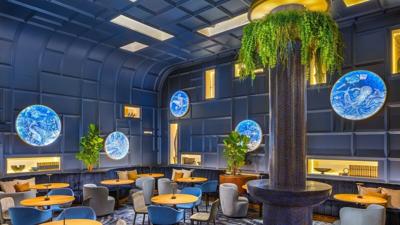


Bar Huso at Kimpton Bem Budapest, Hungary - Photo credit: Kimpton Bem Budapest, Hungary
Kimpton Hotels & Restaurants recorded the largest year-over-year gain among the 25 leading brands in YouGov's 2026 U.S. hotel satisfaction rankings. Could Kimpton's rise in customer satisfaction suggest that its ethos is resonating with travelers?
What Do Travelers Say About Top U.S. Hotel Brands
YouGov's 2026 U.S. hotel satisfaction rankings place Kimpton third among the hotel brands with the most satisfied customers. Its net satisfaction score is 69.7, behind Beaches Resorts (73.5) and Mandarin Oriental (70.6). Ritz-Carlton and Marriott followed, both recording 67.3.
While Mandarin Oriental declined by 5.5 points despite retaining second place, Kimpton's score increased by 6.2 points, the largest year-over-year among the top 25.
However, high satisfaction did not translate into widespread consideration for booking in YouGov's 2026 U.S. hotel rankings. None of the three top-ranked brands for satisfaction, Beaches Resorts, Mandarin Oriental and Kimpton, appear among the top 25 brands Americans would consider booking in 2026.
Since YouGov measured satisfaction among current and former customers, the results may indicate that these brands perform exceptionally well among people who have experienced them while remaining less familiar to the broader traveling public.
Why Could Kimpton Resonate With Travelers Who Stayed There?
IHG describes Kimpton hotels as "bespoke, design-led destinations" that combine distinctive design with informal, personalized service.
Although each property has its own visual identity, the hotels share recognizable elements. These include complimentary evening social hours, restaurants intended to attract locals as well as overnight guests, notably pet-friendly policies and service designed to feel warm rather than ceremonial.
The design philosophy is similarly location-specific. Instead of reproducing the same interiors across its portfolio, Kimpton allows individual hotels to respond to their settings through architecture, artwork, materials and cultural references.
This balance between individual character and consistent brand "rituals" could explain why people who have experienced Kimpton report such high levels of satisfaction.
Kimpton Hotels Around The World
Kimpton Pittman, Dallas, Texas
Kimpton Pittman, located in the Deep Ellum cultural district, incorporates the former Knights of Pythias Temple, designed by William Sidney Pittman, the first Black architect to practice in Texas.
The century-old Beaux-Arts structure once served as an important center of African American business, culture and music in Dallas. Inside, local art and references to Deep Ellum's music history connect the interiors with the neighborhood's creative identity.
Kimpton Alton, San Francisco, California
Kimpton Alton draws on San Francisco's countercultural and musical history. Named for psychedelic rock poster artist Alton Kelley, the hotel combines 1970s-inspired furnishings with warm oak, greenery, contemporary artwork and record players in the guest rooms.
The hotel offers guests regular DJ sets and poetry readings that extend its creative identity beyond the décor.
The result feels connected to San Francisco's unconventional spirit without turning the property into a nostalgic rock-and-roll theme hotel.






Kimpton Hotel Fontenot, New Orleans, Louisiana
Kimpton Hotel Fontenot interprets New Orleans through its music, art and flair for improvisation. Named after influential Creole musician Canray Fontenot, the hotel incorporates hand-painted violins and an installation made from trumpet and trombone mutes honoring jazz musicians King Oliver and Louis Armstrong.
Its richly patterned Peacock Room embraces the city's theatrical side, while the rest of the hotel takes a more restrained contemporary approach. Together, the interiors celebrate New Orleans culture without simply repeating familiar French Quarter imagery.
Kimpton BEM Budapest, Hungary
Set inside a listed historic mansion on the Buda side of the Danube, Kimpton BEM Budapest uses design to tell a distinctly Hungarian story.
Marcel Wanders drew on the country's folklore, native flora and mythology, incorporating poppies, tulips, mythical creatures and the legendary Golden Stag into contemporary interiors.
The cultural references are not straightforward reproductions of traditional motifs; they have been enlarged, abstracted and reimagined to create an atmosphere that feels Hungarian without resembling a museum.
Kimpton De Witt, Amsterdam
Kimpton De Witt takes a quieter approach to Dutch identity. Its rooms feature subtle references to traditional Delft tiles, a restrained blue-and-gray palette, contemporary millwork and design pieces connected to local craftsmanship.
The hotel occupies several buildings, including historic structures, and incorporates a small 17th-century house once associated with Dutch playwright P.C. Hooft.
Kimpton St Honoré Paris, France
Housed in the former Samaritaine de Luxe department store, Kimpton St Honoré Paris retains the building's landmark 1917 Art Nouveau façade.
Parisian designer Charles Zana created the interiors using with custom-made 1930s Art Deco-style furniture, carefully selected artwork and a sophisticated neutral palette.
Rather than filling the hotel with recognizable Parisian symbols, the design evokes the city through proportion, craftsmanship and understated elegance.
Kimpton Maa-Lai Bangkok, Thailand
The name Kimpton Maa-Lai Bangkok refers to the traditional Thai floral garland offered as a symbol of welcome, respect and good health.
Bangkok-based P49 Deesign carried this idea throughout the hotel, using interpretations of the garland, handwoven Thai textiles, locally sourced materials, and sculptural artwork. These elements are combined with clean lines and views of the neighboring greenery.
Kimpton Da An, Taipei, Taiwan
Kimpton Da An interprets Taipei through the city's alleyways, layered façades, tiled architecture and contrasts between urban energy and quiet domestic spaces.
Pale timber, white tiles, screens and restrained colors create an "inner sanctuary" rather than an overtly Taiwanese theme. The result feels rooted in everyday Taipei while remaining contemporary and internationally appealing.

(0) comments
Welcome to the discussion.
Log In
Keep it Clean. Please avoid obscene, vulgar, lewd, racist or sexually-oriented language.
PLEASE TURN OFF YOUR CAPS LOCK.
Don't Threaten. Threats of harming another person will not be tolerated.
Be Truthful. Don't knowingly lie about anyone or anything.
Be Nice. No racism, sexism or any sort of -ism that is degrading to another person.
Be Proactive. Use the 'Report' link on each comment to let us know of abusive posts.
Share with Us. We'd love to hear eyewitness accounts, the history behind an article.