

Consumer prices rose 3.5% over the past 12 months, as of June 2026. And while some inflation is normal for a growing economy, many Americans are feeling the squeeze.
More than 4 in 5 Americans (83%) say the rising cost of living has contributed to them tracking their spending more closely in 2026, according to a recent NerdWallet survey conducted online by The Harris Poll.
This is especially true for millennials: 89% of millennials say rising prices have them tracking their spending more closely, compared with 84% of Gen Xers, 80% of Gen Zers and 79% of baby boomers.
Note: The survey defines Gen Zers as those 18-29; millennials, ages 30-45; Gen Xers, ages 46-61 and baby boomers, ages 62-80.
Millennials are starting to hit their peak earning years, so it could be surprising that they’re also the generation most likely to focus on tracking their spending due to rising prices. But this cohort is likely also in its peak spending years: The median first-time home buyer is 40 years old, according to the National Association of Realtors, and many Americans are starting or continuing to grow their family into their 30s and 40s. This could make millennial finances tight and reining in spending especially important in the face of rising costs.
Which costs are standing out to millennials
Some millennials are finding surprises in both necessary and discretionary expenses.
When asked which categories they were surprised to discover they were spending more than they expected in the past six months, about two-thirds of millennials (66%) said groceries and 54% said gas. Dining out (42%) and household goods (41%) were also among the most commonly cited categories.
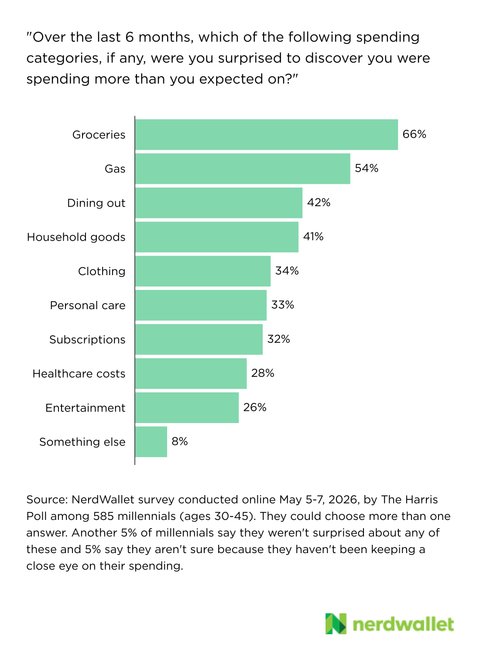
Necessities like groceries, gas and healthcare may be hard to reduce. But even amid rising costs, you can take steps to identify why your spending has increased and make adjustments for more breathing room in your budget going forward.
How to keep budgets in check
1. Separate inflation from habit creep
Yes, the cost of living is up. But that isn’t necessarily the only contributor to higher spending.
If you haven’t already, track your purchases for a month. Consider whether increased expenses are due to inflation, habit creep or a little of both. Spending money isn’t a bad thing, but if it’s gotten a little out of hand, it may be time to scale back.






2. Target the biggest categories first
Identify your discretionary expenses, or the spending you could feasibly cut back on. Which categories are taking up the largest chunk of your budget? Work on those first. Focusing on the big stuff can make a greater overall impact than trimming a little bit across the board.
It also may be worth looking at how much you spend on necessities. Groceries are a non-negotiable expense, but there may be some more affordable swaps you can make, like opting for lower-cost proteins or shopping weekly sales.
3. Set realistic limits for high-cost categories
A tempting “fix” to a potential spending problem is cutting costs to the bone, but this is often not sustainable. Let’s say you want to cut back on dining out and you typically spend $500 a month on this category. Slashing your budget to $25 a month probably isn’t realistic over the long term.
Instead, try cutting your dining out spending by $50 or $100 this month. If that’s not enough, cut it again the month after that, and so on. The goal isn’t dramatic cost cutting followed by burnout. It’s to build sustainable habits that improve your finances going forward.
4. Build in a cushion for uncertainty
Some price increases simply can’t be helped, and that’s where a buffer can come in handy. If possible, keep a few hundred dollars extra in your spending plan to account for costs that are higher than expected. That way, you can handle it when factors outside of your control put you over budget.
This also might be a good time to reevaluate your emergency fund. Experts recommend saving enough to cover three to six months of expenses. Does your current savings still meet that need at today’s costs? To determine your goal emergency fund amount, consider necessities only — like housing, groceries and insurance — plus a little extra for any surprises.
The complete survey methodology is available in the original article, published at NerdWallet.
More From NerdWallet
The article Millennials Keep Closest Eye on Spending: 4 Ways to Help Offset Rising Costs originally appeared on NerdWallet.

(0) comments
Welcome to the discussion.
Log In
Keep it Clean. Please avoid obscene, vulgar, lewd, racist or sexually-oriented language.
PLEASE TURN OFF YOUR CAPS LOCK.
Don't Threaten. Threats of harming another person will not be tolerated.
Be Truthful. Don't knowingly lie about anyone or anything.
Be Nice. No racism, sexism or any sort of -ism that is degrading to another person.
Be Proactive. Use the 'Report' link on each comment to let us know of abusive posts.
Share with Us. We'd love to hear eyewitness accounts, the history behind an article.