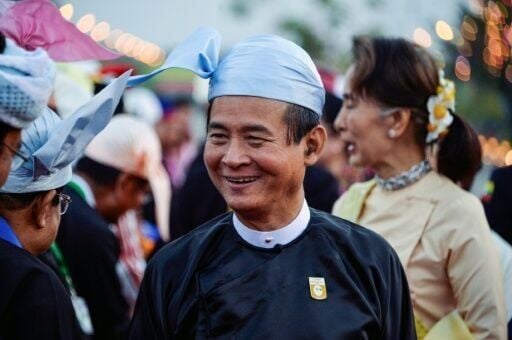
Myanmar's former president Win Myint, detained since a 2021 military coup, was freed on Friday under a mass amnesty which, according to a source close to pro-democracy leader Aung San Suu Kyi, also reduced her sentence.
Win Myint and Suu Kyi, the 80-year-old Nobel Peace Prize laureate, led Myanmar during a decade-long experiment with civilian rule that was abruptly halted by the coup.
The former president, who served from 2018, was pardoned of convictions handed down during the post-putsch period of military rule and released on Friday, a spokesman for his party told AFP.
Suu Kyi meanwhile remains detained, serving a sentence rights groups decry as a politically motivated move to hobble her National League for Democracy (NLD) party.
A source close to her legal case, requesting anonymity for security reasons, told AFP that Suu Kyi's 27-year sentence had been cut as part of the amnesty.
The order announced by Min Aung Hlaing -- the coup leader who ousted Suu Kyi's government and was sworn in last week as civilian president -- to reduce the remaining terms of all sentences under 40 years by one-sixth "also applies to her", the source said.
It is unclear how much of her term was considered served before the commutation order.
UN rights chief Volker Turk said that "all those detained unjustly since the coup -- including state counsellor Aung San Suu Kyi -- need to be released immediately and unconditionally".
While Win Myint had occupied the presidency, it functioned as a ceremonial role following the lead of de facto government head Suu Kyi, who was barred from holding the top spot under a military-drafted constitution.
An official statement from Min Aung Hlaing's office said he had pardoned Win Myint -- who like Suu Kyi was convicted of a host of crimes critics say were fabricated.
- 'Left behind' -
Myo Nyunt, spokesman for the NLD which was dissolved after the coup, told AFP he had visited the ex-president at his daughter's house in the capital Naypyidaw and he was "in good health".
After five years ruling as armed forces chief, Min Aung Hlaing was installed last Friday as civilian leader in a transition democracy watchdogs have described as a rebranding of military rule.
The shift has been accompanied by rollbacks of some of the junta's post-coup crackdown measures -- steps the leadership tout as reconciliation, but which critics describe as cosmetic measures to aid the rebranding effort.
Min Aung Hlaing on Friday also commuted all death sentences and ordered the release of more than 4,300 prisoners in an amnesty to mark Myanmar's new year -- one of many public holidays when mass pardons are commonly made.






But Win Myint's pardon is perhaps the most significant climb-down so far.
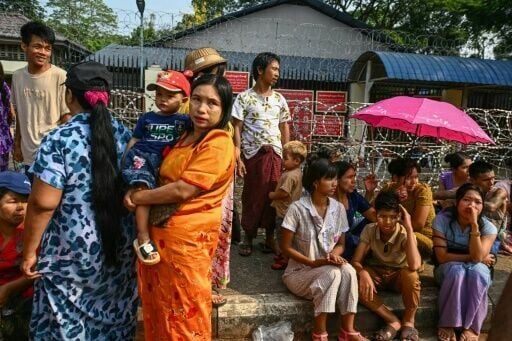
Outside the barbed-wire boundary of Yangon's Insein prison, AFP journalists saw award-winning filmmaker Shin Daewe released.
She was given a life sentence in 2024 -- later commuted to 15 years -- for "complicity in terrorism", according to Reporters Without Borders, which called her initial term the "harshest" post-coup sentencing of a journalist.
"Even though I was fortunate, my unlucky friends were left behind in tears. Even as I return to my family, I am returning with tears in my eyes," said the documentarian.
Less than 14 percent of those released in successive rounds of amnesties since the coup were political prisoners, think tank the Institute for Strategy and Policy Myanmar said late last year.
- Prepared for disappointment -
Other gaggles of families waited in the sweltering heat, hoping their relatives were among those freed.
"My brother has been imprisoned for a political case," said 38-year-old Aung Htet Naing, who was prepared for disappointment.
"We cannot expect much because he wasn't included in previous pardons."
More than 30,000 people have been detained for political reasons since the coup, according to the Assistance Association for Political Prisoners.
Min Aung Hlaing swept aside the elected government of Win Myint and Suu Kyi five years ago, making allegations it had taken power by means of massive voter fraud in polls the previous year.
Election monitors said there was no evidence of that and the military -- which has ruled Myanmar for most of its history -- wrestled back power as it grew anxious about its waning influence after her landslide victory.
The coup triggered an ongoing civil war, pitching pro-democracy guerrillas and long-active ethnic minority armies against the military.
A junta-organised election concluded in January, reversing the result of the 2020 poll by delivering a walkover win for pro-military parties.
lmg-jts/

(0) comments
Welcome to the discussion.
Log In
Keep it Clean. Please avoid obscene, vulgar, lewd, racist or sexually-oriented language.
PLEASE TURN OFF YOUR CAPS LOCK.
Don't Threaten. Threats of harming another person will not be tolerated.
Be Truthful. Don't knowingly lie about anyone or anything.
Be Nice. No racism, sexism or any sort of -ism that is degrading to another person.
Be Proactive. Use the 'Report' link on each comment to let us know of abusive posts.
Share with Us. We'd love to hear eyewitness accounts, the history behind an article.