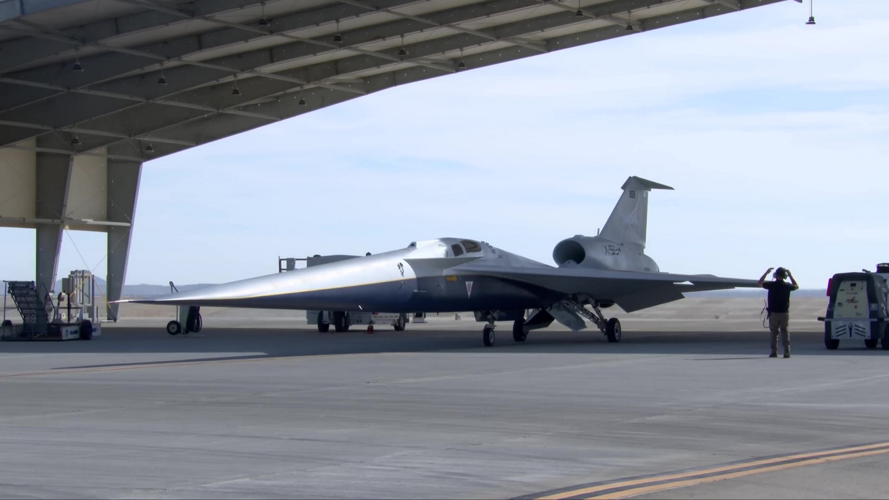

(NASA/Jim Ross via SWNS)
By Dean Murray
A "son of Concorde" that could fly from London to New York in under four hours may be days away from its first supersonic flight.
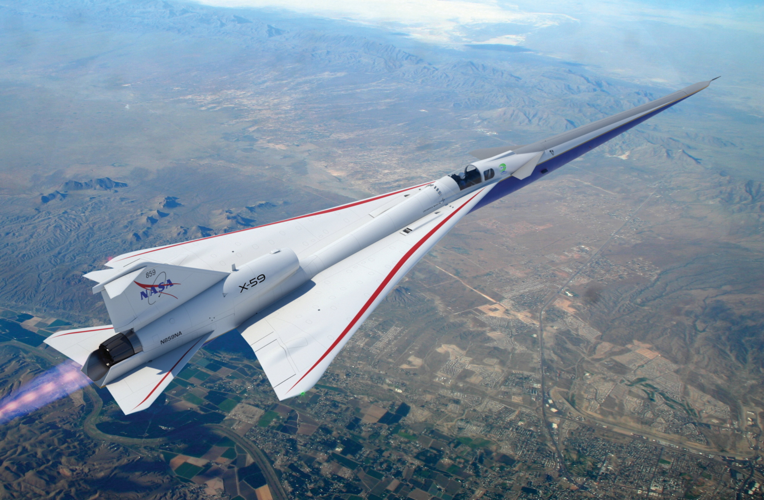
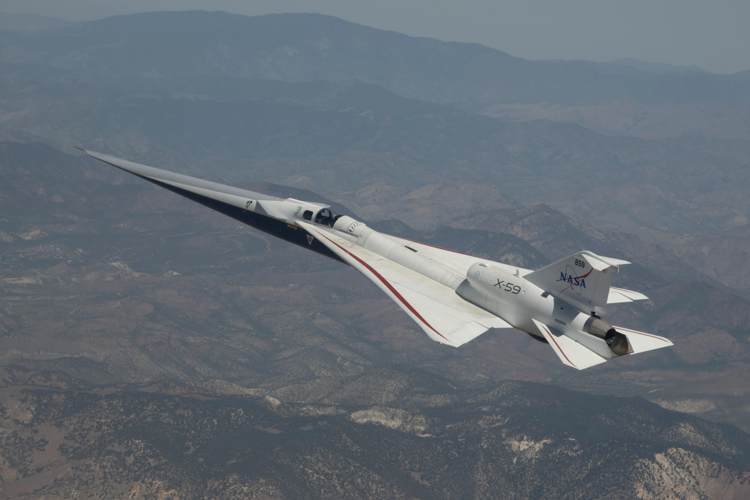
NASA’s X-59 quiet supersonic research aircraft is expected to hit the flight milestone – at speeds of over 630 mph – for the first time at approximately 43,000 feet during a series of test flights in early June.
The space agency said that a “mission conditions” flight will follow, where it will hit Mach 1.4 (925 mph) at approximately 55,000 feet.
That speed and altitude are important because they are NASA’s performance targets for the X-59 to eventually fly over US communities to demonstrate quiet supersonic flight and collect feedback data about the aircraft’s quiet sonic “thump” from the public.
The flights from Edwards Air Force Base in California support NASA’s Quesst mission to demonstrate supersonic flight that avoids the loud sonic boom, one of the problems that has prevented such aircraft from being actively used as cross-country passenger planes.

(NASA/Jim Ross via SWNS)





“What comes next is the first time this one-of-a-kind aircraft will fly supersonic,” said Cathy Bahm, project manager for NASA’s Low Boom Flight Demonstrator. “We are starting toward the mission conditions test point that X-59 was designed for.”
During the X-59’s upcoming flights, pilots will run through test points while engineers monitor the aircraft’s performance – but now in supersonic flight conditions.
“Flying at supersonic speeds is a major milestone for the X-59 team,” Bahm said. “Every step of envelope expansion brings us closer to demonstrating the quiet supersonic capability that is at the heart of the Quesst mission. Completing the first mission-conditions flight is especially meaningful – it’s the moment where we begin validating the aircraft in the environment it was designed for.”
In addition to reaching mission conditions during this block of flight tests, the X-59 will also achieve its maximum speed of Mach 1.6 (1,218 mph) and altitude of 60,000 feet. The aircraft is designed to cruise at about Mach 1.4, approximately 925 mph, which would make a journey from London to New York around 3 hours 45 minutes.
Concorde could reach a maximum cruising speed of Mach 2.04, or 1,354 mph, which is more than twice the speed of sound. This supersonic speed allowed it to reach New York City in about three hours.
Normal commercial flights generally take around seven to eight hours.

(NASA/Jim Ross via SWNS)

(0) comments
Welcome to the discussion.
Log In
Keep it Clean. Please avoid obscene, vulgar, lewd, racist or sexually-oriented language.
PLEASE TURN OFF YOUR CAPS LOCK.
Don't Threaten. Threats of harming another person will not be tolerated.
Be Truthful. Don't knowingly lie about anyone or anything.
Be Nice. No racism, sexism or any sort of -ism that is degrading to another person.
Be Proactive. Use the 'Report' link on each comment to let us know of abusive posts.
Share with Us. We'd love to hear eyewitness accounts, the history behind an article.