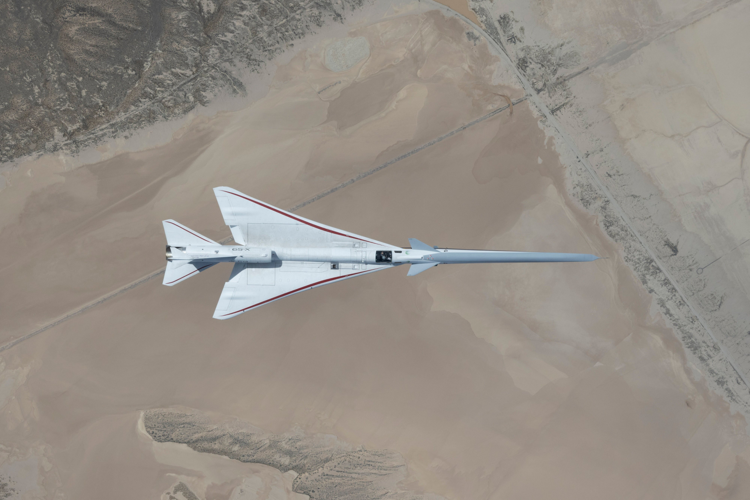
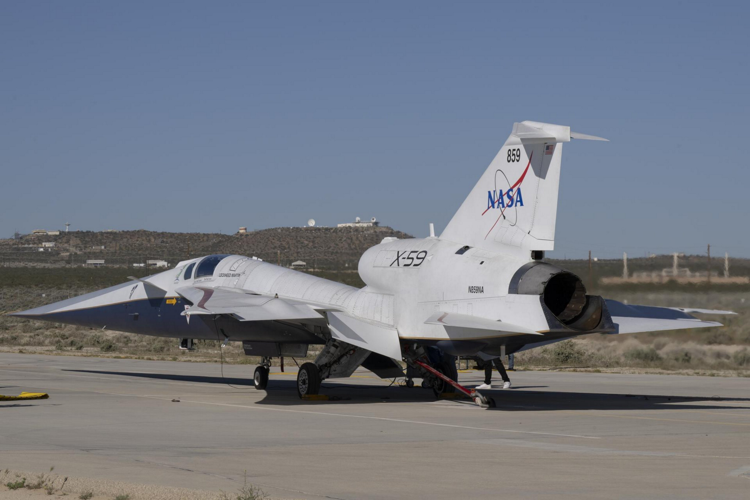

(NASA/Carla Thomas via SWNS)
By Dean Murray
Jaw-dropping images show the latest flight tests of the supersonic "son of Concorde" aeroplane that could fly from London to New York in under four hours.
NASA’s X-59 aircraft flew with its "wheels-up" for the first time last month and has continued to fly so that researchers can collect valuable data.
The flights at Edwards Air Force Base in California support NASA’s Quesst mission to demonstrate supersonic flight that produces a quieter sonic “thump” instead of a loud sonic boom, one of the problems that have prevented such aircraft from being actively used as cross-country passenger planes.





(NASA via SWNS)
The recent important step of flying with the landing gear up paves the way for researchers to examine the aircraft's streamlined profile, a key design element that ensures the Xâ59 can fly faster than the speed of sound with just a quiet thump instead of a loud sonic boom.
The aircraft is projected to fly at Mach 1.5, or approximately 990 mph (1,590 kph), meaning it could potentially fly non-stop from the UK capital to the Big Apple in approximately three hours and 44 minutes.
Concorde could reach a maximum cruising speed of Mach 2.04, or 1,354 mph (2,179 kph), which is more than twice the speed of sound. This supersonic speed allowed it to reach New York City in about three hours.
Normal commercial flights generally take around seven to eight hours.

(0) comments
Welcome to the discussion.
Log In
Keep it Clean. Please avoid obscene, vulgar, lewd, racist or sexually-oriented language.
PLEASE TURN OFF YOUR CAPS LOCK.
Don't Threaten. Threats of harming another person will not be tolerated.
Be Truthful. Don't knowingly lie about anyone or anything.
Be Nice. No racism, sexism or any sort of -ism that is degrading to another person.
Be Proactive. Use the 'Report' link on each comment to let us know of abusive posts.
Share with Us. We'd love to hear eyewitness accounts, the history behind an article.