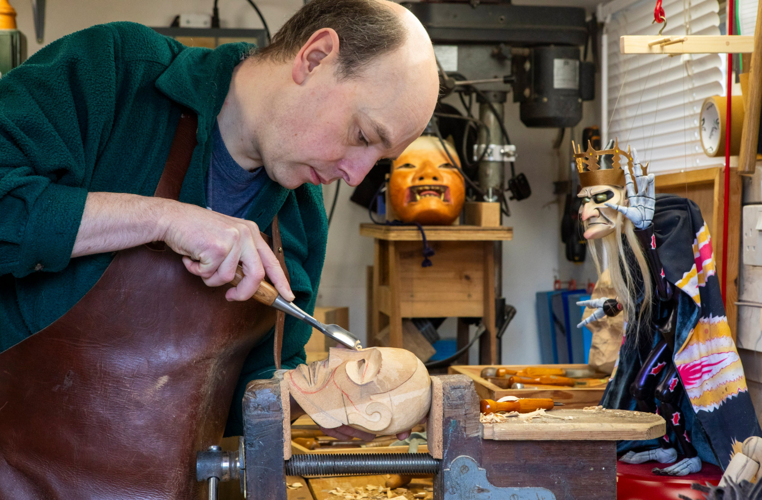
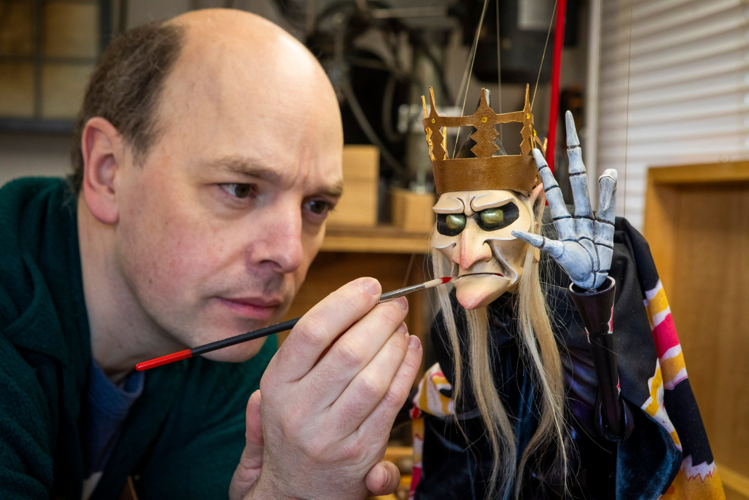
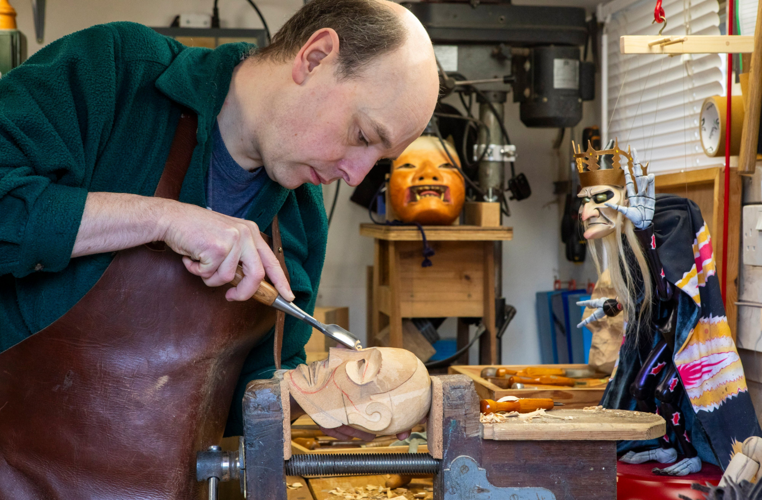
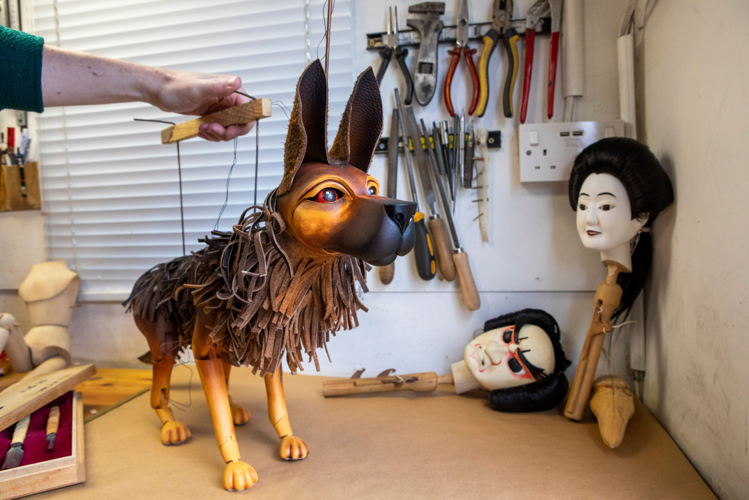
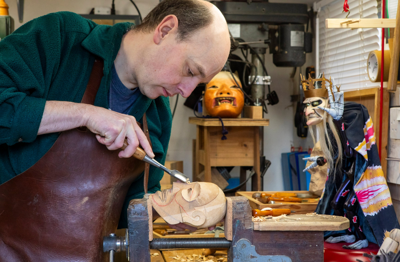

Stephen Foster makes puppets for a living. (Katielee Arrowsmith via SWNS)
By Elizabeth Hunter
One of the last remaining marionette puppet makers in the United Kingdom says the craft is vital to keep theatre alive.
Stephen Foster, 47, is one of only as few as six people making the puppets in Britain - with the art officially recognised as endangered.
He made his first puppet during a woodworking class in high school, after spotting a pattern for a marionette in an old book.
Stephen went on to study theatre in college, where he focused on puppetry - and met a mentor, who taught him the ins and outs of the craft.
Over the years, Stephen has had various jobs - often in the theatre - but has maintained a side-job as a puppet maker, hoping to keep the craft alive for future generations.
But the trade is now at risk, with an recent estimate from Heritage Crafts suggesting that there are only between 6-20 people in the UK who either work full-time or part-time in the trade.

(Katielee Arrowsmith via SWNS)
Stephen of East Kilbride, Scotland, said: "The first time I made a marionette was at high school, when we had a woodworking class in fifth year.
"We could choose whatever we wanted to make.
"There was an old book by a marionette maker called Waldo Lanchester, and he had a pattern on the back of it to make a puppet.
"I redid it when I met my mentor when I went to college, and made it a bit lighter and more flexible, and then continued to make them on and off after that."
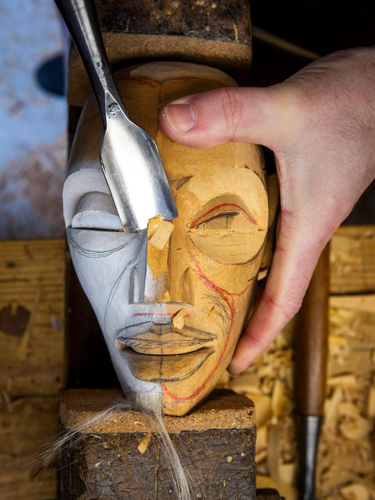
Stephen can take several weeks to a month to create a puppet, depending on how flexible or detailed it needs to be.
Often, he uses the puppets himself in various workshops or performances, but has been known to craft custom pieces for various puppeteers and collectors across the country.
"The first part of the process is finding out what the character is and what it's going to look like, so you design the visuals of it," Stephen said.

(Katielee Arrowsmith via SWNS)
"Then you've got to find out what it's got to do, because there's no point in making something that looks really nice but can't move well - or concentrating on the walk when in reality it's going to be static.
"It can be a long process, and especially with marionettes, a bit of trial and error, because balance is so important with them.






"I did some for an exhibition - they were designs based on real ballet costumes, so I had to interpret the costumes so you could recognise them from the original designs.
"I don't know of the ones I've sold on that are still in use, but some of the early ones that I've made 25 years ago, I've still got working.
"It's important to make the puppets good from a technical point of view.
"I look at them like instruments in a theatre - you've got to make them perform properly. They've got to be robust; they've got to last.
"You don't generally get duff musical instruments in orchestras - they're all good quality.
"It's the same with the puppets. They've got to be of a standard so that they perform properly and the performer can get everything out of them."
But marionette making - the art of crafting traditional puppets from wood and string - is now an endangered craft.
Stephen believes that traditional marionettes are becoming less popular due to the time it takes to learn how to make them move seamlessly.

(Katielee Arrowsmith via SWNS)
He said: "It's a difficult thing professionally, because it takes a long time for someone to learn.
"Even if you are used to marionettes, you have to almost break one in to get used to it.
"Recently, they tend to be more private or decorative pieces to work with."
Stephen hopes to keep the craft alive - as he believes that puppet shows are often a child's first introduction to theatre.
He believes that keeping puppeteering alive will encourage new generations of keen theater-goers and patrons of the arts.
"A good live theatre experience is incredible," he said.
"Puppet theatre is an entryway for most kids into theatre.
"From an experience point of view for the audience, it's important that what you create is of a high standard and it encourages people to come back to the theatre.
"If you get that right, you've possibly set up an audience for future plays - future theatre-goers to keep that alive."



(0) comments
Welcome to the discussion.
Log In
Keep it Clean. Please avoid obscene, vulgar, lewd, racist or sexually-oriented language.
PLEASE TURN OFF YOUR CAPS LOCK.
Don't Threaten. Threats of harming another person will not be tolerated.
Be Truthful. Don't knowingly lie about anyone or anything.
Be Nice. No racism, sexism or any sort of -ism that is degrading to another person.
Be Proactive. Use the 'Report' link on each comment to let us know of abusive posts.
Share with Us. We'd love to hear eyewitness accounts, the history behind an article.