
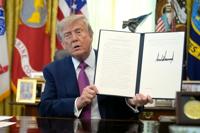
(ATLANTA) President Donald Trump loves a good pardon. His generosity is so well known, in fact, that an industry of lobbyists, lawyers and other insiders has reportedly sprung up to facilitate clemency for wealthy criminals. Clemency, meaning mercy or leniency, lets the president reduce the punishment for, or even forgive, federal crimes.
For defendants hoping to avoid jail and walk away from millions of dollars in financial sanctions, paying, say, US$600,000 to a lobbying firm to influence the president may seem like a good investment.
House Democrats recently reported that Trump’s second-term clemency – which includes both pardons, which wipe away every part of a conviction, and commutations, which typically leave convictions intact but shorten a person’s sentence – has saved convicted defendants nearly $1.7 billion in forgiven financial obligations.
Some of that amount – about $700 million – had not yet been officially imposed by courts because the clemency came through so quickly. Much of the remaining $1 billion had been ordered as restitution, meant to repay victims’ losses.
As a legal scholar researching the evolution of modern presidential clemency, I have reviewed every individual pardon and commutation granted by U.S. presidents since 1989, spanning seven administrations, from George H.W. Bush to Trump’s second term. I have found that while other presidents have canceled tens of millions of dollars’ worth of restitution and fines, none of them have come anywhere near the billion-dollar mark – until now.
What is restitution?
The main financial penalties faced by federal defendants are fines, forfeiture – where a defendant has to give up, say, the Ferrari they bought with the profits from their drug business – and restitution.
Restitution is an order to pay back the criminal’s gains to the victims of the crime. For example, if the CEO of a company tricks people into investing $600 million into a hydrogen-powered truck that was never operational, the court may order that, if convicted, he pay back the people he defrauded.
Restitution is rarely able to return all of someone’s lost money, but it is supposed to prevent the fraudster from enjoying the fruits of their crime.
Getting away with it
Since January 2025, Trump has granted clemency to a lengthy list of big-ticket fraudsters, including a cryptocurrency billionaire whose exchange pleaded guilty to anti–money laundering violations and CEOs convicted of payroll tax fraud.
Many of these pardons and commutations have coincided with the use of lobbying firms or generous donations to causes close to Trump’s heart: his inaugural committee, his reelection campaign or MAGA Inc. One successful pardon-seeker’s mother attended a $1 million fundraising dinner.
Clemency seekers use a variety of ways to catch the president’s attention. The end result is that victims of crime – and taxpayers, who have to pay for these huge white-collar investigations and trials – are often left with nothing.
Unfettered power
The U.S. Constitution grants the president nearly unbounded power to pardon whomever he likes, whenever he likes and for whatever reason he likes. This is why, since 1894, the Office of the Pardon Attorney has tried to impose some guidelines on the process and decide which cases should be eligible for clemency at all.
These guidelines generally require that a clemency seeker have been released from prison for five years before they are eligible to request a pardon. If they never went to prison, the five years is calculated from the date of sentencing. Many presidents adhere to this norm: My study shows that between 94% and 100% of people pardoned by George H.W. Bush, George W. Bush and Barack Obama met this criteria. Because he gave so many preemptive pardons, Joe Biden’s percentage was lower, at around 68%, but still well over half.
In contrast, out of the 216 individual pardons granted by Trump in his second term so far, only 34 – about 15% – have gone to people who waited that long.
The money ladder
A look back at recent past administrations shows an erratic but increasing amount of financial obligations canceled. While some presidents have been frugal with their financial forgiveness – George H.W. Bush and George W. Bush remained under the million-dollar mark, while Joe Biden was just over it – others have been less so.





Bill Clinton erased nearly $10 million in fines and restitution through pardons, most notoriously pardoning Marc Rich, a fugitive financier whose ex-wife contributed more than a million dollars to various Democratic causes and the Clinton Presidential Library.
Obama more than doubled Clinton’s record, forgiving $23 million in financial sanctions.
But Trump surpassed them both in his first term, canceling nearly $195 million in financial obligations. The amount of money saved by convicted defendants during his second term is exponentially higher. One could even say that, as Trump likes to put it, “We’ve never seen anything like it.”
A new role for commutations
Since the main function of commutations is to let people out of prison sooner, commutations usually leave financial obligations in place. During his first term, Trump primarily granted commutations that left “intact and in effect” all conditions of a person’s sentence except for imprisonment. This let numerous defendants out of jail but kept them on the hook for nearly $3 billion in fines and restitution.
That has changed during Trump’s second term. Today, his commutations routinely cancel a recipient’s prison sentence “with no further fines, restitution, probation or other conditions.”
This is how, through commutations alone, Trump has canceled more than $300 million in penalties and restitution since he returned to office.
A word of caution
One figure that is unavailable in public records is whether any given defendant has started to pay, or has fully paid off, their financial obligations. So these figures for every administration represent a ceiling: the full amount of fines, restitution or forfeiture that a judge imposed on a convicted defendant. How much was actually paid down can usually only be estimated, though there are exceptions.
For example, Jason Galanis, who pled guilty to defrauding the Oglala Sioux Nation, had paid just over $2 million of his $80 million restitution before his sentence was commuted and the restitution erased in 2025. But we only know that because he unsuccessfully asked the court to return the money.
One useful indicator of how much someone may have already paid is the speed at which they got clemency. The faster they receive clemency, the less time they have to pay off their penalties. The median delay between sentencing and receiving a pardon during Biden, Obama and George H.W. Bush’s administrations was over 20 years.
During Trump’s second term, in contrast, things are moving faster. Trump has pardoned or given commutations to at least 44 recipients within a year of their sentences who together account for over $270 million in financial obligations.
This includes a nursing home executive who pled guilty to withholding his employees’ payroll taxes – which prosecutors said he spent on a yacht – and was pardoned 12 days after being sentenced, ensuring that he could avoid some $4 million in restitution. A crypto company was pardoned hours before it was due to pay a $100 million fine for violating anti–money laundering laws. A digital media founder was ordered to repay defrauded investors $36 million. His sentence was commuted, and his restitution canceled within four months of sentencing.
In these cases, clemency was issued before most of the money was able to reach the government or the victims it was owed to. The faster clemency is granted, the more likely it is that fraudsters get to walk away without paying their victims anything.
This article is republished from The Conversation, a nonprofit, independent news organization bringing you facts and trustworthy analysis to help you make sense of our complex world. It was written by: Caren Morrison, Georgia State University
Read more:
- Pardons are political, with modern presidents expanding their use
- Pardon who? Hunter Biden case renews ethical debate over use and limits of peculiar presidential power
- Trump’s Jan. 6 pardon order ‘flies in the face of the facts’ of violent insurrection, retired federal judge explains
Caren Morrison does not work for, consult, own shares in or receive funding from any company or organization that would benefit from this article, and has disclosed no relevant affiliations beyond their academic appointment.

(0) comments
Welcome to the discussion.
Log In
Keep it Clean. Please avoid obscene, vulgar, lewd, racist or sexually-oriented language.
PLEASE TURN OFF YOUR CAPS LOCK.
Don't Threaten. Threats of harming another person will not be tolerated.
Be Truthful. Don't knowingly lie about anyone or anything.
Be Nice. No racism, sexism or any sort of -ism that is degrading to another person.
Be Proactive. Use the 'Report' link on each comment to let us know of abusive posts.
Share with Us. We'd love to hear eyewitness accounts, the history behind an article.