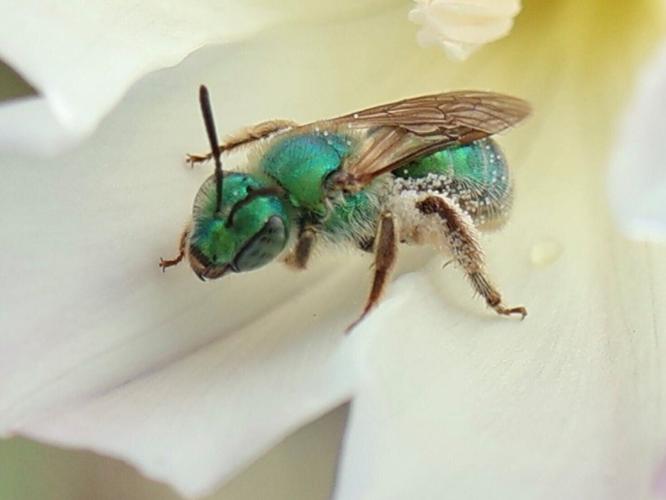
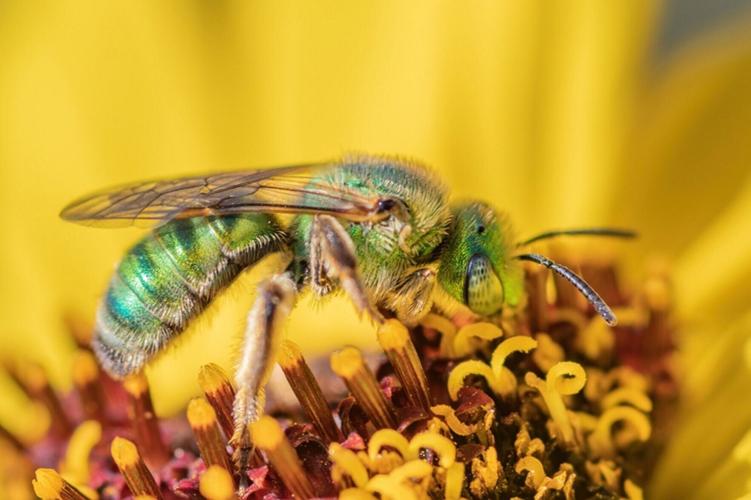
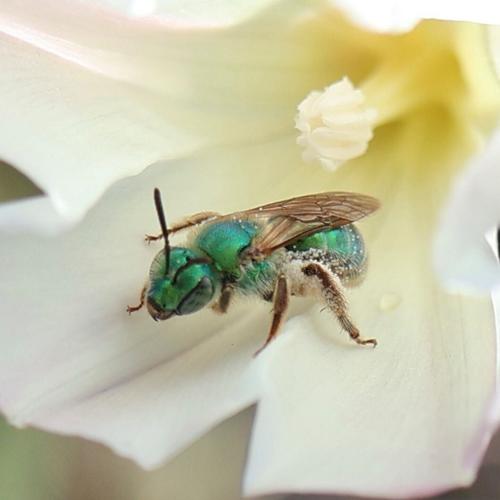
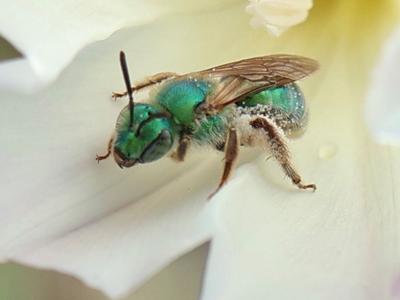

A sweat bee in the wild. (Jeremiah Bender via SWNS)
By Stephen Beech
Some bees change color with the weather, reveals new research.
Humidity can temporarily alter the shimmering hues of certain "chameleon" species, say scientists.
A research team, led by Dr. Madeleine Ostwald of Queen Mary University of London, found that moisture in the air can cause sweat bees to change color — and then change back again when conditions dry out.
Sweat bees are known for their bright, metallic greens and blues.
Until now, reports that their colors could shift had only been anecdotal.
The new research, published in the journal Biology Letters, provides the first experimental proof.
The team studied museum specimens of a North American sweat bee, Agapostemon subtilior.
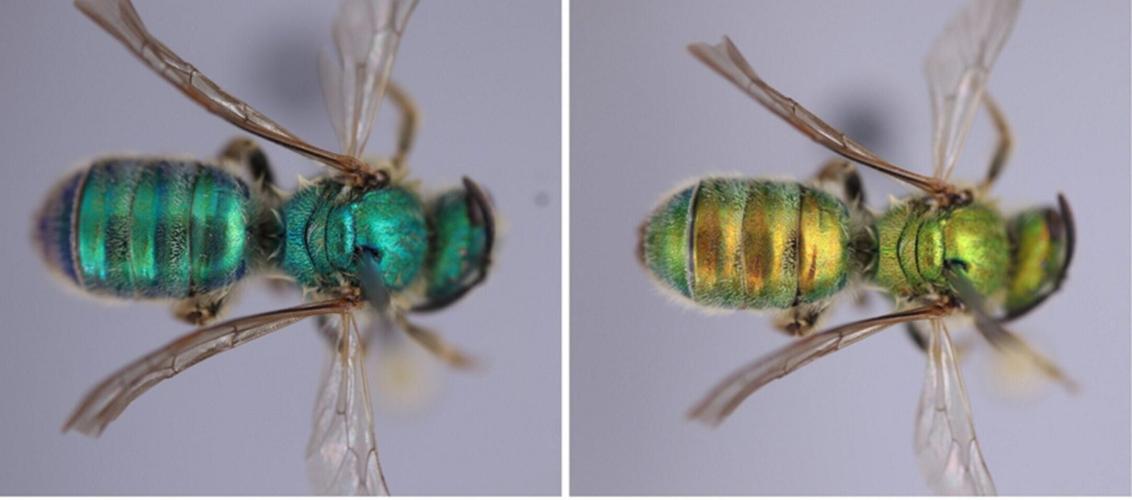
When the bees were placed in dry air, they appeared deep blue.
But when humidity increased, they took on a warmer, copper-green color.
Once dried again, the bees returned to blue.
Ostwald explained that, unlike most animals whose colors come from pigments, the bees get their color from microscopic structures on their bodies that reflect and scatter light at particular wavelengths.

A single museum specimen (about 1 cm long) from the experiment changing color as it goes from blue in dry air (left) to green in humid air (right), with most of the change happening in the first 24 hours. (Leslie Cervantes Rivera via SWNS)
The same effect creates the iridescent feathers of hummingbirds and the shifting skin colors of cuttlefish.
In some animals, the tiny structures swell slightly when exposed to moisture, causing them to reflect redder colors.






The research team believe a similar process may be happening in bees, although more work is needed to fully understand the mechanism.
They also looked at color changes in the wild.
By analyzing hundreds of public photos from the citizen science app iNaturalist, they compared bee color with local humidity levels.
While many factors influence a bee's appearance, the team found that bees in drier areas tended to look bluer — matching the lab results.
Interestingly, older museum specimens showed the strongest color changes.
The researchers believe that may be because bees' outer shells slowly degrade over time, allowing moisture to enter more easily.
The findings suggest the color-changing effect could be common among bees, which display a wide range of shimmering colors and live in environments ranging from deserts to rainforests.

A sweat bee in San Diego County, California. (Karen Fraser via SWNS)
Insects use color for many reasons, including temperature control, communication, and camouflage.
Whether the color shifts affect how bees behave or survive is still unknown.
Ostwald said: "When people think of bees, they often picture drab, brown honey bees.
"In reality, bees are incredibly diverse and colorful — and we're only just starting to understand how their appearance reflects the climate they live in."
She added: "Most people associate color-change with animals like chameleons that actively control it.
"These bees aren't choosing to change color — it's happening passively, simply in response to the humidity around them.
"That adds a whole new layer of mystery to why these colors evolved in the first place."

(0) comments
Welcome to the discussion.
Log In
Keep it Clean. Please avoid obscene, vulgar, lewd, racist or sexually-oriented language.
PLEASE TURN OFF YOUR CAPS LOCK.
Don't Threaten. Threats of harming another person will not be tolerated.
Be Truthful. Don't knowingly lie about anyone or anything.
Be Nice. No racism, sexism or any sort of -ism that is degrading to another person.
Be Proactive. Use the 'Report' link on each comment to let us know of abusive posts.
Share with Us. We'd love to hear eyewitness accounts, the history behind an article.