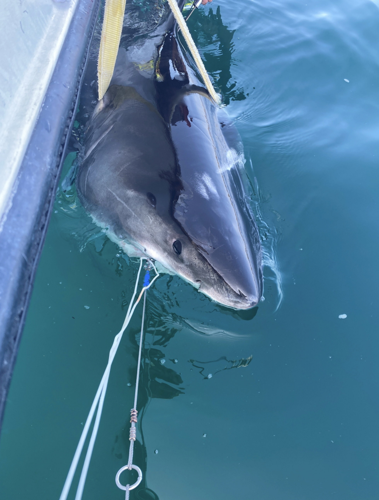

(OCEARCH via SWNS)
By Blaise Cloran
Great white sharks are venturing further north than ever due to a burst in numbers, scientists claim.
An estimated 2,000 great white sharks from the western North Atlantic population are believed to migrate north to feed in Atlantic Canadian waters each summer.
However, researchers have now tracked two sharks traveling further north than ever before - towards the northern tip of Newfoundland.
The great white sharks are being drawn to Canadian waters due to food sources and protection efforts, which are helping their numbers increase, they believe.
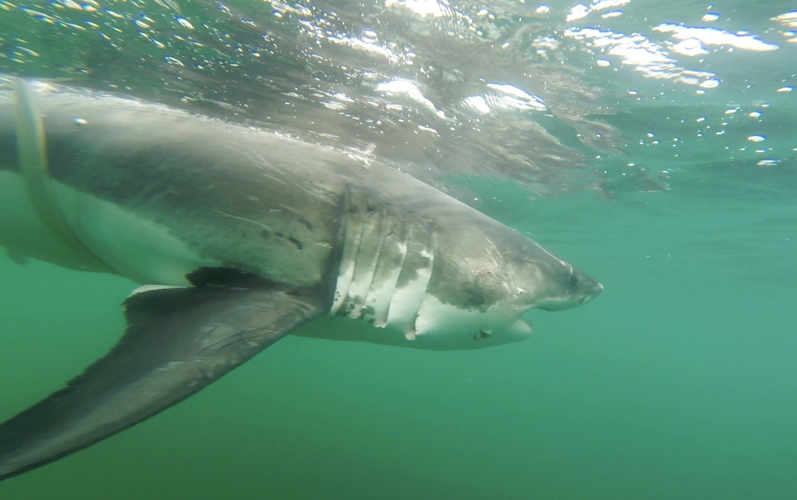
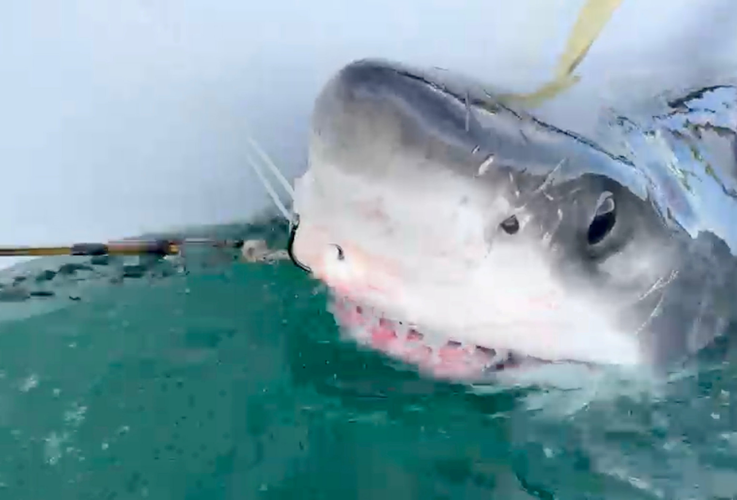
John Tyminki, OCEARCH data scientist, explained a 9 ft male great white shark called Quint has been acting abnormally.
The team are able to follow him because he is fitted with a tracker which 'pings' his location when he surfaces.
John said: "One of the questions that we have is, are shark ranges expanding? Are they moving further north into Atlantic Canada than they have been before?
"Sharks Quint and Cross are way up north on the northwest corner of Newfoundland.
"Very few sharks that we have tagged have ventured into that area.

(OCEARCH via SWNS)
"Is this a range expansion or is this normal and we are only starting to see it now?
"White sharks were greatly depleted in the 1970s to the 1990s and now we are seeing a rebuilding of that population due to protection efforts.
"We are seeing a positive return to abundance in great white shark numbers, we think their numbers are increasing and we are seeing more sharks near Canada this year."
In the last week OCEARCH have located sharks Webster, Nori, Bella, Quint and Ernst in waters near eastern Canada shorelines.





The sharks' trackers transmit a locating "ping" signal when their dorsal fins are exposed above the water surface.
Great white shark sightings were previously considered rare in Canadian waters but 10 ft 729Ilb Bella was the first great white shark of the season to be documented in the area on June 29.
Since then scientists have been tracking more and more sharks storming along the Canadian coast near popular tourist destinations like Quebec.
OCEARCH said in a video on X: "Quint, a sub-adult male is moving north in the Strait of Belle Isle since July 26.
"About 18 miles from shore from the Great Northern Peninsula and Quebec."

(OCEARCH via SWNS)
Quint was tagged last year weighing 587 lbs and is the 100th shark OCEARCH have tagged and released.
John added: "Right now our white sharks are doing what we kind of expect.
"They have moved into Canada waters and they are using the area as a summer foraging area. There are lots of seals there and schooling fishes which they can prey on.
"Food is a big driver but there are also sustainable habitats there.
"We are trying to understand how they are using that habit in Atlantic Canada, we want to know how the males and females and juveniles use the food.
"We probably have half a dozen pinging in right now. I hope that for every one we have tagged there are 100 out there we haven't.
"I can see seven on our tracking system in that area right now."
John explained great white sharks typically hunt close to rocky Canadian coastlines where there are seals.
He said: "We estimate that roughly 2,000 white sharks from the Western North Atlantic population utilize Atlantic Canadian waters each summer, although no formal peer-reviewed abundance estimate currently exists for the region."
Nearly all of the white sharks that "ping" from Atlantic Canada on the Shark Tracker were tagged last year by TIMFS in collaboration with OCEARCH.

(0) comments
Welcome to the discussion.
Log In
Keep it Clean. Please avoid obscene, vulgar, lewd, racist or sexually-oriented language.
PLEASE TURN OFF YOUR CAPS LOCK.
Don't Threaten. Threats of harming another person will not be tolerated.
Be Truthful. Don't knowingly lie about anyone or anything.
Be Nice. No racism, sexism or any sort of -ism that is degrading to another person.
Be Proactive. Use the 'Report' link on each comment to let us know of abusive posts.
Share with Us. We'd love to hear eyewitness accounts, the history behind an article.