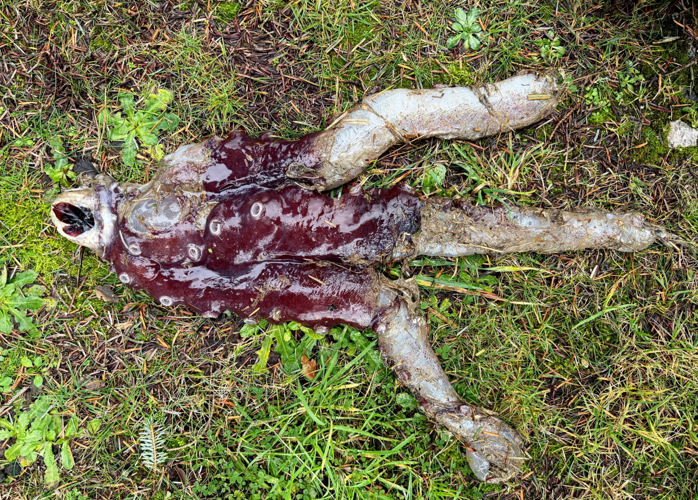
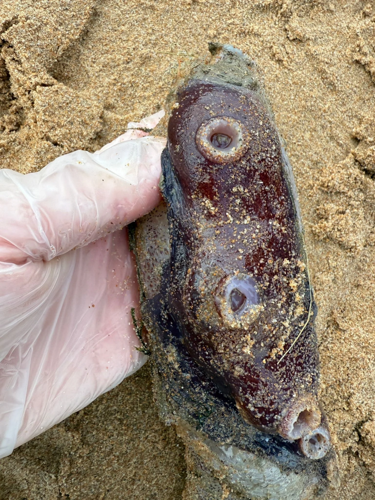
Dr. Lauren Smith, marine biologist at Saltwater Life, said: "I went out looking every day for the missing arms and beak that had washed back out with the tide.
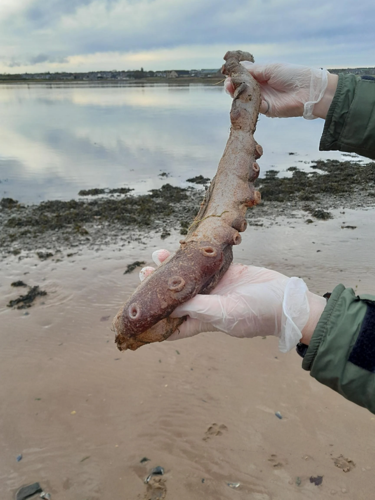
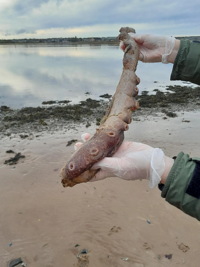
"One of the local residents who had first reported the finds sent me a message to say he had just found this piece which must have washed back in on the high tide.
"There has been a lot of speculation as to how the remains ended up where they did - for example, trawl capture and thrown overboard, whale predation, disoriented in the shallows and then predated on and so forth - but it is practically impossible to say for certain."
(Dr. Lauren Smith via SWNS)
By Talker
Dr. Lauren said the level of interest in the rare underwater animal has been "truly incredible".
She explained: "Researchers and museums are interested in genome work, stable-isotope analysis and preservation of the specimens.
"Currently they are all in my freezer however they will be sent off to Aberdeen University, Trace Wildlife Forensics Networks, National Museum Scotland and Natural History Museum London."
The giant seven-armed octopus lives hundreds of meters below the surface of the sea and is one of the world's largest species of octopus.
Also known giant gelatinous octopus or blob octopus, they have eight arms like other types - but in males, one of the arms is also a reproductive organ that they attach to females when mating.
Keep it Clean. Please avoid obscene, vulgar, lewd,
racist or sexually-oriented language. PLEASE TURN OFF YOUR CAPS LOCK. Don't Threaten. Threats of harming another
person will not be tolerated. Be Truthful. Don't knowingly lie about anyone
or anything. Be Nice. No racism, sexism or any sort of -ism
that is degrading to another person. Be Proactive. Use the 'Report' link on
each comment to let us know of abusive posts. Share with Us. We'd love to hear eyewitness
accounts, the history behind an article.








(0) comments
Welcome to the discussion.
Log In
Keep it Clean. Please avoid obscene, vulgar, lewd, racist or sexually-oriented language.
PLEASE TURN OFF YOUR CAPS LOCK.
Don't Threaten. Threats of harming another person will not be tolerated.
Be Truthful. Don't knowingly lie about anyone or anything.
Be Nice. No racism, sexism or any sort of -ism that is degrading to another person.
Be Proactive. Use the 'Report' link on each comment to let us know of abusive posts.
Share with Us. We'd love to hear eyewitness accounts, the history behind an article.