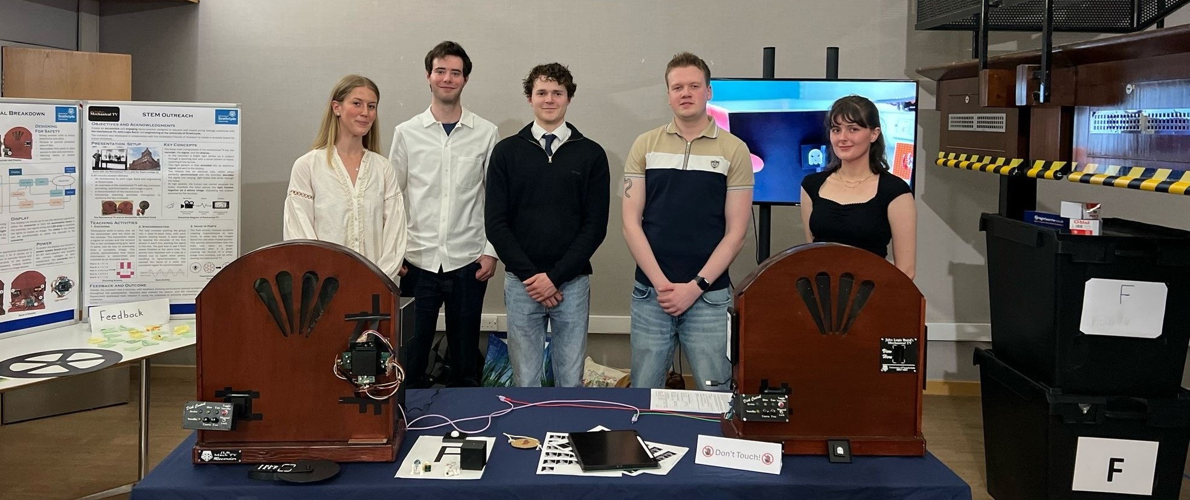

The students with their creation. (University of Strathclyde via SWNS)
By Elizabeth Hunter
Students at John Logie Baird's former university have recreated a working version of his original 1926 television.
The final-year engineers from the University of Strathclyde have built a televisor system, using the same principles as the original invention.
But it also features a modern twist - allowing users to send and display images from their mobile phones.
The replica project was created by Molly Barry, Guy Horne, Angus Milligan, Lewis Gibney and Jade Graham, from programs in Electronic and Electrical Engineering, Electrical and Mechanical Engineering, and Computer and Electronic Systems at the University.

Wikimedia Commons
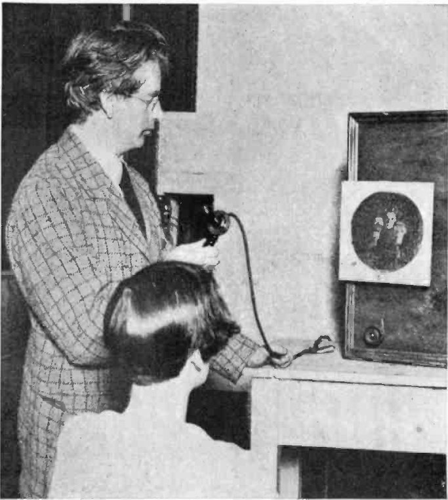
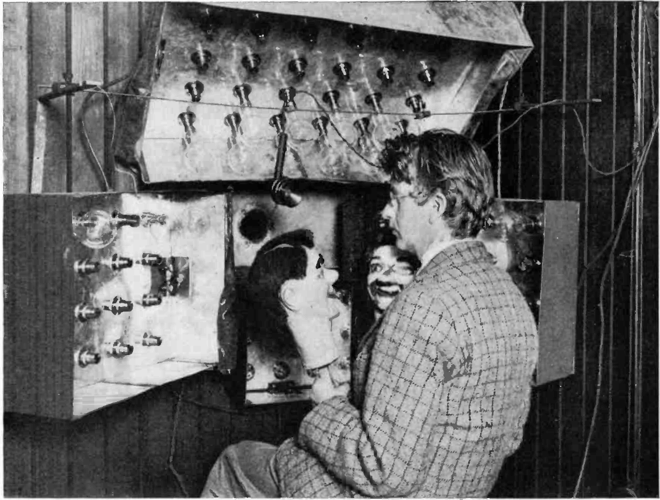
Baird, born in Argyll in 1888 and a former student of Strathclyde’s predecessor institution, the Glasgow and West of Scotland Technical College, achieved worldwide fame as the first person to televise moving pictures.
Images of ‘Stooky Bill,’ the head of a ventriloquist’s dummy created by the inventor, were the first to be successfully transmitted by television.






Molly Barry said: “The further into the work we got, the more we noticed the plaques and posters on John Logie Baird across the campus and the sense of the history of it sank in.”
Lewis Gibney added: “Recreating John Logie Baird’s invention was an interesting, grounding and inspiring experience and a real source of pride to be from Scotland’s west coast.”
The mechanical television recreation was designed to follow key characteristics of Baird’s prototypes, including the utilisation of spinning nipkow disks for image encoding and decoding. It was found that many historic components, like florescent bulbs, used by Baird weren’t available and modern counterparts, like LEDs, were instead used.

Wikimedia Commons
Their final-year project not only pays homage to Baird’s work but also supports educational outreach. The system is already being used to inspire school pupils through outreach activities. It featured at the University’s Engineering the Future for Girls event, aimed at encouraging young women into STEM fields.
Jade Graham said: “It was important to me that the project has a use after our assignment and it’s nice that it will be used for outreach work.”
The centenary of his invention will be marked on 2 October 2025 when Baird first transmitted an image in his laboratory, with the first public demonstration anniversary following on 26 January 2026.
Professor Graeme West, from the Department of Electronic and Electrical Engineering who oversees the Mechanical Engineering group projects, said: “It is fantastic to see how John Logie Baird’s original innovation is being brought to the new generation of engineers and scientists through this interactive recreation of the mechanical televisor.
“Outreach demonstrators such as this are a great way of explaining the fundamental principles that underpin the technology we use on a daily basis, inspiring school pupils to take up careers in STEM-related fields.”



(0) comments
Welcome to the discussion.
Log In
Keep it Clean. Please avoid obscene, vulgar, lewd, racist or sexually-oriented language.
PLEASE TURN OFF YOUR CAPS LOCK.
Don't Threaten. Threats of harming another person will not be tolerated.
Be Truthful. Don't knowingly lie about anyone or anything.
Be Nice. No racism, sexism or any sort of -ism that is degrading to another person.
Be Proactive. Use the 'Report' link on each comment to let us know of abusive posts.
Share with Us. We'd love to hear eyewitness accounts, the history behind an article.