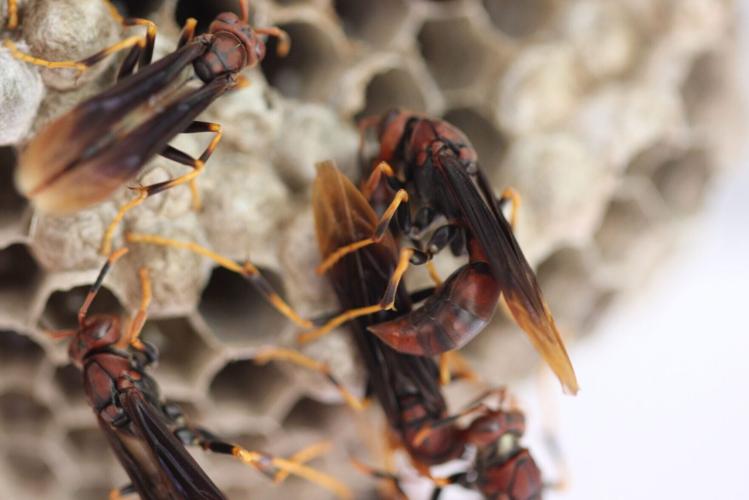
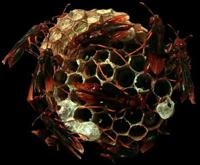
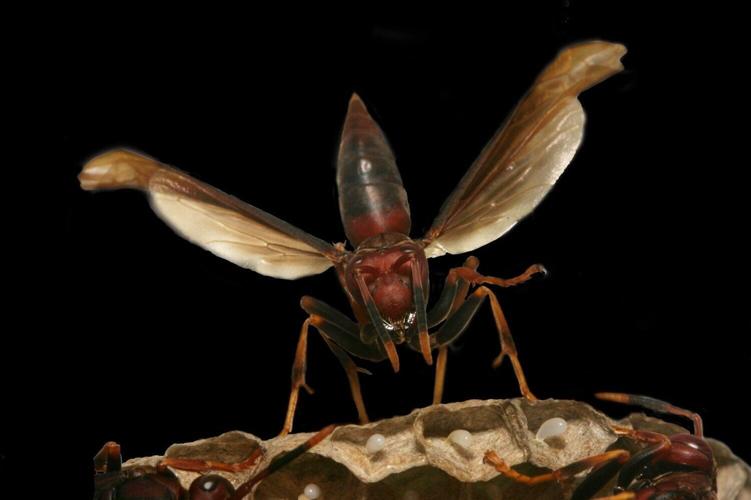
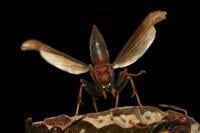
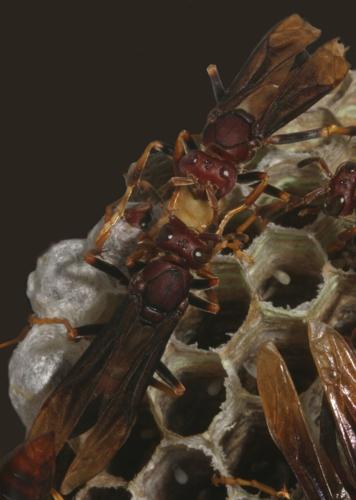
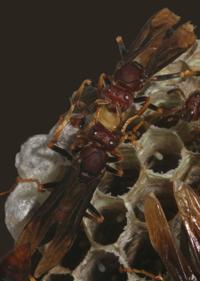

Polistes canadensis. (UCL via SWNS)
By Stephen Beech
Wasp societies overcome brutal battles to be queen by helpful workers picking up the slack, reveals new research.
The loss of a queen wasp triggers a power struggle and social turmoil that can often be violent and chaotic, say scientists.
But their findings show that even in colonies where leadership succession wars are the fiercest, there are individual wasps that compensate for the upheaval by working harder on essential tasks.
The study focuses on cooperative societies of tropical paper wasps, found in the Caribbean, where many individuals live together but reproduction is controlled by a single dominant female.
But the other female workers are not sterile, and could take over as the next breeder if a power vacuum arises.
To understand how colonies respond to leadership loss, researchers from University College London (UCL) experimentally removed queens from established colonies.
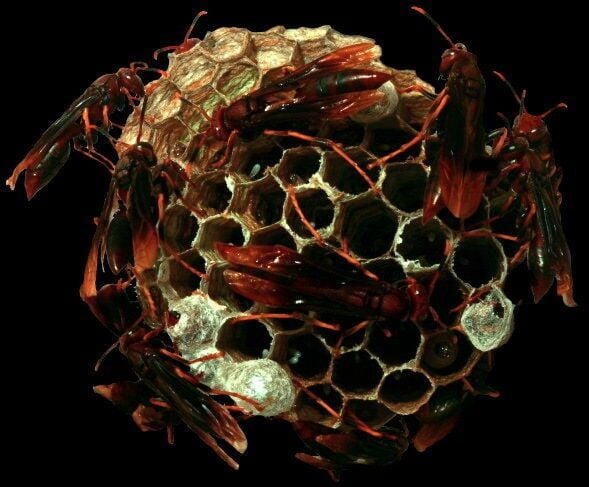
Scientists say the loss of a queen wasp triggers a power struggle and social turmoil that can often be violent and chaotic. (UCL via SWNS)
What followed was immediate disruption, according to the study published in the journal Animal Behaviour.
The research team observed aggressive interactions between females escalated as multiple wasps competed for reproductive dominance, and the colony's usual social networks rapidly broke down.
Rather than a smooth transfer of power, succession involved a period of intense conflict involving many group members.
But, despite all the turmoil, the wasp colonies did not collapse.
Instead, stability was maintained by a distinct group of individuals the researchers term "compensators."
The compensators avoided engaging in aggressive conflict and power struggles, and instead increased their investment in essential tasks such as foraging and brood care.

Findings show that even in colonies where leadership succession wars are the fiercest, there are individual wasps that compensate for the upheaval by working harder on essential tasks. (UCL via SWNS)





By ensuring that food continued to reach developing offspring, they helped maintain societal function through periods of intense social turmoil.
The compensators did not appear to be biologically different from those engaging in fighting, which the researchers say suggests their behavior may reflect strategic decisions rather than fixed roles.
The team believe some wasps may see achieving dominance as their best chance of future reproduction, while others seek to ensure the survival of the brood, typically composed of the workers' own siblings.
Lead author Owen Corbett said: "The conflict after queen removal was intense, but it wasn't the whole story."
Corbett, who conducted the research as part of his Ph.D. at UCL, added: "While some individuals fought over dominance, others completely avoided the conflict and quietly stepped up to keep the colony running.
"Cooperation didn't disappear; it was redistributed."
He said most previous studies of cooperative colonies have focused on temperate species such as those found in Europe or North America that have highly ordered dominance hierarchies and predictable succession rules.

A new study focuses on cooperative societies of tropical paper wasps, found in the Caribbean. (UCL via SWNS)
The new research instead examined a more chaotic, aggression-driven system in a group that has received far less attention, broadening understanding of the diverse ways animal societies can resolve leadership conflicts.
The insights come from a fresh analysis of behavioral data collected by some of the study's research team during fieldwork in the early 2000s in Panama.
They say the findings challenge the idea that cooperative societies must depend on orderly, rule-based succession systems to remain stable.
While aggression-based succession is often assumed to be too costly to persist, the study shows that such systems can be viable when compensators offset the costs of conflict.
Study senior author Seirian Sumner said: "Understanding how animal societies manage conflict can help us think differently about cooperation more broadly."
She added: "In times of turmoil, society depends on those who keep doing the essential work in the background.
"In many ways, we may be more like wasps than we realize."

(0) comments
Welcome to the discussion.
Log In
Keep it Clean. Please avoid obscene, vulgar, lewd, racist or sexually-oriented language.
PLEASE TURN OFF YOUR CAPS LOCK.
Don't Threaten. Threats of harming another person will not be tolerated.
Be Truthful. Don't knowingly lie about anyone or anything.
Be Nice. No racism, sexism or any sort of -ism that is degrading to another person.
Be Proactive. Use the 'Report' link on each comment to let us know of abusive posts.
Share with Us. We'd love to hear eyewitness accounts, the history behind an article.