By Stephen Beech
Chimps, gorillas and humans have been laughing the same way for millions of years, suggests new research.
The great apes may have been chuckling with a similar rhythm to mankind for at least 15 million years, scientists say.
The University of Warwick study also offers unexpected clues to how human speech evolved.
All living great apes — chimpanzees, bonobos, gorillas and orangutans — laugh.
But until now, it had been unclear how our laughter may have changed over millions of years of evolution, and how it might relate to the evolution of speech in humans.
The Warwick team analyzed laughter recordings from four orangutans, two gorillas, three bonobos, four chimps and four humans, aged 6 months to 7 years, measuring 140 individual laughter sequences.

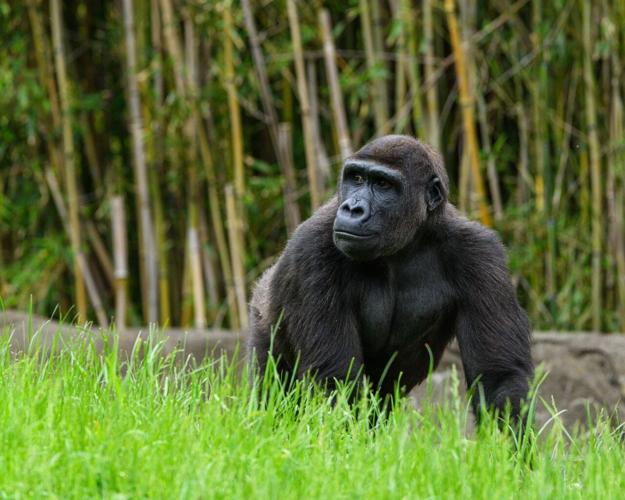
Photo by Jay Brand via Pexels
All great apes and humans were recorded in their home environments during controlled, playful interactions with familiar humans, who elicited both play and tickle-induced vocalizations.
The study, published in the journal Communications Biology, focused on the rhythmic structure, the timing intervals between successive bursts of sound, rather than pitch or intensity.
Across 140 laughter sequences, they found the same pattern: all species produce laughter with evenly spaced rhythmic intervals between successive sounds.
The researchers believe that basic rhythmic structure was already present in a shared common ancestor 15 million years ago — and has remained "remarkably conserved" with all living great apes still showing the same underlying pattern.






Study co-author Chiara De Gregorio said: "Speech leaves no fossils, and complex language exists only in our own species.
"But we've found a 15-million-year-old clue in an unexpected place: our laughter.
"Unlike speech, laughter is shared by all living great apes.
"By comparing how different species laugh, we can see that a basic rhythmic structure has remained unchanged since our last common ancestor. That's extraordinary.”

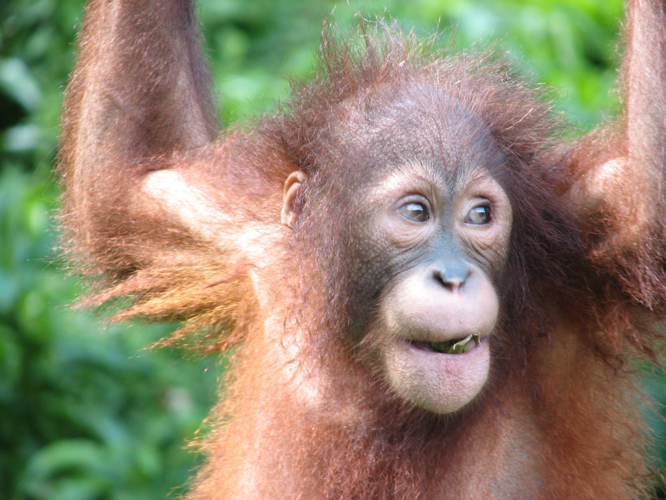
(Marina Davila-Ross via SWNS)
The research team found that while the basic rhythm stayed constant, human laughter has become faster, more variable and gained sophisticated context-dependent control.
Of the great apes, humans alone have the ability to control when and how they laugh depending on context: an uncontrollable laugh when tickled differs sharply from a polite laugh in a meeting, a nervous laugh after a mistake or the infectious laughter that spreads through friends.
The same underlying rhythm remains, shaped by conscious control to communicate different emotions and intentions.
The study findings suggest that throughout great ape evolution, our ancestors gradually developed greater control over the timing of their vocalizations, including laughter.
Co-author Adriano Lameira said: “It is impossible to assess the precursor forms of language directly from our extinct ancestors.
"Laughter, being evolutionarily older and having remained shared between all living great apes, provides a rare evolutionary window into the vocal transformations that unfolded across hominid evolution until the first humans appeared on scene."
He added: "Contrary to the classic notion that the first humans suddenly acquired vocal control capacities remarkably different from their predecessors, laughter evolution tells us that humans lay on a continuum, a prolongation of vocal control capacities that were already being cumulatively honed in for 15 million years.”

(0) comments
Welcome to the discussion.
Log In
Keep it Clean. Please avoid obscene, vulgar, lewd, racist or sexually-oriented language.
PLEASE TURN OFF YOUR CAPS LOCK.
Don't Threaten. Threats of harming another person will not be tolerated.
Be Truthful. Don't knowingly lie about anyone or anything.
Be Nice. No racism, sexism or any sort of -ism that is degrading to another person.
Be Proactive. Use the 'Report' link on each comment to let us know of abusive posts.
Share with Us. We'd love to hear eyewitness accounts, the history behind an article.