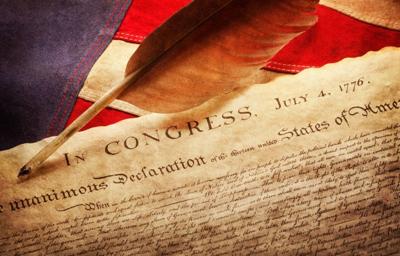
The Declaration of Independence is disappearing, and it has nothing to do with the country's current divides. The document at the center of the nation's 250th birthday has faded so badly over two and a half centuries that large sections of it read as blank parchment. The bold "In Congress, July 4, 1776" at the top still holds up, and John Hancock's signature is still there. Past that, a lot of the text disappears into the page.
It's the actual condition of the actual document, and it's been getting worse since roughly the 1820s, decades before anyone now alive was born to argue about it.
The National Archives doesn't hide this. Conservators have written about it for years, and the explanation is almost embarrassingly mundane: nobody in charge thought to put it somewhere out of the sun. For about three decades after the signing, the Declaration was rolled up, unrolled, hung on walls, and carried between cities with no real protection from sunlight, the single fastest way to destroy ink on parchment.
Around 1820, someone tried to make an official copy using a wet-pressing technique that pulled a noticeable amount of the original ink straight off the page. By the time the federal government got serious about preservation in the early 1900s, the damage was already done, and there was no putting it back.
What's left is locked inside a titanium-framed case filled with humidified argon gas, lit at a light level that makes a candlelit room look bright by comparison, and lowered into a vault every single night. The whole setup exists because the document has already lost the fight it's currently being protected from. Visitors aren't seeing a national treasure preserved in pristine condition. They're seeing what's left after the country spent its first century not realizing what it had.
Why People Still Come
None of this seems to be talking anyone out of visiting. If anything, the 250th has pushed interest in the other direction. A renovation of the permanent galleries opened to the public in October 2025, and a new flagship exhibit called The American Story now pairs original documents with digital kiosks.
On July 4, the building has a full slate of programming planned around the Rotunda exhibit. Activities include a ceremony with period-dress reenactors reading the Declaration aloud, a Space Force Color Guard presentation, and museum exhibits open until 10 p.m., giving the crowd more than a single morning window to get through.






The condition of the document may be part of its appeal. Plenty of historic sites display replicas, reconstructions, or buildings that have been restored multiple times. The Rotunda offers something different. Visitors stand a few feet from the original parchment approved by Congress in 1776, complete with the fading and damage accumulated since then. Even when parts of the text prove difficult to read, the document's survival remains part of the experience.
Getting In Without Losing the Morning to a Line
The Archives sells timed-entry tickets online for a dollar apiece, in 15-minute windows running from 10 a.m. to 5 p.m. While walk-ins are allowed, a dollar buys a shortcut around what's likely to be the building's busiest day in years.
The ceremony out on Constitution Avenue is separate from the museum entry. Seating works on a first-come, first-seated basis, no ticket involved at all, so anyone planning to watch George Washington and Thomas Jefferson's stand-ins read the Declaration aloud at 10 a.m. should plan to claim a spot on the steps well before then.
The National Archives streams the ceremony live on YouTube and Facebook for anyone who'd rather skip the crowd and watch from somewhere with air conditioning.
The Rest of the Trip
The Archives' own programming is one stop on a much longer 250th calendar running through Washington, DC, for the rest of 2026. A flag-focused exhibition at the National Gallery and a citywide series built around the country's food history are both part of that lineup, so a trip built around July 4 has plenty to fill the days before and after the holiday itself.
But the Rotunda is where the year's anniversary actually points, and what's waiting inside isn't a crisp, readable founding document. It's a worn, faded piece of parchment that survived war, fire, bad handling, and a hundred years of nobody quite knowing how to take care of it. Two hundred fifty years on, the words are harder to read, but the country built on them is still standing.

(0) comments
Welcome to the discussion.
Log In
Keep it Clean. Please avoid obscene, vulgar, lewd, racist or sexually-oriented language.
PLEASE TURN OFF YOUR CAPS LOCK.
Don't Threaten. Threats of harming another person will not be tolerated.
Be Truthful. Don't knowingly lie about anyone or anything.
Be Nice. No racism, sexism or any sort of -ism that is degrading to another person.
Be Proactive. Use the 'Report' link on each comment to let us know of abusive posts.
Share with Us. We'd love to hear eyewitness accounts, the history behind an article.