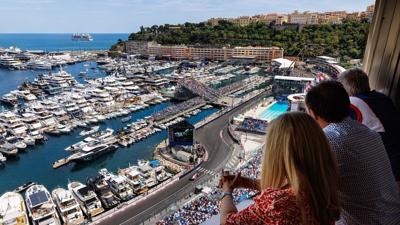

Monaco Grand Prix spectators overlook Port Hercule as a Silversea ship anchors alongside the harbor’s superyachts and race circuit.
Approximately one in seven Virtuoso travelers plan vacations around major sporting events, a trend on full display during the Monaco Grand Prix. Helicopters sweep above Port Hercule, superyachts crowd the harbor, and cruise ships transform Formula One’s most glamorous race into a Riviera-wide migration of yachts, cruises, and weeklong itineraries.
Newer additions to the F1 calendar, like Miami, Las Vegas, and Qatar, offer hyper-modern spectacles, but the sovereign city-state is the undisputed bucket-list Grand Prix. For motorsport purists and luxury guests alike, it is the one race weekend that carries a legendary mystique that must be experienced firsthand.
What was once a frantic three-day weekend sprint has expanded into a weeklong Mediterranean travel circuit.
"Monaco is such a unique destination because there are so many other ancillary things to do," said Keith Bruce, International President of Quint and F1 Experiences. "People flying in want to take advantage of the Côte d’Azur, the South of France, and even Italy."
Bruce noted that a subtle shift in the Formula One calendar has accelerated this vacation trend. Historically held over Memorial Day weekend in late May, the race now positions itself in early June.
"While it sounds somewhat insignificant, that’s really important in terms of the traveling fan," Bruce explained. "Families can now travel there because kids are generally out of school. June tends to be a better travel month, especially as it relates to building a week-long itinerary where the Monaco Grand Prix is."
Because local properties enforce strict four-night minimum stays during race week, attendees are increasingly booking shoulder nights in neighboring Nice, Cannes, or Menton, for a broader European holiday around the main event.
A Floating Luxury Market
With land-based accommodations at a premium, the cruise sector has positioned itself as a crucial segment of Monaco's floating hotel market. Rather than navigating complex regional highway traffic, travelers use cruise ships as floating bases anchored right in the bay.
Ultra-luxury lines like Silversea embed the event into larger regional itineraries, such as the Silver Ray's sailing from Rome to Barcelona. Similarly, Windstar Cruises deploys its 342-guest flagship sailing yacht, Wind Surf, to give fans a highly curated entry point.
"While Windstar's ships aren't the smallest and compete with quite a few smaller-ship brands during Grand Prix weekend, Wind Surf’s intimate 342-guest size allows Windstar to create a highly curated and immersive experience around the event," according to a statement from Windstar Cruises. Windstar positions the yacht more as a floating social club for Formula One fans. The line says the vessel’s smaller scale encourages guests to interact more directly with onboard speakers, themed programming, and fellow fans throughout race week.
Onboard programming brings the paddock atmosphere out to sea. Windstar voyages feature insider perspectives from legendary Formula 1 broadcaster Bob Varsha, whose 30-plus years covering the sport bring decades of Formula One institutional knowledge.
According to the cruise line, Varsha’s talks explore "everything from the evolution of F1 technology and race strategy to the personalities, rivalries, and championship storylines shaping the current season.” Varsha’s onboard sessions dissect the track in detail, helping guests understand the technical precision and race strategy required at Formula One’s most unforgiving circuit.
While individual cruise brands coordinate their own trackside ticket packages independently, corporate alignments are shifting. "The only cruise line that F1 Experiences works with directly is MSC and Explora Journeys, as they are the official cruise partner of Formula One," Bruce noted. "For the most part, cruise ships operate on their own, selling the vessel as an elite accommodation alternative where guests stay on the water and commute to the trackside hospitality lounges."
Monaco from Multiple Vantage Points
The physical constraints of Monte Carlo’s narrow, historic corridors make it unique. Unlike purpose-built tracks where fans remain in one grandstand seat for three days straight, Monegasque spectating now stretches across rooftops, yachts, harbor terraces, and hospitality lounges scattered throughout the circuit.




"The combination experiences have become more and more popular, because people generally like the idea of taking in Monaco from different perspectives, which, again, sets them apart from a lot of Grand Prix," Bruce said.
This demand for variety has led to hospitality concepts like the "Monaco Triple Crown" package from F1 Experiences. "The Monaco Triple Crown allows you to spend one day viewing on a yacht, one day viewing in the pit lane, the Gordon Ramsay La Terrasse, as we call it," Bruce said. "And then, one day, in the actual Paddock club, which is located on La Rascasse turn of the circuit in the port. So all three have amazing views of the port, and also, you have amazing views of the track."
Navigating this multi-layered environment requires a distinct approach from the standard race weekend. "Monaco is tricky, logistically," Bruce added. "It’s not a typical race where you can take a big motor coach, stay in a city hotel, go out to the circuit... it’s a walking Grand Prix. So you're dropped off on the edge, or you're staying at one of the hotels in Monaco and you're walking everywhere because of the nature of it."
Luxury cruise lines match this demand by securing their own diverse land-based inventory. Rather than keeping passengers on board, Silversea assembles a range of viewing options for its guests. These range from traditional grandstand seating in Section K to private 14th-floor apartments overlooking 80% of the circuit, along with dedicated space on the Miramar Hotel's privatized rooftop terrace.
The Post-Race Recovery Vacation
By Sunday night, Monaco can feel physically punishing. The Grand Prix plays out across steep staircases, crowded pedestrian tunnels, packed harbor walkways, and narrow streets that keep spectators moving for most of the weekend. After days of engines echoing through Port Hercule and dense crowds around Casino Square, building recovery time directly into their itineraries has become popular.
After Monaco, many travelers continue west along the Côte d’Azur in search of a slower pace. La Réserve Ramatuelle offers a more secluded, wellness-driven alternative just six miles from Saint-Tropez. Recently modernized by Jacques Garcia, mornings shift from Formula One engines to coastal hikes above the sea, extended lunches beside the pool, and treatments at Spa Nescens, where much of the programming focuses on sleep restoration and recovery after long-haul travel and overstimulating itineraries.
Guests also enjoy priority access to La Réserve à La Plage, the Philippe Starck–designed beach club led by Michelin-starred chef Eric Canino. The atmosphere leans quieter and more restrained than many of Pampelonne’s louder summer scenes.
A Shifting Demographic
The intersection of high-end cruising, regional vacationing, and motorsport is also driving a noticeable shift in trackside demographics. Prompted by the global visibility of Netflix's Drive to Survive, the race is drawing a younger, female, and lifestyle-driven audience alongside traditional purists.
This evolving consumer profile is clear in cruise line booking data. Windstar reports that bookings for its Monaco Grand Prix sailings are split almost evenly between returning alumni and travelers who are brand new to the company, with approximately 48% first-time Windstar guests.
"It reflects the growing appeal of combining a marquee global sporting event with a more intimate, yacht-style travel experience," Windstar noted. "Guests increasingly want experiences that go beyond simply attending the event itself — they’re looking for deeper access, expert insight, and the ability to combine iconic moments with the comfort, culinary experiences, and destination discovery of a luxury voyage."
This changing landscape is also opening doors for families. While high-end hospitality carries an expectedly steep price tag, the industry has responded by diversifying its offerings to attract millennial parents traveling with teenage children.
"The general trend for families or adults bringing their kids has grown, particularly post-COVID. I think in the last 4 or 5 years, probably the last 3 years, we've seen more and more families go," Bruce said, noting that entry-level experiential packages under $1,000 have helped bridge the gap.
"The sport's become much more popular with families in that age group because they're old enough to understand what's going on and take it all in. And they're becoming young fans. They're wearing their McLaren cap or the Ferrari cap and Red Bull cap and they're all in."
By the time the checkered flag drops in the microstate, a significant number of travelers are only halfway through the trip. Some continue into Tuscany. Others disappear into beach clubs along Pampelonne or board cruise ships bound for Barcelona. Formula One may still provide the excuse to come, but more and more, the Monaco Grand Prix is the starting point for a much larger Mediterranean itinerary.

(0) comments
Welcome to the discussion.
Log In
Keep it Clean. Please avoid obscene, vulgar, lewd, racist or sexually-oriented language.
PLEASE TURN OFF YOUR CAPS LOCK.
Don't Threaten. Threats of harming another person will not be tolerated.
Be Truthful. Don't knowingly lie about anyone or anything.
Be Nice. No racism, sexism or any sort of -ism that is degrading to another person.
Be Proactive. Use the 'Report' link on each comment to let us know of abusive posts.
Share with Us. We'd love to hear eyewitness accounts, the history behind an article.