Travelers no longer just chase beautiful places, comfort, or escape. In 2026, many seek something deeper; a story worth bringing home.
For an overwhelming number of travelers, their dream trip is no longer simply unplugging at a five-star resort or taking a luxury getaway. They want chance encounters, unconventional accommodations, spontaneity and discovery.
A Shift From Polished To Unscripted
American Express Travel's 2026 Global Travel Trends Report points to a growing appetite for memorable, less-scripted adventures.
The report found 76% of global respondents say they are likely to do something adventurous or outside their comfort zone while traveling. Of those, 87% plan to leave room in their itineraries for unexpected local discoveries, and 82% would do something completely out of the ordinary.
The Adventure Travel Trade Association (ATTA) also notes travelers increasingly prioritize meaningful experiences over luxury amenities.
The association notes, in its 2026 Trends & Insights report, that tour operators appear to have anticipated this change and are now designing smaller-group trips and more tailored experiences.
As ATTA President Gustavo Timo put it in the official statement, "It is not about running bigger trips, it is about running better ones."
Why Travelers Are Looking Beyond The Usual
Holly Budge, founder of the conservation charity How Many Elephants and the small-group travel company Wildlife Positive Travel, said in a video interview that she has seen this shift firsthand.
Over the past decade, she has worked on the front lines of conservation, including alongside the Black Mambas, South Africa's first all-female anti-poaching unit.
Through that work, she says, travelers began asking how they could go beyond traditional safaris and see wildlife conservation up close.
That demand helped inspire Wildlife Positive Travel, where she could now link up travelers with conservation teams, female rangers and projects that are usually closed to regular visitors.
"One of the inspirations for me setting up Wildlife Positive Travel was to be able to connect those people to frontline conservation efforts that you wouldn't otherwise be able to visit," Budge adds.






She describes the shift as part of a move toward what she calls "adventure with purpose" or "experiential philanthropy," where travelers do not just donate to conservation, but see firsthand where their support goes and why it matters.
What Adventure With Purpose Looks Like On The Ground
The difference is not simply whether a trip is adventurous, but what the adventure is for. "For me, it's all about finding adventure with purpose," Budge explains.
Traditional adventure travel often centers on personal achievement, bucket-list moments, or access to remote places. But, a growing number of vacationers want something more; they want to be connected to their impact.
Travelers don’t just look for a dramatic landscape or a rare wildlife encounter, but also to understand the people, the fieldwork, and the conservation challenges behind the place they are visiting.
In South Africa, a small group of travelers led by Budge join morning or night patrols with the Black Mambas, Africa's first all-female anti-poaching unit.
"For me, there is no better adventure than patrolling on the front line with the female rangers," Budge says. "When you're out on morning or night patrol with the Black Mambas, you're out in the bush, there's not a tourist in sight and there are wild animals. You're just out there in the wilderness."
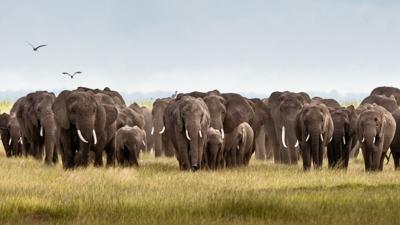
During a small-group trip to Kenya, travelers spend time with the Mara Elephant Project and mixed ranger teams. They see firsthand the elephant conservation work beyond the traditional safari elements, such as a high-end lodge stay and helicopter rides.
Budge also organizes small-group trips to Slovenia, which have a different pace from her Africa itineraries. When asked where Slovenia fits into all this, she shares the common thread is women-led conservation. "For me, it's about trying to highlight as many different female-led conservation efforts as possible," she adds.
In Slovenia, that means pairing wilderness, wellbeing and conservation insight with local female expertise. "We'll be hiking hut to hut in Triglav National Park, but we'll be walking alongside a female ranger and a biologist who are born Slovenians," Budge explains.
Across all three trips, Budge said the goal is not simply to take travelers to an unusual or remote place, but to connect them with wildlife and conservation work behind the destination.
"You can't care about something you don't know about," Budge finishes. "When you have these experiences and they make a real impression on you, then you want to give back."
Sponsored by Holly Budge. The Roam Report maintains full editorial independence. The brand did not review or approve our content before publication.

(0) comments
Welcome to the discussion.
Log In
Keep it Clean. Please avoid obscene, vulgar, lewd, racist or sexually-oriented language.
PLEASE TURN OFF YOUR CAPS LOCK.
Don't Threaten. Threats of harming another person will not be tolerated.
Be Truthful. Don't knowingly lie about anyone or anything.
Be Nice. No racism, sexism or any sort of -ism that is degrading to another person.
Be Proactive. Use the 'Report' link on each comment to let us know of abusive posts.
Share with Us. We'd love to hear eyewitness accounts, the history behind an article.