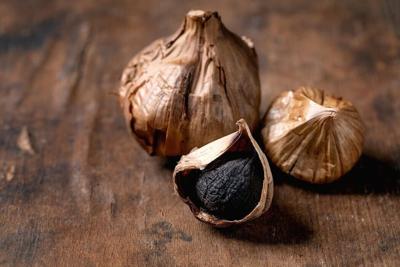
(EAST LANSING, MICH.) You may have seen black garlic appear more frequently in grocery stores, restaurants and online recipes over the past few years. Many chefs and food writers describe it as a unique and deeply flavored ingredient. So what is black garlic, and how is it made?
I noticed a growing curiosity about black garlic firsthand while presenting my food science research at a showcase at Michigan State University. Several people asked me basic questions about black garlic, like how it is made and what sets it apart from regular garlic. The ingredient’s growing popularity reflects a broader interest in foods that offer both distinctive flavor and potential health benefits.
Black garlic is not an ancient traditional food, but a recent innovation developed in Japan in the late 20th century. The process of making black garlic is often attributed to Japanese scientist Hamasuke Hamano, who spent a decade refining a method to make garlic more palatable before securing a patent in 2004.
How is black garlic made?
Black garlic is not a different type of garlic. It is made from regular garlic bulbs that have been kept under warm, humid conditions typically in specialized chambers that maintain exact heat and humidity levels for several weeks to months.
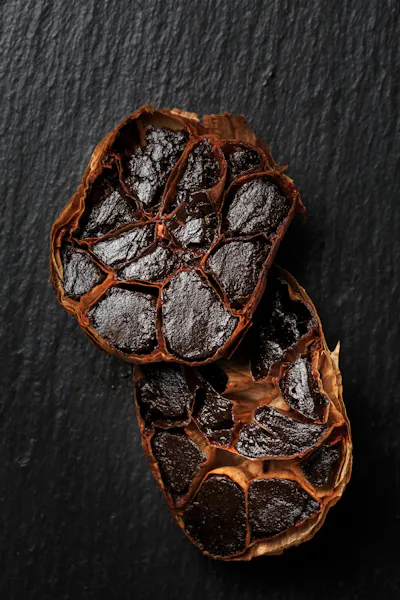
Unlike traditional fermentation, this process does not use added microorganisms. Instead, the transformation happens through a combination of heat and moisture. As the garlic is slowly heated under controlled conditions, natural chemical reactions known as Maillard reactions take place within the cloves. These reactions give black garlic its dark color and its slightly sweet, rich flavor.
Producers may use different processing times, storage temperatures and packaging materials, all of which can make the final product vary in taste and quality. Because of this variation, black garlic often doesn’t taste the same across products.
Texture and taste of black garlic
While raw garlic has a sharp, pungent taste, black garlic typically has a milder, slightly sweet taste. The underlying chemistry is complex, but the basic idea is straightforward: Heat and humidity transform both the taste and structure of garlic. These shifts in flavor happen because the compound responsible for garlic’s strong taste breaks down during the heating process. At the same time, heat-driven reactions form new compounds that contribute to a smoother and more complex flavor.
The texture also changes significantly. Instead of being firm and crisp, black garlic becomes soft and almost spreadable.
The heat and humidity break down the structure of garlic by softening its cell walls and altering its sugars and proteins. The reactions also reduce allicin: the compound responsible for garlic’s sharp and pungent flavor. At the same time, Maillard reactions between sugars and amino acids – which make up proteins – create new compounds, including brown pigments called melanoidins and a range of flavor compounds.
What is known about black garlic’s health effects?






Some studies suggest that black garlic may have higher antioxidant activity than raw garlic. Antioxidants are compounds that help neutralize unstable molecules in the body, which can damage cells over time.
Researchers have explored the effects of black garlic on metabolic and cardiovascular health, including blood sugar and cholesterol levels. Some studies report modest improvements in these markers, although the results are not always consistent.
Previous studies have suggested that compounds in black garlic may help reduce inflammation, fight harmful bacteria and even show some potential in slowing the growth of cancer cells.
These findings are promising, but they should be interpreted carefully, especially because most studies have been conducted in laboratory settings or animal models, rather than on people.
What are scientists still figuring out?
Despite growing interest, researchers still have important gaps in their understanding of black garlic. Without well-designed human trials, it is difficult to draw firm conclusions about its health effects.
Another challenge lies in the lack of standardized production methods. Because black garlic production methods vary, its composition can vary. It’s much harder for researchers to compare results across studies and identify consistent benefits. Scientists will need to conduct more research before they can make any promises about black garlic’s benefits – or lack thereof.
Black garlic is proof that a few simple tweaks in how you prepare a food can rewrite its story entirely. For now, you can appreciate black garlic as an interesting addition to your kitchen, while researchers continue to explore what it can and cannot do for your health.
This article is republished from The Conversation, a nonprofit, independent news organization bringing you facts and trustworthy analysis to help you make sense of our complex world. It was written by: Mavra Javed, Michigan State University
Read more:
- Kicking off the new year by cleansing your body with a detox diet? A dietitian unpacks the science behind these fads
- What’s behind America’s pickle craze?
- Cheesemaking is a complex science – a food chemist explains the process from milk to mozzarella
Mavra Javed does not work for, consult, own shares in or receive funding from any company or organization that would benefit from this article, and has disclosed no relevant affiliations beyond their academic appointment.


(0) comments
Welcome to the discussion.
Log In
Keep it Clean. Please avoid obscene, vulgar, lewd, racist or sexually-oriented language.
PLEASE TURN OFF YOUR CAPS LOCK.
Don't Threaten. Threats of harming another person will not be tolerated.
Be Truthful. Don't knowingly lie about anyone or anything.
Be Nice. No racism, sexism or any sort of -ism that is degrading to another person.
Be Proactive. Use the 'Report' link on each comment to let us know of abusive posts.
Share with Us. We'd love to hear eyewitness accounts, the history behind an article.