Moms who work from home earn 10% more than those who don't, reveals new research.
But dads who work from home get no significant benefit, according to the findings.
The study of 8,869 UK employees found that mothers, on average, earned more each year if they started to work from home because it allowed them to better balance work and family demands.
Johanna Pauliks, a doctoral researcher at the University of Wuppertal in Germany, conducted the first ever UK research to examine the relationship between working from home and wages.
The study compared employees who began working from home regularly between 2010 and 2019 with those who did not.
Pauliks adjusted survey data from the UK Household Longitudinal Study to rule out the influence of age, education and other factors in order to study the effect of "WFH" in isolation.
The findings, published in the journal Work, Employment and Society, showed that women earned between 9% and 12% more than women who did not work from home, depending on the research model she chose.
Pauliks said: “Mothers are the ones who benefit the most from working from home in terms of their earnings, which points to the idea that mothers have the most to gain in terms of work-life reconciliation and therefore that the productivity advantages might be beneficial for them.
“Mothers are expected to prioritize family over work."
"Therefore, mothers stand to benefit more from the productivity advantages of working from home."
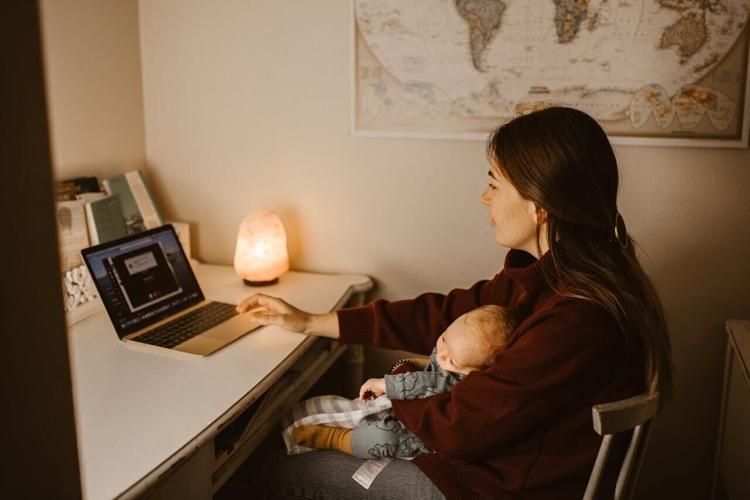
(Photo by Ketut Subiyanto via Pexels)
“Working from home allows individuals to coordinate work and other life obligations more sustainably, enabling them to work more productively, which can then shape career and job opportunities, and could therefore be positively associated with earnings.”
The findings showed that for moms, the common idea that “workers who utilise flexible working arrangements may experience discrimination from managers and co-workers because they are seen as less productive or committed to their work” was not correct.
Pauliks found no significant evidence that women overall earned more if they switched to working from home, and none that fathers, or men overall, benefited.
She added, “The article’s unique methodological approach reveals that the earning benefits of working from home are specific to mothers.”
Keep it Clean. Please avoid obscene, vulgar, lewd,
racist or sexually-oriented language. PLEASE TURN OFF YOUR CAPS LOCK. Don't Threaten. Threats of harming another
person will not be tolerated. Be Truthful. Don't knowingly lie about anyone
or anything. Be Nice. No racism, sexism or any sort of -ism
that is degrading to another person. Be Proactive. Use the 'Report' link on
each comment to let us know of abusive posts. Share with Us. We'd love to hear eyewitness
accounts, the history behind an article.












(0) comments
Welcome to the discussion.
Log In
Keep it Clean. Please avoid obscene, vulgar, lewd, racist or sexually-oriented language.
PLEASE TURN OFF YOUR CAPS LOCK.
Don't Threaten. Threats of harming another person will not be tolerated.
Be Truthful. Don't knowingly lie about anyone or anything.
Be Nice. No racism, sexism or any sort of -ism that is degrading to another person.
Be Proactive. Use the 'Report' link on each comment to let us know of abusive posts.
Share with Us. We'd love to hear eyewitness accounts, the history behind an article.