For more than 30 years, Rose Wilkins, Ph.D., has worked to help people navigate life's challenges through wellness, beginning with students facing behavioral and emotional challenges in Chicago Public Schools.
What started as a simple idea—creating calming spaces where students could de-escalate and regroup—eventually became City Blocks Wellness, an organization dedicated to community wellness.
Today, through a partnership with Alabama CEAL, Wilkins is expanding that same philosophy to community-engaged research in Selma, helping create experiences where residents can improve their health, enjoy themselves, and build relationships while having a voice in the work happening in their community.
From School Hallways to Community Wellness
Wilkins founded City Blocks Wellness after spending nearly three decades working in Chicago Public Schools, where she served in several leadership roles, including principal of an alternative learning center for students facing significant behavioral and emotional challenges.
Recognizing that many students needed more than academic support, Wilkins began creating calming spaces where they could decompress and develop coping skills. Over time, those ideas evolved into the City Blocks Wellness framework, a model focused on improving school climate while supporting students' mental, emotional and physical well-being.
After relocating closer to her Alabama roots, Wilkins adapted that model for schools across the state. Following the COVID-19 pandemic, she saw many of the same challenges she'd spent her career addressing now affecting entire families and communities. In response, City Blocks Wellness expanded beyond schools, opening its first community wellness center in Selma to provide wellness coaching, fitness classes, healthy lifestyle programming and opportunities for connection.
That mission naturally aligned with Alabama CEAL’s goal of creating sustainable, community-level change around Food is Medicine and Exercise is Medicine concepts when City Blocks Wellness became a community partner in 2024.
Today, Wilkins serves as Alabama CEAL’s regional implementation managing partner for Selma, where she creates and builds on local partnerships, coordinates partner activities, and serves on the Community Health Working Group.
More Than Delivering a Program
When Wilkins first joined Alabama CEAL, she expected another community partnership; instead, she found something different.
Rather than asking City Blocks Wellness to fit into a predetermined model, Wilkins says Alabama CEAL encouraged the organization to continue doing what it does best while working toward shared goals.
"We actually feel like a partner,” Wilkins said. “Because we feel like an extension of what is being offered as part of CEAL, we feel like we can maintain our own brand.”
The sense of ownership has also changed the way Wilkins views research. By participating in Alabama CEAL's Annual Meetings, the UAB Comprehensive Healthy Living Research Center Symposium, and other collaborative opportunities, she gained a new appreciation for what community-engaged research can look like.
Instead of viewing research as something designed by universities and carried out in communities, she began to see how community organizations could actively shape the process through shared planning, continuous dialogue, and lived experience.
"People don't feel like guinea pigs," she said. "They just realize they're having fun. And that's a key part of this process. The partnership with UAB has allowed us to do that. It's not checklists. It's more active engagement, ongoing engagement, dialogue, conversations, meetings and support as needed."
For Wilkins, having that voice means City Blocks Wellness can test ideas, identify what resonates with residents, and adjust programming based on what the community needs.
"Having that voice in a partnership, not someone just coming in and saying, 'Do these 10 things and check off when you're finished,' is really, really critical in this type of work," Wilkins said. "We're discovering different levels of support that people need... not by simply explaining it, but really showcasing different levels of activities that reinforce those concepts."






Meeting Communities Where They Are
That collaborative approach is reflected throughout City Blocks Wellness programming. Whether introducing healthy cooking, exercise classes, or opportunities for neighbors to gather over a healthy meal, every activity begins with one question: What will resonate with the community?
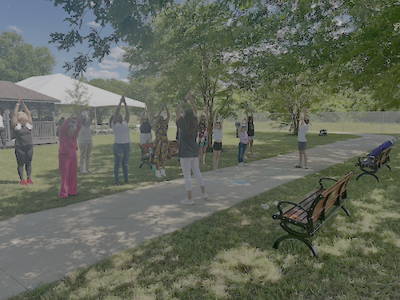
When City Blocks Wellness introduced seated yoga and Tai Chi classes, Wilkins noticed that some residents hesitated because of the names alone. Rather than focusing on unfamiliar terminology, the organization began inviting participants to "Stretch the Stress," an approach that emphasized relaxation and movement instead of the exercise itself.
"Terms and words are very important to people, and you have to know your environment," Wilkins said.
The same philosophy has shaped some of the organization's most successful community programs.
Friday Night Wind Downs began as an opportunity for residents to move their bodies and unwind after the workweek. Now, the gathering has grown into a community tradition, bringing neighbors together for activities like painting, line dancing, Zumba, and healthy meals.
"People literally ask me, 'When's the next one coming?'" Wilkins said. "We watched that go from just a social time to something that has morphed into large gatherings."
That approach has helped City Blocks Wellness reach residents across Selma. Since April 2025, the organization has participated in or hosted more than 140 community events, engaged more than 1,500 participants, and helped deliver more than 430 Alabama CEAL Food and Exercise Prescriptions for Community Health.
Wilkins credits much of that growth to the ongoing conversations between City Blocks Wellness and Alabama CEAL about what keeps residents engaged, what barriers exist, and how programming can continue evolving to meet community needs.
Nurturing Change
For Wilkins, however, the work has always been about something much bigger than programming or research. It's about helping people take the first step toward healthier lives.
She believes lasting change happens gradually. Rather than asking people to change overnight, City Blocks Wellness focuses on creating welcoming experiences that encourage residents to return again and again.
"The mindset of the people here is very slow to change," Wilkins said. "So it's been a nurturing process. That's what makes it so important; it's nurturing people into change."
Sometimes that means inviting someone to try a fitness class. Other times, it's sharing a healthy meal, introducing neighbors to one another, or simply creating a place to spend a Friday evening.
She recalls one resident telling her that Friday Night Wind Downs gave them somewhere to go on Friday evening, rather than spending the night alone at home. For Wilkins, knowing that the community seeks out and looks forward to this program, and in turn makes it their own, is the true measure of success.
In partnership with Alabama CEAL, City Blocks Wellness continues to build on its existing staff, space, and relationships in Selma while creating programs that residents have made their own. Those connections give Wilkins hope that the work taking shape today will continue to grow well into the future.
"We are in the process of creating change," she said. "But we're doing it in a manner that is non-threatening, non-intrusive, and just allowing people to enjoy themselves as they walk into change."
(0) comments
Welcome to the discussion.
Log In
Keep it Clean. Please avoid obscene, vulgar, lewd, racist or sexually-oriented language.
PLEASE TURN OFF YOUR CAPS LOCK.
Don't Threaten. Threats of harming another person will not be tolerated.
Be Truthful. Don't knowingly lie about anyone or anything.
Be Nice. No racism, sexism or any sort of -ism that is degrading to another person.
Be Proactive. Use the 'Report' link on each comment to let us know of abusive posts.
Share with Us. We'd love to hear eyewitness accounts, the history behind an article.