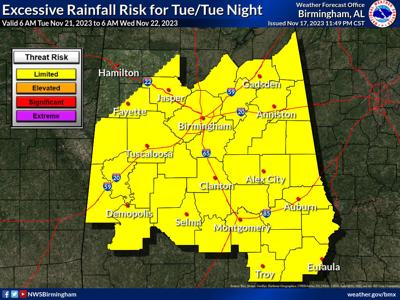

After a dry summer, we could see the “bottom fall out” in the coming months, starting this week.
WAKA Channel 8 Chief Meteorologist Shane Butler said a system is moving through Tuesday. The front should be gone for the heavy holiday travel period, but before it leaves, Butler said, “This system will present a potential for some severe weather,” including an increased potential for tornadoes.
“Thanksgiving looks good, although colder,” Butler said. “It is going to get colder behind this system. Friday looks good. There is some chance that Iron Bowl Saturday there might be a risk of showers trying to increase.”
Butler said Wednesday through Friday should be mostly sunny. Temperatures will be below average with highs in the 50s and lows in the upper 30s to around 40.
“We’re in an El Nino year, and it could be a strong one,” Butler said. “That’s going to play a factor in our weather going forward.” Butler said that could mean more storms and a higher potential for severe weather. In Alabama, we have a fall severe weather season around November and the main severe weather season from January through May.
“When you have more storms coming through, and it’s winter, if you get any arctic air,it intrudes on that, then there is the potential for wintry precipitation,” he said.
With a heightened potential of severe weather, Butler said it is important to be prepared. “It all starts by making sure your family has a plan,” Butler said. “It’s never too early to start planning and to make sure everyone knows the severe weather plan.”
Butler said the safest place to be in a home is on the lowest floor, away from windows. Put as many walls between you and the outside as possible. It is also a good idea to know where the tornado shelters are in your community if there are any. Always leave a mobile home; they are never safe in severe weather.
The No. 1 best way to be informed is a weather radio, according to Butler. Most modern weather radios will plug into the wall but also run on batteries if the power goes out. Weather radios are programmable so you can get alerts for your area and any surrounding areas you may want to monitor.
Butler said some people have problems programming these radios,but that problem can be eliminated by buying a radio with a chip like a GPS in it. “Once you turn it on, it knows your location,” he said.
The next alert system Butler recommends is phone apps. There are many on the market, and they have numerous features.
The problem with apps is the internet and cell phone systems are vulnerable during severe weather.
Tornado sirens are the last alert people should depend on. Sirens are often too far away and cannot be heard from inside the home.
Weather radio broadcast stations, on the other hand, have redundant backup and rarely will leave the air during a severe weather emergency.
“Hopefully the season will be quiet, but it’s an El Nino year, and that typically says more storms coming through,” Butler said. The good news is the rain could end the drought conditions, he said.


(0) comments
Welcome to the discussion.
Log In
Keep it Clean. Please avoid obscene, vulgar, lewd, racist or sexually-oriented language.
PLEASE TURN OFF YOUR CAPS LOCK.
Don't Threaten. Threats of harming another person will not be tolerated.
Be Truthful. Don't knowingly lie about anyone or anything.
Be Nice. No racism, sexism or any sort of -ism that is degrading to another person.
Be Proactive. Use the 'Report' link on each comment to let us know of abusive posts.
Share with Us. We'd love to hear eyewitness accounts, the history behind an article.