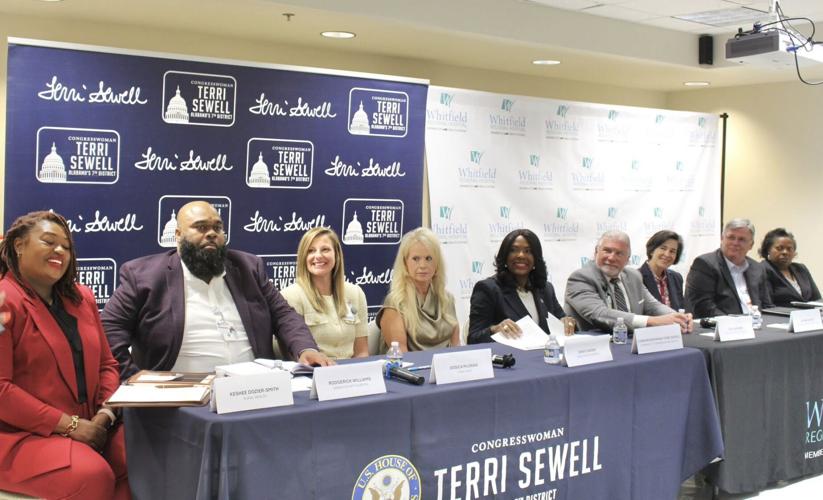

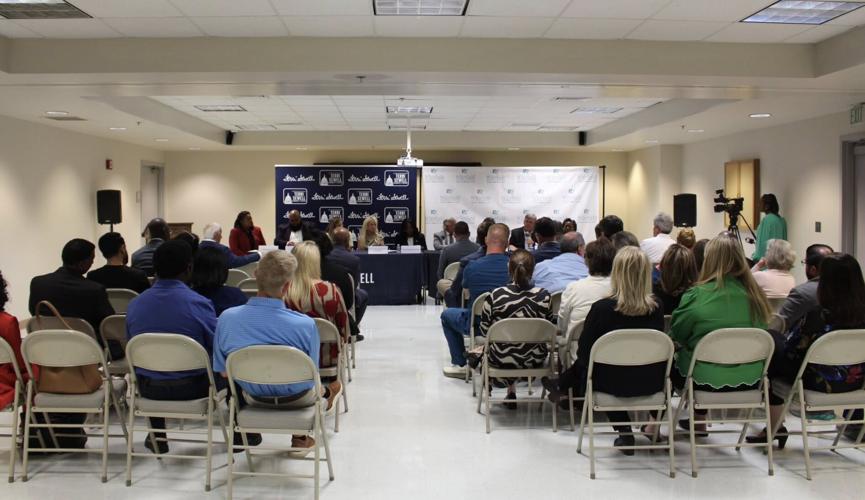
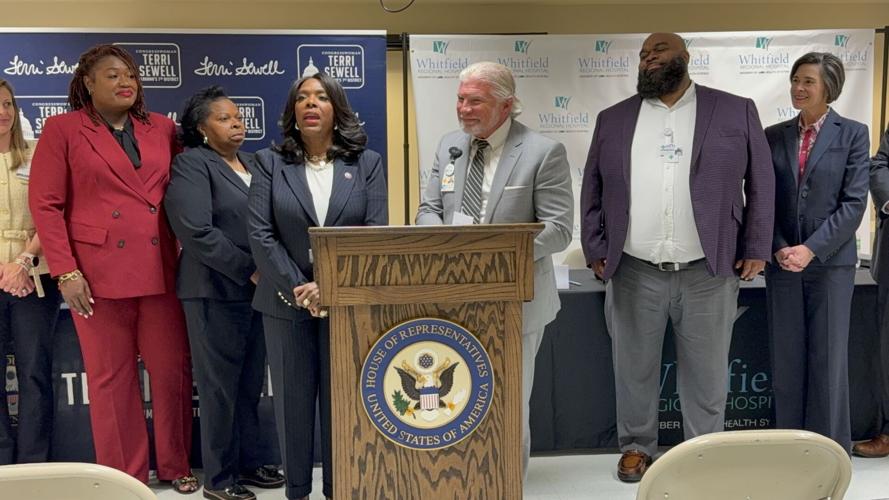
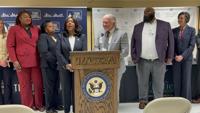
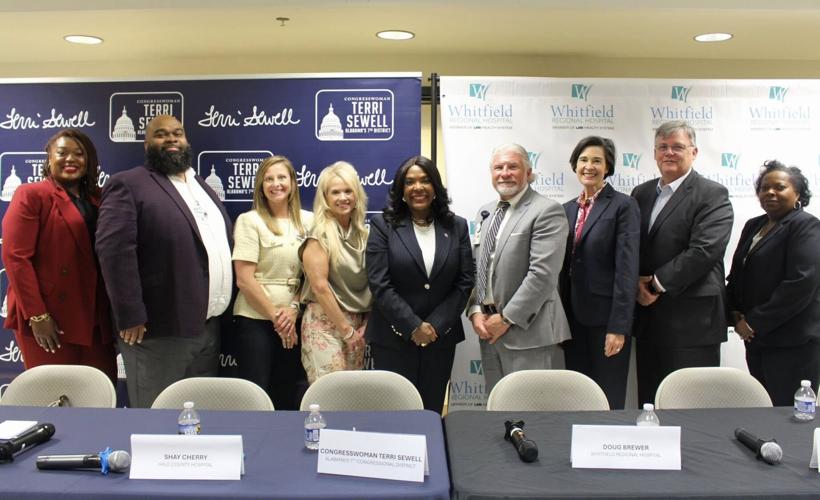

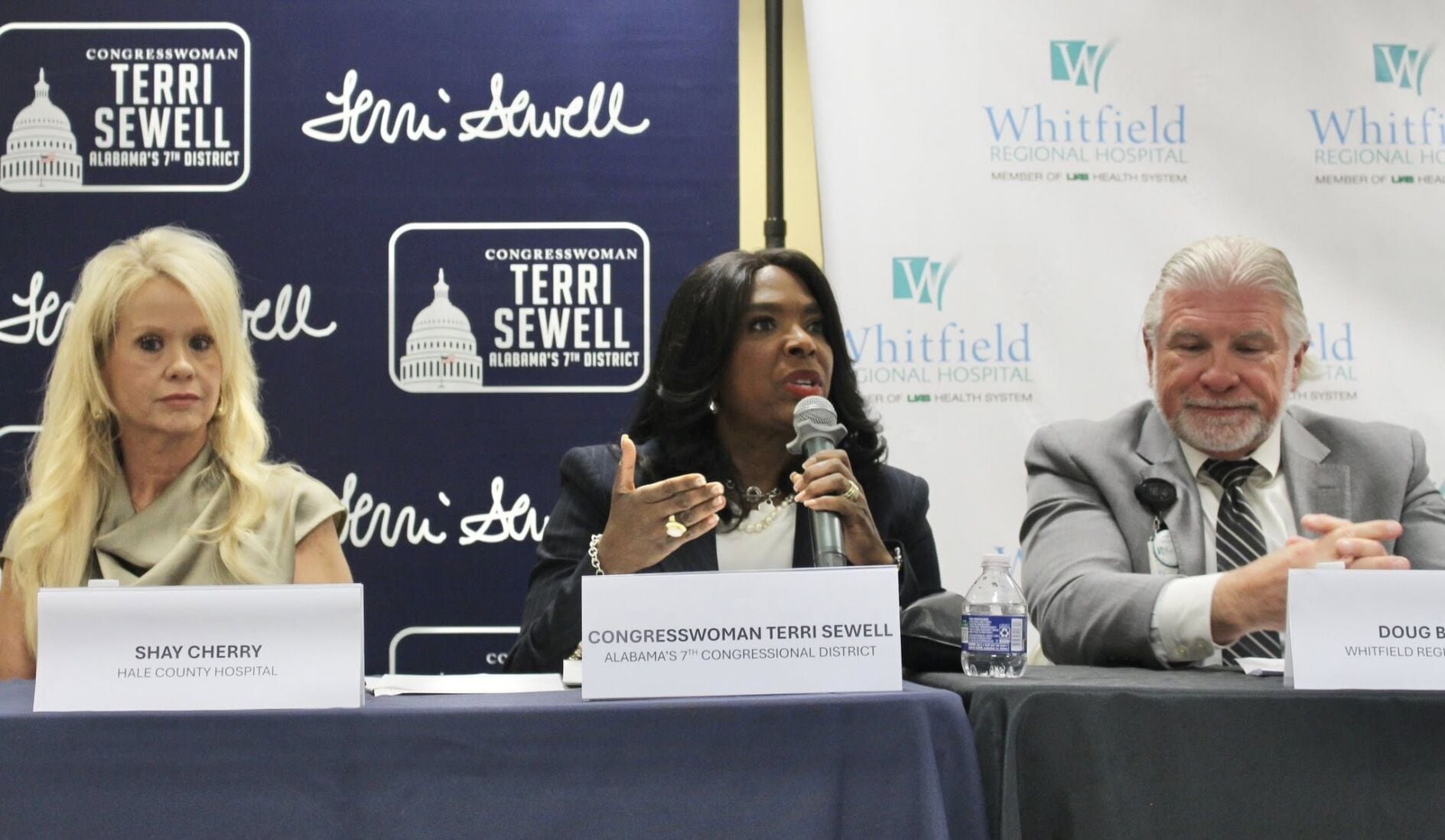


U.S. Rep. Terri Sewell convened healthcare leaders from across Alabama’s Black Belt on Wednesday for a rural health care roundtable aimed at addressing the growing challenges hospitals face in providing care to residents in some of the state’s most underserved communities.
The meeting, held at Whitfield Regional Hospital in Demopolis during National Public Health Week, brought together executives and representatives from several regional facilities, including Greene County Health System, J. Paul Jones Rural Emergency Hospital in Camden, Hill Hospital in York, Grove Hill Hospital, DCH Health System, Hale County Hospital, the Rural Medical Program in Selma and Whitfield Regional Hospital.
Sewell said the purpose of the roundtable was to hear directly from hospital leaders about the obstacles they face and how federal policy can help sustain rural health care.
“Access to quality health care should be a right for every American and not a privilege for the few,” Sewell said. “Sadly, the health care system that so many of my Alabamian constituents rely on has been under attack.”
Sewell noted that host Whitfield Regional Hospital will soon work with the new Alabama School of Healthcare Sciences that is being built in Demopolis for high school students to learn healthcare jobs and strengthen the region’s health care workforce.
The roundtable centered around hospital leaders’ shared concerns, including low Medicare reimbursement rates, rising uncompensated care and the difficulty of maintaining specialized services in rural areas.
Sewell said one major issue is the Medicare wage index, which determines how much hospitals are reimbursed for services. She said Alabama hospitals are paid significantly less than hospitals in other states for the same procedures.
“An appendix operation is an appendix operation whether it’s in Massachusetts or Alabama,” Sewell said. “Yet hospitals in Alabama are reimbursed at a far lower rate, and that makes it extremely difficult for rural hospitals to keep their doors open.”
To address that disparity, Sewell said she recently reintroduced the Save Struggling Hospitals Act legislation designed to reform the Medicare wage index and ensure fairer reimbursement rates for rural providers.
She also highlighted the recent passage of the Nancy Gardner Sewell Multi-Cancer Early Detection Act, named after her mother. The bipartisan legislation accelerates Medicare coverage for new blood tests capable of screening for dozens of cancers once they receive approval from the U.S. Food and Drug Administration.







Currently, Sewell said, those tests are expensive and largely available only to wealthy patients. The bill would make them available to Medicare beneficiaries much sooner.
“We know cancer affects all of us in one way or another,” Sewell said. “Having the ability to screen for up to 40 cancers with one vial of blood is truly amazing.”
Another topic discussed was the closure of obstetrics units in many rural hospitals, often one of the first services cut when facilities face financial strain. Sewell said that trend contributes to Alabama’s high maternal mortality rate, forcing some mothers to travel long distances for care.
“At a time when maternal mortality rates in Alabama are skyrocketing, having to drive an hour and a half to have a baby is not ideal,” she said.
The group also discussed a rural hospital transformation fund created by Congress last year that will bring more than $200 million to Alabama to support struggling facilities. Sewell said state officials are still developing guidelines for distributing those funds, which will be administered through the Alabama Department of Economic and Community Affairs.
Brewer said the opportunity to speak directly with Sewell about those issues is critical for hospital leaders trying to sustain services in rural communities.
“We are incredibly blessed to get to do the work that we do,” Brewer said. “The people we see in our hospitals are those most in need in our country.”
But he said hospitals throughout the region face constant financial pressure, and they appreciate the opportunity to meet with a member of Congress like Sewell to share concerns.
“Every one of us struggles every day to continue to fight to provide that care to the patients in our region,” Brewer said. “It’s a payroll weekend, and we’re all making sure we make payroll.”
(0) comments
Welcome to the discussion.
Log In
Keep it Clean. Please avoid obscene, vulgar, lewd, racist or sexually-oriented language.
PLEASE TURN OFF YOUR CAPS LOCK.
Don't Threaten. Threats of harming another person will not be tolerated.
Be Truthful. Don't knowingly lie about anyone or anything.
Be Nice. No racism, sexism or any sort of -ism that is degrading to another person.
Be Proactive. Use the 'Report' link on each comment to let us know of abusive posts.
Share with Us. We'd love to hear eyewitness accounts, the history behind an article.