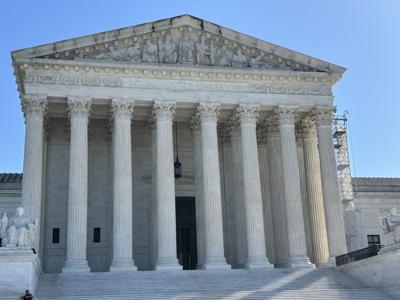
The U.S. Supreme Court’s request to the parties in a Louisiana redistricting case could affect Alabama’s similar, long-running battle over congressional boundaries.
In an order issued Friday, the justices asked parties to address whether the state’s creation of a second majority-Black congressional district violated the Fourteenth or Fifteenth Amendments of the U.S. Constitution, which provide for congressional representation and due process and forbid the denial of the vote based on race.
Experts say the move could signal that the U.S. Supreme Court is looking to overturn Section 2 of the 1965 Voting Rights Act, which forbids election laws that discriminate based on race, color or membership in language minority groups.
A lower federal court in 2023 ordered Alabama to draw a second “opportunity” district for Black voters after ruling that Alabama’s racially polarized voting patterns — where white voters tend to support Republicans and Black voters tend to support Democrats — meant a map approved by the Republican-dominated Legislature in 2021 did not give Black voters a chance to choose their preferred leaders.
The court’s ruling in the case, known as Allen v. Milligan, leaned in large part on Section 2 of the law, and Jason Mazzone, a professor of law at the University of Illinois Urbana-Champaign, wrote in a n email that the Supreme Court’s order for supplemental briefing was “a very big deal.”
“The case might result in the Court invalidating entirely Section 2 of the VRA on the basis that the Constitution is color blind and it bars race-conscious districting, including when mandated by Congress to remedy historical racial discrimination in voting,” Mazzone wrote. “Such a result would represent a massive change in election laws and practices with seismic consequences for democratic processes at every level of government.”
The Louisiana case, Louisiana v. Callais, stems from a map drawn by the state legislature that created a second majority-minority district to comply with the Voting Rights Act. The map was subsequently challenged as an unconstitutional racial gerrymander by a group of non-Black voters.
The Milligan plaintiffs sued Alabama shortly after the Legislature approved a new congressional map in 2021. A three-judge panel ruled for the plaintiffs in early 2022, but the U.S. Supreme Court stayed the lower court’s original ruling. The court upheld it in 2023, which led to a special session of the Alabama Legislature that July. Legislators approved a map that House Speaker Nathaniel Ledbetter, R-Rainsville, signaled was an attempt to get the case back before the U.S. Supreme Court. The lower court rejected the map and the nation’s high court upheld that ruling on appeal. The court later had a special master draw a new congressional map for the state.





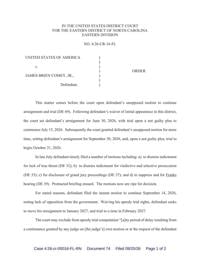
Under the map, Alabama in 2024 elected two Black U.S. representatives to serve together for the first time in state history.
Following a trial earlier this year, the panel in May ruled that the Alabama Legislature intentionally discriminated against Black voters in approving the map in the July 2023 special session. The court is currently considering sanctions for the state, which could include requiring any future maps to win approval from the court, a process known as preclearance.
Deuel Ross, a lawyer with the Legal Defense Fund who represents plaintiffs in Alabama’s redistricting case, offered a more cautious view in an interview on Monday. Ross noted that the court had the U.S. Supreme Court had a chance to invalidate Section 2 of the VRA in the Milligan case two years ago, but chose not to.
“Just two years ago, a majority of the Supreme Court in Milligan expressly agreed that the Voting Rights Act is constitutional,” Ross said.
Ross said the Supreme Court’s request for briefs “doesn’t necessarily mean that the justices are looking to strike down the Voting Rights Act.”
“They’re asking about a particular district in this specific Louisiana map,” Ross said.
This story is from alabamareflector.com.
(0) comments
Welcome to the discussion.
Log In
Keep it Clean. Please avoid obscene, vulgar, lewd, racist or sexually-oriented language.
PLEASE TURN OFF YOUR CAPS LOCK.
Don't Threaten. Threats of harming another person will not be tolerated.
Be Truthful. Don't knowingly lie about anyone or anything.
Be Nice. No racism, sexism or any sort of -ism that is degrading to another person.
Be Proactive. Use the 'Report' link on each comment to let us know of abusive posts.
Share with Us. We'd love to hear eyewitness accounts, the history behind an article.