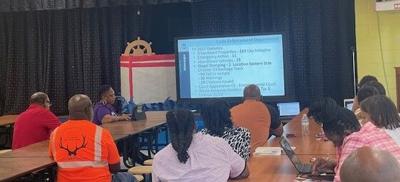

Selma Mayor James Perkins Jr. has kicked off five public meetings to make his case for a property tax increase and to introduce his proposed budget for the fiscal year that starts Oct. 1.
Perkins pitched the idea of raising property taxes and reducing the impact of the increase by having the city take over garbage collection last year. He renewed his call for increased property taxes at the first of five public meetings last week.
Perkins told a small crowd at a meeting at Payne Elementary that the city needs more money to do its job, and increasing the city property tax from 27 mills to 48 mills is the best way to do it.
Any property tax increase would require a vote of the public, and the Selma City Council would have to vote to put the proposal in front of the public in a citywide referendum.
This year’s city budget included $100,000 to pay for a citywide referendum to vote on increasing the property tax, but the City Council removed it, with the understanding that it could be added back if the vote takes place. Perkins told the Selma Sun after his public meeting that the council’s vote to remove funding for the referendum gave him “some indication of (the council’s) mindset” toward the referendum.
“There are not sufficient funds the way it’s going,” Perkins said at the meeting. “You cannot run municipal government or your house with a pre-COVID budget.”
He told the Selma Sun after the meeting that the city must approve a tax increase this year because even if voters approve it, it can’t take effect until the fiscal year that begins Oct. 1, 2026.
Selma’s property tax rate of 27 mills is “substantially lower than the communities we want to be like,” Perkins said at the meeting. “These communities decided to pay for what they want. As long as we want to keep it cheap, we’re going to look cheap.”
Perkins distributed a chart that he said shows the impact increasing property taxes from 27 mills to 48 mills would have on property in the city. Here’s what the increased city tax increase would look like for property valued at $50,000, $100,000, $150,000 and $200,000.
Assessed | Assessed | Property Tax at 0.027 millage rate | Assessed Value at 0.048 millage rate | Property Tax at 0.048 millage rate | Difference |
$50,000 | $1,350 | $135 | $2,400 | $240 | $105 |
$100,000 | $2,700 | $270 | $4,800 | $480 | $210 |
$150,000 | $4,050 | $405 | $7,200 | $720 | $315 |
$200,000 | $5,400 | $540 | $9,600 | $960 | $420 |
If garbage collection is taken over by the city, property owners would save $240 a year in garbage fees, reducing the impact of the property tax increase, Perkins said.
Perkins also proposed redistributing tax money among the three funds that make up city taxes. Currently, 29% of the city’s collected property tax goes to the city’s general fund, 44% goes to the City School Board and 27% goes to the bond fund. If property taxes went up to 48 mills, Perkins proposes allocating 33% to the general fund, 40% to the School Board fund and 27% to the bond fund.
About 75% of the city’s residents who live in low-value housing would come out ahead even with a property tax increase if the city takes over the garbage service because they wouldn’t have to pay Martin Environmental to pick up their garbage, Perkins said. He acknowledged that residents who live in more valuable homes would pay more overall because their increased property tax would be more than what they would save by not paying for garbage pickup.
Perkins said the city would have to lease three trucks and hire between six and nine employees to take over garbage pickup. He said that garbage service was a money maker when the city ran it in the past, and the city would be cleaner because Martin Environmental, the private company that inherited the city garbage pickup service, is struggling.
Perkins presented a synopsis of the budget he plans to present to the Selma City Council for their approval. The city is projected to have $25.2 million in revenue, but that includes moving $3 million into the general fund from cash reserves, Perkins said. Expenses are projected at $23.6 million, leaving a surplus of $1.6 million.
A little more than 10% of the budget, or $2.4 million a year and $188,000 a month, will go to long-term debt service. Now that the city has reestablished its credit rating, the city can refinance the high-interest warrant (similar to a bond) “and get this albatross from around our neck,” Perkins said.
The city lost its bond rating in 2019 because it did not complete the required audits.




More than 38% of the proposed budget is devoted to public safety, with the Police Department budgeted for $4.4 million, the Fire Department budgeted for $3.9 million and other funds going to E-911 and Police Department Cops Grants.
The proposed budget includes $3.1 million, or 13% of the total budget, for the Public Works Department.
Other budget meetings will be held:
July 11, 5:30 p.m.
Sophia P. Kingston Elementary School Library
2224 Selma Ave.
July 16, 5:30 p.m.
Meadowview Elementary School Library
1816 Old Orrville Road
July 25, 5:30 p.m.
McRae-Gaines Learning Center
1101 Woodrow Ave.
July 30, 5:30 p.m.
Carl C. Morgan Convention Center
211 Washington St.
Light refreshments will be served.

(0) comments
Welcome to the discussion.
Log In
Keep it Clean. Please avoid obscene, vulgar, lewd, racist or sexually-oriented language.
PLEASE TURN OFF YOUR CAPS LOCK.
Don't Threaten. Threats of harming another person will not be tolerated.
Be Truthful. Don't knowingly lie about anyone or anything.
Be Nice. No racism, sexism or any sort of -ism that is degrading to another person.
Be Proactive. Use the 'Report' link on each comment to let us know of abusive posts.
Share with Us. We'd love to hear eyewitness accounts, the history behind an article.