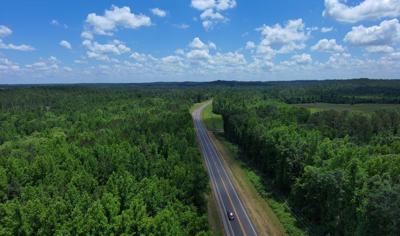
State officials today plan to sell $730 million in bonds to help finance a major highway project in West Alabama.
The state plans to use a significant portion of its revenue from the 2019 gas tax increase to pay down the bond debt over about two decades, to the frustration of some state lawmakers who question pledging so much of the money to one project.
The bond sale was reported by the publication Bond Buyer and confirmed by the Alabama Department of Finance on Wednesday.
“The Alabama Highway Authority will secure funding to finance the planning, design, and construction of the West Alabama Corridor project, which is widening the existing two-lane highway to a four-lane highway from Thomasville to Moundville, Alabama,” the finance department said to Alabama Daily News is response to questions about the bond sale and plans to repay the funds and how much of the gas tax revenue would be committed to the project. “This project will complete a roughly 200-mile four-lane corridor connecting Mobile and Tuscaloosa.”
The project was announced by Gov. Kay Ivey in 2021 and is a priority for her administration. Four-laning portions of U.S. Highway 43 and State Route 69 will create economic development opportunities and ease congestion on I-65, her administration has argued.
“This expansion advances one of the state’s primary transportation objectives: ensuring four-lane access to an interstate for counties currently lacking such access, thereby strengthening the state’s economic development efforts, and supporting infrastructure capacity necessary for growth,” finance’s statement said.
The project has been divided into more than a dozen segments and several are well underway.
Unlike most state road projects that are 80% federally funded with a 20% state match, no federal funds are being used in the West Alabama Corridor. The funding is sourced wholly from revenue collected under the state gas tax increase.
The law phased in the 10-cent increase over two years. It also allows the tax to be adjusted up or down with the National Highway Construction Cost Index, with increases up to a penny every two years. Those increases happened in October 2023 and July of this year, bringing the tax increase to 12 cents per gallon.
The Rebuild Alabama fuel tax proceeds have gone from $203.8 million in 2020 to $405.8 in 2025, according to state data.
Cities and counties get a portion of the net revenue: 25% for counties and 8.33% for municipalities.
From there, there are other demands on the state’s 66.67%: At least $10 million in annual grants to cities and counties; at least $30 million for the annual ATRIP-II Program; and an additional $26.8 million per year to counties.
In 2025, the state had $173.9 million in gas tax revenue after meeting the above obligations, according to bond documents.






The act allows for 50% of the state’s projected revenue from the tax increase to be committed to bond debt. Finance Department officials have said Rebuild Alabama was designed to provide additional funds for economic development projects like the West Alabama Corridor.
“Debt service for this project is expected to account for less than 25% of total ALDOT Rebuild receipts,” finance’s statement said. “To support large projects, the Rebuild Alabama Act allows for borrowing against no more than 50% of total ALDOT receipts. Following this bond issuance, we expect that more than half of the authorized bonding capacity will remain available for future needs.”
But some state lawmakers are taking issue with committing that much of the revenue to a single project when there are capital needs all over the state.
“This isn’t what I voted for,” Elliott told ADN said about the 2019 legislation and this project that is 100% state funded.
“Rebuild Alabama was so transformational, but if you blow most of the money on one project to hurry it, when that money could have been leveraged against federal resources to do five times as much road work, that’s a tremendous opportunity cost.”
“…(This bond issue) is going to end up putting her projects around the state in jeopardy, whether it’s the Northern Beltline or the I-10 bridge, major, huge projects that have big capital requirements. This just strikes me as irresponsible.”
The Alabama Department of Transportation has previously said federal funds are not unlimited. The use of them on the west Alabama project would mean less available money for other projects in the state and lead to the cancellation of some planned projects.
Elliott noted that he does see blue signs around the state noting Rebuild Alabama Act funded projects, but many of them are resurfacing projects, not new roads.
House Speaker Pro Tem Chris Pringle, R-Mobile, in October said he expects the next governor of Alabama “to shut that project down.”
On Wednesday, Pringle said he’s also concerned that once complete, maintaining and resurfacing the highway will be the state’s burden because the project doesn’t have the federal permits required to get federal funds.
He said the Ivey administration is trying to fast-track the project while she’s still in office to ensure the state’s commitment to it before her term expires in January 2027.
“They’re going to max out the credit card on the way out the door in the next year,” Pringle said.

(0) comments
Welcome to the discussion.
Log In
Keep it Clean. Please avoid obscene, vulgar, lewd, racist or sexually-oriented language.
PLEASE TURN OFF YOUR CAPS LOCK.
Don't Threaten. Threats of harming another person will not be tolerated.
Be Truthful. Don't knowingly lie about anyone or anything.
Be Nice. No racism, sexism or any sort of -ism that is degrading to another person.
Be Proactive. Use the 'Report' link on each comment to let us know of abusive posts.
Share with Us. We'd love to hear eyewitness accounts, the history behind an article.