


On Jan. 16, attorneys from the Alabama Education Association, led by AEA Associate Executive Director Theron Stokes and with support from the Alabama School Board Association, held a press conference in front of the judicial center to announce the filing of a lawsuit against the Phenix City Board of Education.
The plaintiffs in the lawsuit, Civil Action No. CU-25-002, are Dr. Susan Williams Brown, who is president of the Alabama Education Association Board; Barbara Chapman, president of the Phenix City Education Support Professionals, and Russell County resident Leroy Davis.
The lawsuit alleges that PCBoE members Dr. Keanthony Brooks, Brady Baird, Jonathan Taylor, Elliot Patrick, President Yolaunda Daniel, Katrina Collier-Long, and Florence Bellamy, who are elected officials, willfully violated the Alabama Open Meetings Act (AOMA) during the Dec. 16, 2024 meeting, and the Jan. 9, 2025, meeting and that the PCBoE “developed and pursued a pattern and practice of violating the Act on multiple occasions....” The lawsuit includes a request for a temporary restraining order, as well as preliminary and permanent equitable relief.
Attorneys for both sides appeared before Judge Zach Collins last week to come to an agreement. According to the AEA, after hours of discussion, the PCBoE refused to acknowledge wrongdoing or agree to the proposed terms; a hearing has been scheduled for March 10 at 1 p.m. ET. A copy of the filing is available on the newspaper’s website, www.citizenofeastalabama.com, in PDF format.
Dr. Susan Williams Brown:As president of the AEA board, Brown is representing the interests of the AEA. The AEA is a membership organization made up of Alabama public education employees, whose members are affected by actions taken by local school boards, including the Phenix City Board of Education. The AEA also serves as a media organization since it publishes the “Alabama School Journal” that covers K-12 education across our state monthly, except for when the Alabama Legislature is in session, during which time it publishes bi-monthly. To best advocate for its members at the public-at-large, the AEA requires to know what matters school boards will discuss and vote on in advance.
Leroy Davis, a Russell County resident is suing on an individual basis in interest grandchildren who attend Phenix City schools.
Barbara Chapman is president of the Phenix City Education Support Professionals and a public education employee with Phenix City Schools. She needs to know what matters will be discussed at the PCBoE meetings in advance to best serve the interest of PCESP members as well as the public.
July 1, 2024, called meeting
The board gave notice of a meeting in June that would occur on July 1, 2024. Among the topics to be discussed, listed on the agenda, was the contract of PCS Superintendent Dr. Janet Sherrod, whose contract began June 1, 2023, and was not up for renewal until June 30, 2026. Many PCS employees and members of the public showed up at the meeting in support of the superintendent and in opposition of her termination, though the PCBoE did not publicly say anything about possibly terminating the superintendent.





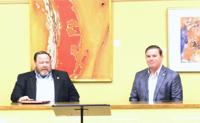
The Citizen, present at that meeting, noted that when it came time to discuss the contract at the July 1 “called” meeting, the board members and Sherrod went into executive session, along with attorney Bob Meadows. When they came out of the session, the board announced that Sherrod’s contract would continue. Under the Alabama Open Meetings Act, a superintendent’s contract, nor their job performance, can be taken into executive session but must be discussed publicly for transparency. The board did not hold a public discussion of Sherrod’s contract, nor did it hold a public discussion about why board members were dissatisfied with her performance. At the meeting, the board displayed the superintendent’s evaluation, which had a score of two (needs improvement) in every category, with only brief and vague comments from the board. A public discussion regarding Sherrod’s contract and job performance was not held as required under the Act, so how did the board come to the decision to extend the superintendent’s contract? It was also noted that Dr. Sherrod went into the executive session with the board, but her attorney, who was present at the meeting, did not go into the executive session
Dec. 16 , 2024, “called” meeting
Another meeting was called on Dec. 16, a day before the scheduled work session. A preliminary agenda was posted for that meeting with an executive session for “legal matters,” but did not give any detail to the nature of those legal matters. No other items were on the agenda.
Board members, with their attorney, went into executive session without any public discussion. More than 60 concerned citizens showed up at that meeting to show support for the Superintendent with the belief that the board wanted to terminate her contract. The filing states: “On information and belief, among the matters discussed in executive session on Dec. 16, 2024, was the potential termination of Superintendent Dr. Sherrod’s contract;” also, that the discussion was planned in advance and before preparation and public posting of the agenda, knowing that the preliminary agenda was the actual agenda without notifying the public, the media, or the plaintiffs.”
Jan. 9, 2025 “called” meeting
At the Jan. 9 meeting, the board went into executive session for legal matters, but did not disclose to what those legal matters pertained. In the filing, Paragraph 12, it states: “On information and belief, among the matters discussed in executive session on January 9, 2025, was the potential termination of Superintendent Dr. Janet Sherrod’s contract. On information and belief, this was planned in advance, before preparation and public posting of the agenda. Defendants knew that was the actual agenda, but Defendants did not tell that to the public or news media or to the plaintiffs.” The filing also states that the superintendent was not responsible for information placed on the agenda for the Dec. 16 and Jan. 9 meetings.
The Violations
The filing states, in summary, that the board and its defendants intentionally disregarded AOMA requirements for proper notice by failing to give proper description of matters on the agendas for the above meetings; also, by voting to go into executive session without disclosing anything about the topic to be discussed in that session. The AOMA is for governmental transparency to the public, and multi-member boards must act openly and publicly with advance notice. Not only must the board give proper and timely notice of its meetings and agendas, it must also disclose about what it is meeting. From the filing: “The purpose of such a (executive) session is not to hide from the public and the news media what matters are being discussed; any deliberation, as opposed to strictly attorney-client discussions, must be public.”

(0) comments
Welcome to the discussion.
Log In
Keep it Clean. Please avoid obscene, vulgar, lewd, racist or sexually-oriented language.
PLEASE TURN OFF YOUR CAPS LOCK.
Don't Threaten. Threats of harming another person will not be tolerated.
Be Truthful. Don't knowingly lie about anyone or anything.
Be Nice. No racism, sexism or any sort of -ism that is degrading to another person.
Be Proactive. Use the 'Report' link on each comment to let us know of abusive posts.
Share with Us. We'd love to hear eyewitness accounts, the history behind an article.