
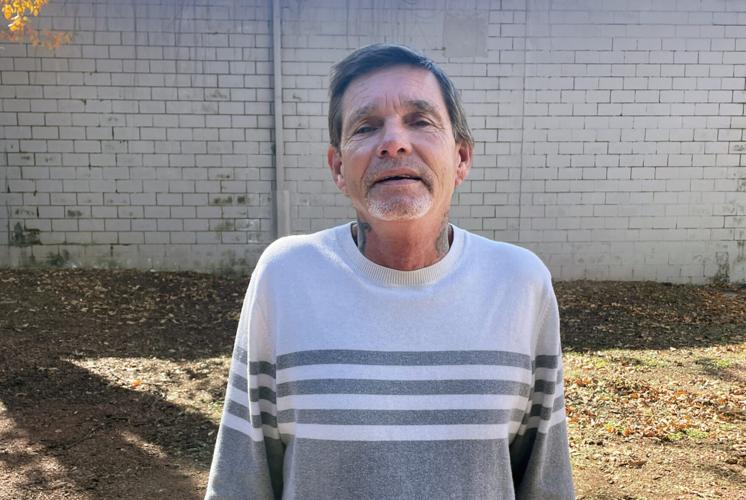

Mark Miller worked a dangerous job for more than four decades, but he said he’d never gotten hurt at work until his employment with an automotive supplier in Montgomery.
In two years with the company, he broke his hand and four ribs in two separate accidents. Miller said he received no safety training before being charged with running production lines for vehicle consoles and dash components, and employees were constantly dodging forklifts whizzing by at full speed, carrying parts from trucks to assembly lines.
“You was on your alert at all times,” said Miller, who worked at the facility from 2022 to 2024.“I was trained maybe 10 minutes on the job, and I was told to do it and go as fast as I could go.”
As bad as these conditions were, Miller — at the time one of thousands of incarcerated people that private companies employ in Alabama — said quitting would have meant facing greater risks in a higher security facility within the state’s notoriously dangerous prison system.
“So I had no choice in the matter,” he said.
The limited options Miller and other incarcerated workers face could be suppressing wages and increasing safety risks throughout the automotive-supply industry in areas — including Montgomery — where suppliers make use of prison labor. That’s the conclusion of a study the Columbia University Labor Lab released Nov. 6.
“Even when you just look at the free-world workers, the non-incarcerated workers, we find that the plants that are using a higher share of incarcerated workers have worse wages, worse working conditions,” Suresh Naidu, an economics professor at Columbia University and one of four study authors, said at a Nov. 6 press conference during which Miller also spoke.
Focus on Hyundai supply chain
Hyundai and other major manufacturers don’t use prison labor in their own facilities in any meaningful way, said Aaron Sojourner, a senior economist at the W.E. Upjohn Institute for Employment Research. “It’s too reputationally risky for the brand,” he said.
The study instead centers on Hyundai suppliers in Alabama, companies that provide the automaker with parts for vehicle construction.
Through the Alabama Department of Corrections’ work-release program, prisoners are housed in minimum-security facilities and work, without officer supervision and in plain clothes, alongside free employees for private companies. They also work for public agencies. Auto suppliers employ many people in the work-release program, which is being challenged in court through state and federal lawsuits after a 2022 change to Alabama’s Constitution that banned “involuntary servitude.”
In addition to working for auto-parts suppliers, incarcerated people work in a range of industries, including general manufacturing, lumber, fast food, meat processing and other food processing/distribution, according to the federal lawsuit and public records reviewed by the Alabama Reflector. Incarcerated people also work for city, county and state agencies, including the Alabama Department of Transportation, the city of Montgomery and Jefferson County, according to the federal lawsuit.
The study connects prison labor to low pay among Alabama’s Hyundai suppliers.
The study correlates a 10% increase in the proportion of incarcerated workers at a plant with a 10% to 14% drop in wages for free workers.
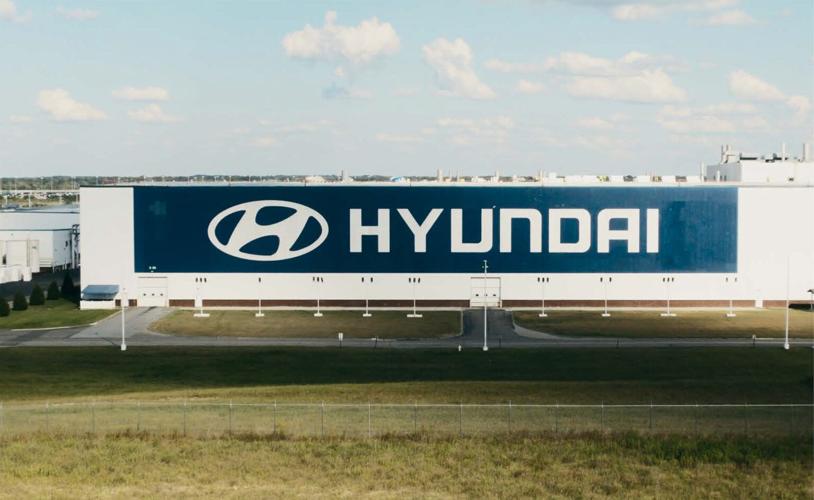
Hyundai Motor Manufacturing Alabama’s plant, which produces around 360,000 vehicles annually, has been operating since 2005. With 4,500 workers, the plant is Montgomery’s largest manufacturing employer and is one of only two plants in the United States where Hyundai vehicles are assembled. The other opened in Georgia late last year.
Hyundai’s supply chain is concentrated in the Montgomery area, and its suppliers employ another 6,000 people nearby, according to the study. Multiple facilities that house work-release inmates also are in this part of the state.
According to the study, wages for workers in the entire auto-supply sector in the Montgomery area are 7% to 9% below expectations, based on wages in nearby regions.
Hyundai Motor Manufacturing Alabama did not respond to specific questions from the Alabama Reflector, but public relations manager Scott Posey provided a statement saying the company is aware some suppliers previously participated in Alabama’s work-release program.
“However, Hyundai was not involved in any supplier’s decision to participate in such program,” the statement reads. “Consistent with the standards and values to which we hold ourselves as a company, we mandate that our suppliers and business partners strictly adhere to the law, and we have an established track record of taking action when alleged violations occur.”
Posey also pointed to Hyundai’s supplier and business partner codes of conduct, both of which have sections on forced labor.
“HMMA expects Business Partners to support HMMA’s commitment to ensuring that no products entering its supply chain are mined, produced, or manufactured, in whole or in part, with forced, imprisoned, indentured, or indentured child labor (collectively, “forced labor”), by preventing the use of forced labor within their own operations and undertaking measures to ensure that forced labor is not used within their supply chains,” states the business partner code of conduct, which includes suppliers in its definition of business partners.
Still, advocates contend suppliers are still employing Alabama prisoners through the work-release program.
Effects of prison labor on all workers’ wages, working conditions
Study authors explained how prison labor can push down wages and negatively impact working conditions for all employees in a facility or entire industry sector.
When workers feel they can’t leave a job, this gives employers power to keep wages low, they said. Using surveys of more than 600 auto-supplier workers in Alabama — 13% of them incarcerated — researchers found that incarcerated workers were less likely than others to quit their jobs based on hypothetical wage decreases and felt less freedom in general to leave their employment.
Jobs to Move America has been investigating prison labor in the auto-supply chain for years, and staff conducted worker surveys used in the Columbia study between August and December 2024, primarily through in-person visits to manufacturing plants.
Alabama’s work-release program participants typically receive only a third of wages their employers pay. The state takes 40% of their gross earnings and also deducts fees for things like transportation and laundry.






And workers don’t choose their jobs in the first place. Job-placement officers at work-release facilities and community work centers where they’re housed make those decisions.
“I was put there,” Miller said of his assignments to two Montgomery-area plants operated by the same Hyundai supplier. He said he was told, “if I couldn’t do my job, that they’d just call the camp and report it, and then the camp would write me up if I didn’t do it, and probably send me back to one of the dangerous prisons.”
In a lawsuit the U.S. Justice Department filed against ADOC in 2020, the department said its investigation into the state’s prisons for men found use of excessive force by guards, failure to protect inmates from violence, overcrowding, understaffing and other conditions that amounted to cruel and unusual punishment in violation of inmates’ Eighth Amendment rights. The litigation is ongoing, and ADOC public information manager Kelly Windham Betts said the department can’t comment on it for that reason.
By contrast, work-release facilities are often safer.
An ADOC regulation requires employers to pay for inmate labor in the same manner as for any other employee, which means they must pay the same wage for similar work. Because of this — and because surveys showed free workers in the Montgomery area also felt compelled, to a higher-than-average degree, to stay in their jobs — study authors said prison labor is a factor that explains lower wages for all auto-supplier workers in the Montgomery area.
“Since the free-world workers also find it hard to quit, and the suppliers and the plants that use incarcerated labor have access to this additional pool of workers that have an even harder time quitting, employers can profitably lower wages for both free and incarcerated workers,” Naidu said.
Some of the same dynamics also could be affecting safety and other working conditions, according to the study.
The ADOC regulation states employers must comply with the Fair Labor Standards Act and incarcerated workers can’t be used as strikebreakers, but the Columbia study points out those on work release aren’t allowed to join labor unions.
Job-placement officers within ADOC’s work-release program monitor working conditions for people in the program and handle any complaints, Betts wrote in an email. “Work release programs are instrumental to the success of inmates preparing for release back into the community,” she continued.
Study authors also note reports that Hyundai suppliers have used child and migrant workers, according to reporting by Reuters and the New York Times and a lawsuit, “for whom similarly coercive dynamics likely apply, and which similarly drive down wages and working conditions for all.”
Possible solutions
In an academic working paper related to the study, the same authors report creating a model to determine how four potential changes could affect both incarcerated and free workers.
They conclude all four changes — reforming prison conditions to eliminate violence, eliminating prison labor wage garnishment, imposing a $15 minimum wage, and abolishing prison labor — would improve welfare of free workers while only the first three would positively affect incarcerated workers. Ending prison labor would have negative consequences for those who are incarcerated, the authors write.
Will Tucker, Southern director for Jobs to Move America, said his ideal solution would be to release, through parole or other means, all participants in the work-release program.
“They are quote-unquote safe enough to be released into the free world to work an 8-hour, 10-hour shift, and yet they’re not safe enough to just go home to their families,” he said. “That’s absurd. They should just be freed. And for a state that has a massive overcrowding problem in their prisons, it’s a solution that’s right there in front of them.”
In the meantime, cutting contracts with private employers and sending people back into dangerous prisons isn’t the right thing to do, he continued.
Companies that are benefiting from the work-release program have a role to play as well, he said.
Jobs to Move America filed a lawsuit in California on Nov. 13 against Hyundai and Kia alleging the automakers falsely certified compliance with that state’s “high-road” labor standards while profiting from suppliers in the U.S. South that have used child and prison labor.
A long history

Mark Miller said he was injured while working for a Hyundai supplier through a work release program. (Courtesy Jobs to Move America)
Alabama’s work-release program is the latest chapter in a long history of systems that make use of captive labor.
After slavery was abolished, Alabama came to operate the most profitable convict-leasing system in the country, said study author Adam Reich, a sociology professor at Columbia. And it was the last state to end convict leasing in 1928. Prison labor currently benefits the state to the tune of hundreds of millions of dollars per year, according to one lawsuit.
Arguments in the courts surrounding another lawsuit, which challenges the legality of the work-release program in light of the 2022 state constitution change, hinge on the definition of “involuntary servitude,” with attorneys for the state saying it doesn’t exist in Alabama’s prison system.
Miller gained his freedom in April. Tucker said Jobs to Move America and some of its partners successfully advocated for his and six other former workers’ parole — a major feat in Alabama, where parole is denied to the vast majority of those eligible for it.
Miller said after he broke his ribs at work and was lying on the ground, gasping for air, supervisors told him they would call an ambulance, but they called the state van instead. He said the company called him back to work before he had healed, and supervisors ordered him to continue working immediately after the incident that broke his hand.
“I would never work there again,” he said.

(0) comments
Welcome to the discussion.
Log In
Keep it Clean. Please avoid obscene, vulgar, lewd, racist or sexually-oriented language.
PLEASE TURN OFF YOUR CAPS LOCK.
Don't Threaten. Threats of harming another person will not be tolerated.
Be Truthful. Don't knowingly lie about anyone or anything.
Be Nice. No racism, sexism or any sort of -ism that is degrading to another person.
Be Proactive. Use the 'Report' link on each comment to let us know of abusive posts.
Share with Us. We'd love to hear eyewitness accounts, the history behind an article.