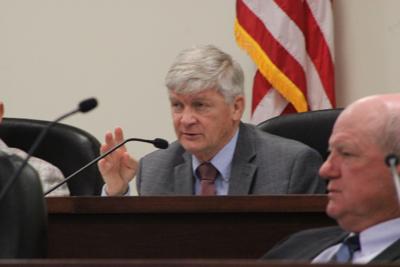
The chair of the Senate’s General Fund committee said Tuesday “the numbers are not adding up” on budget requests from state agencies for fiscal year 2027.
“The needs far exceed what the resources are going to be,” said Sen. Greg Albritton, R-Atmore, in an interview after budget hearings on Tuesday. “We’ll be fine this upcoming year, the budget that’s coming up. After that, it gets much more dicey, but we’ve got a long ways to go.”
The state faces challenges from federal funding changes and cuts from the One Big Beautiful Bill Act (OBBBA), which will increase the state’s responsibility in funding programs within the Alabama Department of Human Resources (ADHR), especially in the Supplemental Nutrition Assistance Program (SNAP).
The Legislature will take up the 2027 Education Trust Fund and General Fund budgets in the 2026 regular session, which starts in January.
Nancy Buckner, commissioner of ADHR, told legislators Tuesday that the OBBBA cuts will increase her budget request for FY27 by $35 million due to the ratio change for administration funding. Prior to OBBBA, Buckner said administration costs were equally paid by the state and the federal government. Now, the share is 75% from the state and 25% from the federal government.
In FY28, the state will be responsible for 10% of benefits for SNAP, which it has never had to pay for. That increases the state’s appropriations by an estimated $173 million, based on FY24 costs and an 8.32% error rate, bringing the total increase to $208.7 million.
Those errors, Buckner said, are mostly from clients overpaying or underpaying for their benefits by not reporting a need within their household. Buckner said there were 752,000 Alabamians enrolled in the food assistance program in 2024, 331,0000 of whom were children.
“We also deny 20,000 people every month in this state for SNAP,” Buckner said.
Alabama’s penalty for an 8.32% error rate is about $36,000. For states whose error rates are greater than 20% when multiplied by 1.5, penalties are delayed four years. Albritton said that is not fair.
“Our error rates are the lowest in the Southeast and lower than most of the country, and yet we’re going to be stuck with the $200 million thing and all the others that don’t,” Albritton said. “That doesn’t make sense, so we got to sort some things out like that.”
Kirk Fulford, the legislative fiscal officer, told the legislators that while the General Fund and Education Trust Fund have grown 3.22% and 3.26%, respectively, from July 2024 to July 2025, the state will have more funding responsibility with the OBBBA cuts.
“You’re the controller of the appropriation process,” Fulford told the joint committee. “It is absolutely critical that you understand and pay attention to the issues going on in Washington with regards to federal programs, federal funding, federal grants, because it will eventually impact your budget in a big way.”


Fulford said while the funds have grown, it is a slower growth and will get slower as federal interest rates change. He said the general fund will lose about 15% of its revenue because of decreased interest rates on state deposits.
“Everything else in the General Fund doesn’t grow by enough to offset a big decline in one revenue source,” Fulford said.
The budget hearings, which continue Wednesday, are for the legislature to get an understanding of what challenges state agencies are facing, Allbritton said. For DHR, those challenges remain to be employee turnover rates in its child welfare programs and not being able to control how many children are brought under state care.
“Relinquishments, that’s what’s hurting us greatly. We can’t say no,” Buckner said. “The judge gives us an order. We can’t say ‘we don’t have a place to put them today, can we pick them up next week.’”
Bo Offord, the newly appointed commissioner of the Alabama Medicaid Agency, said Alabama will not be substantially impacted by cuts through the OBBBA, as the state never expanded Medicaid. He said the agency is waiting on guidance from the Centers for Medicare & Medicaid Services (CMS) on eligibility changes made by the OBBBA. The agency is watching drug prices and health care inflation, he said.
“It’s impossible to predict when an FDA approved medication may enter the market, how CMS will treat that in the Medicaid space, or what the associated expense will be for the Medicaid program to bring that to our Medicaid beneficiaries,” Offord said.
The Alabama Department of Mental Health has a similar story to the state’s Medicaid agency. The changes in the OBBBA will impact who qualifies for mental health service through Medicaid, but the ADMH is not expecting federal funding cuts, Commissioner Kim Boswell said.
Boswell said ADMH’s biggest challenge is that the state does not have enough beds per 100,000 people for in-patient treatment. She said there are supposed to be 30 beds per 100,000 people, but the state only has 13.7 beds.
“We have two objectives: Protect the facilities that are there now and get them at a reasonable rate … and we also need to expand the number of beds we have,” Boswell said.
Albritton said that the only thing the Legislature can control with the budgets is how much they spend.
“We can’t control the asks. The asks are going to be there. All those asks are going to be valid and good,” he said. “We’ve got to control what goes out of the coffers of the state.”



(0) comments
Welcome to the discussion.
Log In
Keep it Clean. Please avoid obscene, vulgar, lewd, racist or sexually-oriented language.
PLEASE TURN OFF YOUR CAPS LOCK.
Don't Threaten. Threats of harming another person will not be tolerated.
Be Truthful. Don't knowingly lie about anyone or anything.
Be Nice. No racism, sexism or any sort of -ism that is degrading to another person.
Be Proactive. Use the 'Report' link on each comment to let us know of abusive posts.
Share with Us. We'd love to hear eyewitness accounts, the history behind an article.