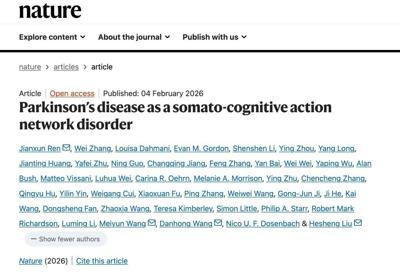
BEIJING, Feb. 5, 2026 /PRNewswire/ -- A research team led by Prof. Hesheng Liu, founder and Chief Scientific Officer of Galaxy Brain Scientific Inc., has published a study in Nature that pinpoints the core functional circuit underlying Parkinson's disease (PD). The findings redefine the biological mechanism of PD and provide a scientific basis for developing precision neural circuit stimulation strategies for treating the condition.
PD currently affects over 13 million people worldwide and continues to pose a major clinical challenge, as existing treatments ranging from long-term medication to invasive deep brain stimulation (DBS) are often limited by diminishing efficacy or surgical risks. For decades, the disease was conceptualized as a movement disorder arising from dysfunction of the basal ganglia. We are tackling this big challenge head-on: clinical ready solutions that solve brain disorder. This study— an international collaboration between Galaxy Brain Scientific Inc., Washington University in St. Louis, Tsinghua University, Peking University, and Harvard University—analyzed precision functional neuroimaging data from over 800 participants to reveal a different story.
The researchers identified severe dysfunction in the somato-cognitive action network (SCAN)—a brain network essential for planning, coordinating, and executing actions—as the core feature of PD. In patients, this network shows abnormally high functional connectivity with deep brain regions, a signature not observed in other movement disorders such as essential tremor. "Our work shows that the disease is rooted in a much broader network dysfunction," noted Prof. Hesheng Liu. "The SCAN is hyperconnected to key subcortical regions in PD, and this abnormal hyperconnectivity disrupts not only movement but also related cognitive and automatic functions."
A critical finding of the research is that all existing effective therapies for PD share a common mechanism: they reduce this abnormally high connectivity between the SCAN and deep brain regions, essentially normalizing the circuit. "Our findings establish Parkinson's as a SCAN disorder. By targeting this network with personalized precision, we can now treat the disease more effectively than ever—potentially slowing or reversing its progression, rather than just suppressing symptoms," said co-author Nico U. Dosenbach, MD, PhD, the David M. & Tracy S. Holtzman Professor of Neurology at WashU Medicine.
This pioneering study was enabled by Galaxy Brain Scientific's proprietary personalized Brain Functional Sectors (pBFS) technology and its precision circuit stimulation system. The company's China NMPA -approved software and hardware system offers individualized precision targeting and non-invasive TMS stimulation with millimeter accuracy.
Galaxy Brain Scientific is already moving to bring these insights to the clinical frontline, having begun a pivotal registration trial for Class III devices dedicated to treating PD. Beyond Parkinson's, the company is also pioneering the application of this technology to treat other complex brain disorders, including Autism and Alzheimer's Disease.
 View original content to download multimedia:https://www.prnewswire.com/news-releases/galaxy-brain-scientifics-technology-enables-landmark-parkinsons-study-published-in-nature-redefining-disease-mechanism-302679712.html
SOURCE Galaxy Brain Scientific Inc.




(0) comments
Welcome to the discussion.
Log In
Keep it Clean. Please avoid obscene, vulgar, lewd, racist or sexually-oriented language.
PLEASE TURN OFF YOUR CAPS LOCK.
Don't Threaten. Threats of harming another person will not be tolerated.
Be Truthful. Don't knowingly lie about anyone or anything.
Be Nice. No racism, sexism or any sort of -ism that is degrading to another person.
Be Proactive. Use the 'Report' link on each comment to let us know of abusive posts.
Share with Us. We'd love to hear eyewitness accounts, the history behind an article.