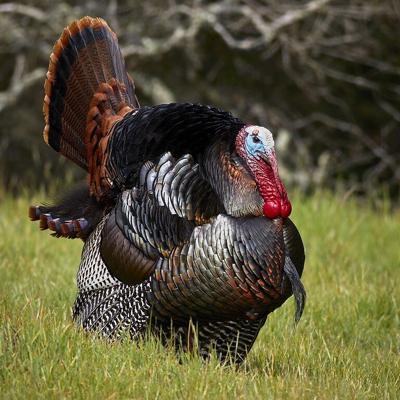
AUBURN UNIVERSITY, Ala. — For the first time, the public is being asked to participate in the Wild Turkey Brood Survey. With this tool, the Alabama Department of Conservation and Natural Resources collects valuable data about annual nesting success, brood survival and distribution and abundance of wild turkeys.
While the survey is conducted annually, previous submissions were solicited from a more limited group. Norm Haley, a forestry, wildlife and natural resources agent with Alabama Extension at Auburn University, said he hopes people will take advantage of this new opportunity.
“This is really the first chance that the public has had to participate,” Haley said. “Their information is valued and very important.”
Survey Details
The survey is currently open and will close Aug. 31. People from all regions of Alabama, including rural and developed areas, can submit information.
Caleb Blake, the upland game bird coordinator with Alabama Wildlife and Freshwater Fisheries, said the data collected from private citizens is essential to obtaining the best geographic coverage.
“By expanding participation beyond agency personnel and cooperators, we can collect more observations," Blake said. "That data from across the state will improve our understanding of wild turkey reproduction and productivity.”
The Alabama Department of Conservation and Natural Resources is interested in observations of hens with and without poults and male birds, both jakes and gobblers.
Learning Opportunities
For more reliable data, Haley suggested brushing up on how to accurately identify turkeys and their age class.
“With a little bit of research to make sure that you can accurately identify turkeys, we can be excited about the data,” Haley said. “The collected data is only as good as what is put in.”
Additionally, the department encourages people to look carefully when reporting numbers of poults. They may be difficult to see in tall vegetation. Studying up on turkeys at different ages, particularly jakes versus toms and the age class of poults, is also helpful.
Alabama Extension offers numerous resources to help people learn more about turkeys. The archives of the Natural Resources Webinar series includes the presentation, “From Spring Gobblers to Summer Broods: Tracking Alabama's Wild Turkeys.” People can also receive guidance on turkey identification by contacting their local forestry, wildlife and natural resources Extension agent.
Ways to Participate
There are numerous options to submit reports, including mobile app, online entry or mail-in, printable survey form. Blake said that the easiest way to report turkey observations is through the mobile Survey123 field app. He said participants should record all turkey observations, even if the bird's age or sex is unknown.
Find more information, including the printable survey sheet, at outdooralabama.com/WildTurkeyBroodSurvey.
Participants can access the online wild turkey brood survey through this link: https://arcg.is/1Tq4Wv1.
# # #
The Alabama Cooperative Extension System takes the expertise of Auburn University and Alabama A&M University to the people. Our educators in all 67 counties are community partners — bringing practical ways to better our homes, farms, people and the world around us. Our research extends knowledge and improves lives.

(0) comments
Welcome to the discussion.
Log In
Keep it Clean. Please avoid obscene, vulgar, lewd, racist or sexually-oriented language.
PLEASE TURN OFF YOUR CAPS LOCK.
Don't Threaten. Threats of harming another person will not be tolerated.
Be Truthful. Don't knowingly lie about anyone or anything.
Be Nice. No racism, sexism or any sort of -ism that is degrading to another person.
Be Proactive. Use the 'Report' link on each comment to let us know of abusive posts.
Share with Us. We'd love to hear eyewitness accounts, the history behind an article.