


(Photo by Dulcey Lima via Unsplash)
From working out to spending time with loved ones, seven in ten Americans feel they don’t do “enough” each day, according to new research.
A survey of 2,000 U.S. adults found that for some, this stems from a lack of time: One in four say there's not enough time in the day to talk to their loved ones enough (23%), while 20% say a time crunch forces them to skip workouts.
For another 19%, busy schedules also mean not being able to visit aging family members.
More than half of those polled (54%) even go so far as to say their mental load is at maximum capacity during a typical week.
And for those who are currently a caregiver for an aging family member, that mental load increases exponentially, with two-thirds (67%) admitting they’re at their limit.
Conducted by Talker Research on behalf of Visiting Angels, the survey split respondents based on whether they’ve been a caregiver in the past (16%), are currently a caregiver (49%) or plan to be one in the future (8%) and looked at how guilt and other emotions manifest in someone who is caring for someone else.
And it’s not always something you plan for: Most former and current caregivers polled describe their role as a sudden need (62%) rather than something they’d been planning and preparing for (26%).
Looking back, many current and former caregivers admit they were mentally (23%), emotionally (22%) and financially (31%) unprepared for the role.
And the role came with real trade-offs; from cutting back on “me time” (36%) and their social lives (29%) to de-prioritizing mental health (27%), losing their independence (22%) and putting their physical health on the back burner (21%).

(Talker Research)
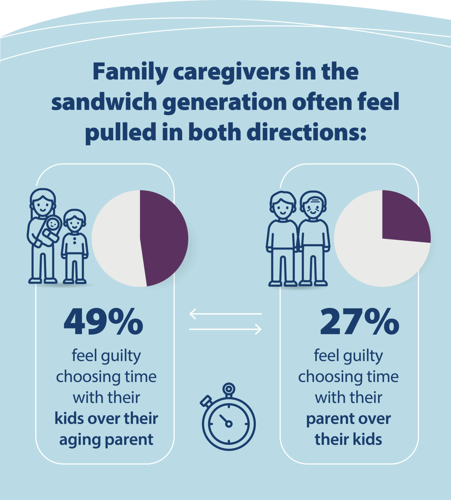
Among the sandwich generation, or current caregivers who are also raising kids at the same time (19%), that guilt is a double-edged sword.





Nearly half of caregivers in the sandwich generation (49%) feel guilty being with their children because they believe they should have been with their aging loved one, while 27% feel guiltier being with their loved one because they believe they should have been with their kids.
On top of the emotional toll, caregivers worry whether they’re doing everything right (35%), if they’re understanding the needs of the person they’re caring for (30%), whether they’re a good caregiver (28%) and if they’re being as patient as they should be (27%).
"Many family members don't plan to be a part-time or even full-time caregiver. It is something that happens over time and that can become very taxing on a person's physical and mental well-being,” said Scott Parrish, President of Visiting Angels. “The best thing you can do is begin the conversation with an aging parent or loved one about seeking assistance to help them age in place with dignity.”
To help guide future caregivers to a more balanced and less guilt-filled experience, the survey asked former and current caregivers what they wish they’d known when stepping into the role.
Their advice includes everything from the unfiltered reality and hardships to the quiet reminders and moments that make us all human.
Patience and kindness were two of the most common themes, followed by the importance of taking time for yourself. One respondent said, “Be kind to yourself and accept that you will make mistakes. Perfection is not the goal.”
Another doubled down on the importance of self-care and said, “Find time every day for yourself, even if you have to lock yourself in the bathroom for five minutes. You can't take care of somebody else until you take care of you.”
One caregiver offered guidance from the beginning to the end, and said, “It will never be perfect or feel [like] enough. But you are there to do your best. To be there for them. Ask questions. Write stuff down. Give yourself grace. And when they are gone, forgive yourself. You will always find something you feel could have been done better or differently.”
“It's important for families to recognize that there is help available," Parrish said. "Caregiving looks different for every family, and outside support isn't the right fit for everyone, or always financially possible. But whether it's full-time care or just a few hours a week, having a professional in-home caregiver can ease some of that burden and give families room to breathe. Ultimately, the goal is for families to know their options and make the choice that works best for them, without feeling guilty either way.”
BIGGEST PIECES OF ADVICE TO FUTURE CAREGIVERS
- “Always take care of yourself.”
- “As stressful as it can be, always remember that you're helping someone that you really care about.”
- “Be kind to yourself and accept that you will make mistakes. Perfection is not the goal.”
- “Be patient. Patience is everything and the foundation to a healthy caregiver-to-patient relationship.”
- “Be prepared mentally, physically and emotionally”
- “Be kind and patient; things aren’t always easy”
- “Be present. Don’t be afraid of not being enough because you are making a difference in someone’s livelihood.”
- “Burnout is real; you need other people to rely on. You can't do it alone”
- “Don’t lose yourself in the process; prioritize your mental health.”
- “Don't overthink everything; just love the person enough to take care of them and realize that you, too, may someday be in the position of needing care.”
- “Find time every day for yourself. Even if you have to lock yourself in the bathroom for five minutes, find time for yourself. You can't take care of somebody else until you take care of you”
- “I wish I had looked into local caregiver support groups and community resources much earlier in the process than I did”
- “If you're caring for someone with dementia, like I am, they're going to say things that are going to hurt. Be prepared and keep telling yourself they don't mean it, it's the dementia.”
- “It will never be perfect or feel enough. But you are there to do your best. To be there for them. Ask questions. Write stuff down. Give yourself grace. And when they are gone forgive yourself. You will always find something you feel could have been done better or differently.”
- “Just do one day at a time”
- “Keep yourself healthy”
- “Make sure you do your research to help advocate for them as well as help take better care of them.”
- “Make sure YOU have support, too. It's a big change and you'll need the mental/emotional help.”
- “Prioritize your own well-being first”
- “There is no perfect way to do this. It's mainly about showing up.”
- “You can’t do everything all the time”
Research methodology:
Talker Research surveyed 2,000 general population Americans who have access to the internet; the survey was commissioned by Visiting Angels and administered and conducted online by Talker Research between August 14 to 17, 2026. A link to the questionnaire can be found here.
To view the complete methodology as part of AAPOR’s Transparency Initiative, please visit the Talker Research Process and Methodology page.
(0) comments
Welcome to the discussion.
Log In
Keep it Clean. Please avoid obscene, vulgar, lewd, racist or sexually-oriented language.
PLEASE TURN OFF YOUR CAPS LOCK.
Don't Threaten. Threats of harming another person will not be tolerated.
Be Truthful. Don't knowingly lie about anyone or anything.
Be Nice. No racism, sexism or any sort of -ism that is degrading to another person.
Be Proactive. Use the 'Report' link on each comment to let us know of abusive posts.
Share with Us. We'd love to hear eyewitness accounts, the history behind an article.