


Assisted living statistics: Demographics, services, and trends
More than 32,000 assisted living communities throughout the United States provide housing and support for older adults who can no longer live independently. As the population ages, demand for assisted living continues to grow. This report by A Place for Mom highlights key assisted living statistics, including resident demographics, care needs, costs, and industry trends.
Key insights
- Over 1 million people live in assisted living communities throughout the U.S.
- More than half of assisted living residents are 85 or older, and most are women.
- The median cost of assisted living is $5,419 per month, but actual costs can vary significantly based on location and care needs.
- Most people use personal income and assets to pay for assisted living. About 17% of residents rely on Medicaid for support.
Assisted living communities in the US
There are 32,231 assisted living communities and other residential care communities in the U.S., according to the most recent data available from the National Center for Health Statistics. Assisted living goes by many names, including personal care homes, board and care homes, and adult foster care. Specific terminology and regulations typically vary by state.
In general, these communities provide similar services for adult residents: housing, meals, supervision, and help with daily activities. While they don’t typically provide medical care, some residents receive additional services such as nursing care or physical therapy through third-party providers.
Assisted living resident demographics
An estimated 1,016,424 people live in assisted living communities and other residential care communities throughout the U.S., many of whom have complex care needs.
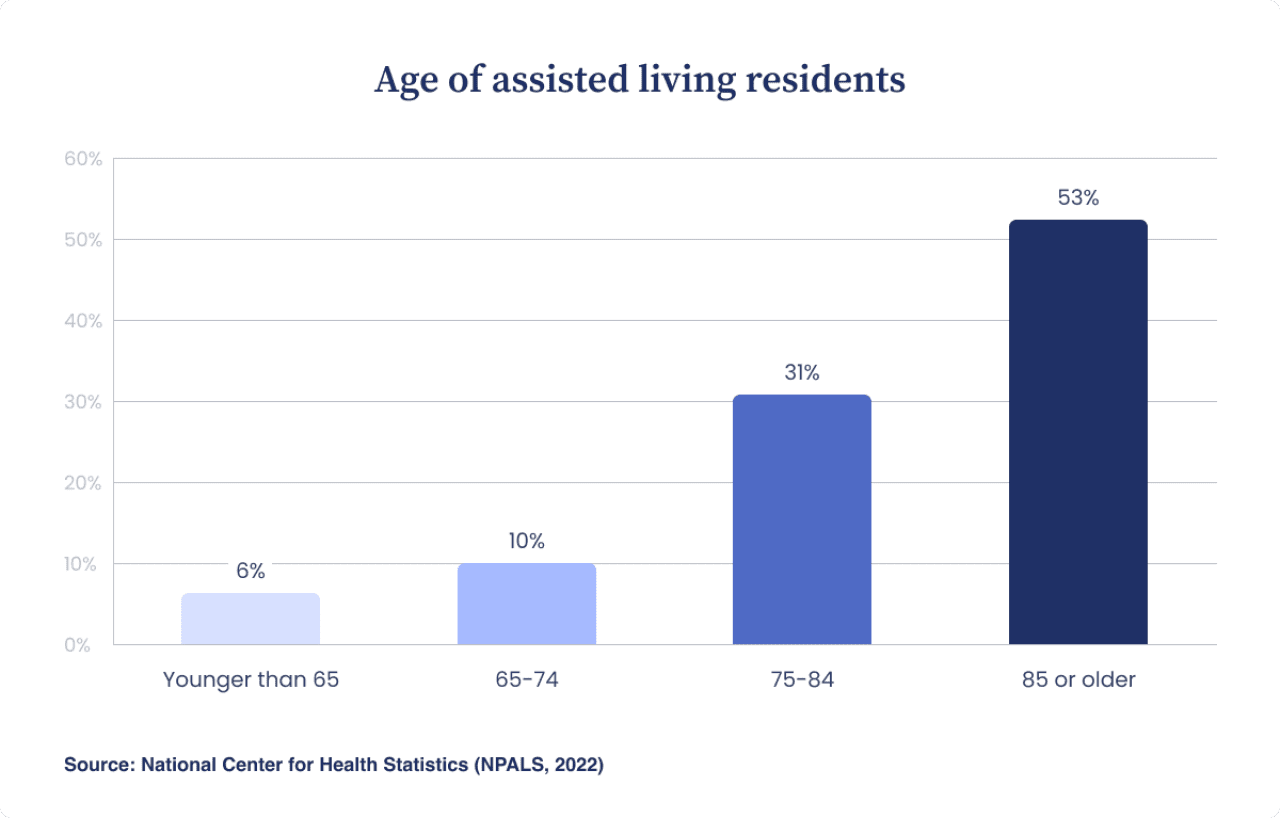
Residents are more likely to be female and in older age groups. About 67% are women, and 84% are age 75 or older.
Most assisted living residents are white (92%), while 2% are Black non-Hispanic, and 6% are Hispanic or another race.
Residents of assisted living communities typically have chronic health conditions that affect their ability to live independently. The most common conditions include high blood pressure (58%), Alzheimer’s disease or other forms of dementia (44%), heart disease (33%), depression (26%), and diabetes (16%). Only 8% of residents have never been diagnosed with any of these conditions.
Assisted living services and care needs
Most assisted living residents need significant daily support — 62% require help with three or more of the six activities of daily living (ADLs). However, the level of care each resident needs varies. A small portion of residents (12%) do not need any assistance with ADLs, but they may require other forms of support, such as medication management, supervision, or assistance with household tasks.
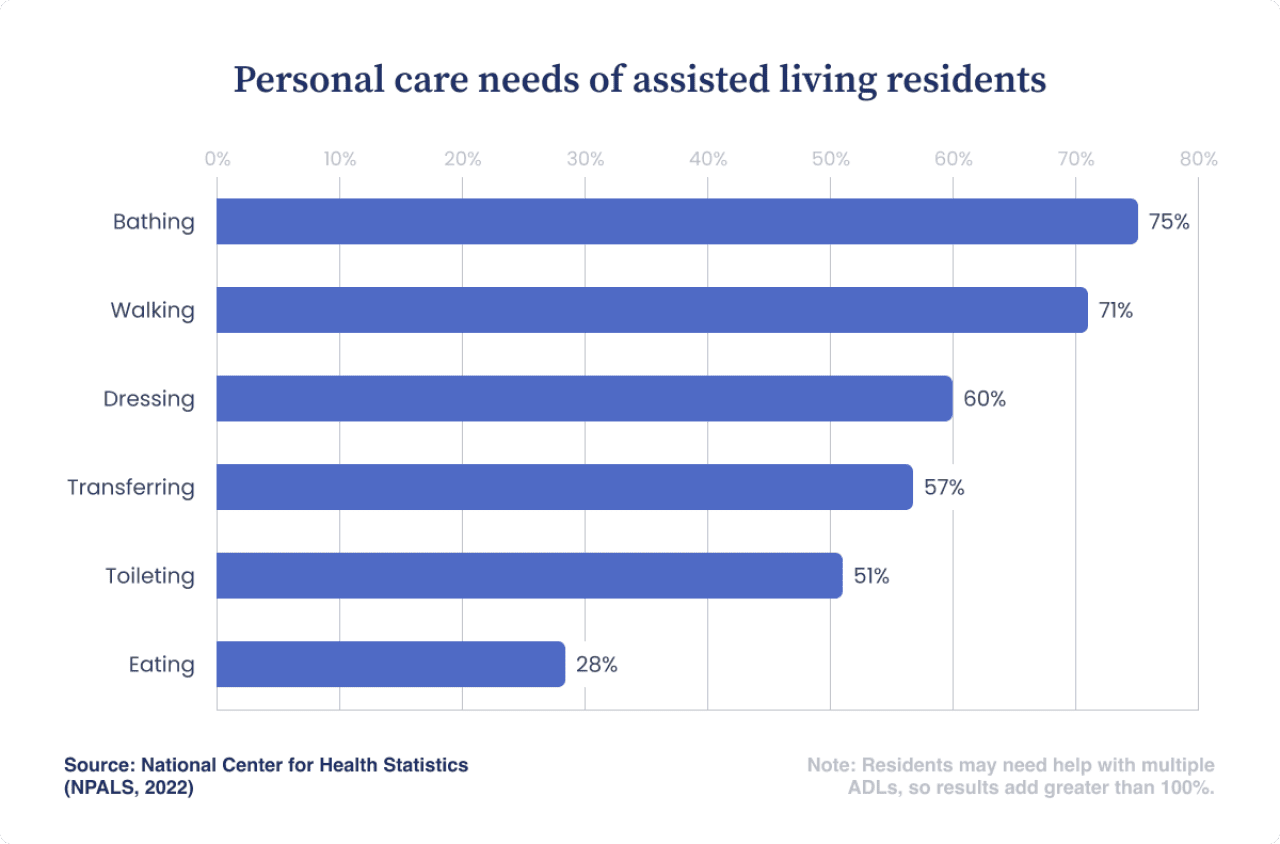
The most common resident needs in assisted living include assistance with bathing (75%), walking (71%), dressing (60%), transferring to/from a bed/chair (57%), toileting (51%), and eating (28%).
Assisted living services and amenities are designed to meet these needs. Residents can typically benefit from help with ADLs, 24-hour supervision, meals, housekeeping, medication reminders, transportation, activities programming, and communal areas for socializing, hobbies, and events.
Staffing requirements
Staffing requirements in assisted living facilities and other types of residential care communities are set at the state level and vary widely. Most states do not require a specific staff-to-resident ratio for assisted living.
For example, regulations in Colorado merely stipulate that in each assisted living residence, “Staff shall be sufficient in number to help residents needing or potentially needing assistance, considering individual needs such as the risk of accident, hazards, or other challenging events.”
On the other hand, Florida sets minimum staffing requirements based on the number of residents, requiring assisted living communities to provide a certain number of total staff hours each week as occupancy increases. By law, a mid-sized community with about 50 residents in Florida must provide at least 375 hours of staff time per week.






Staffing requirements may also vary within states depending on factors such as community size and whether specialized services, like dementia care, are offered.
Assisted living financial statistics
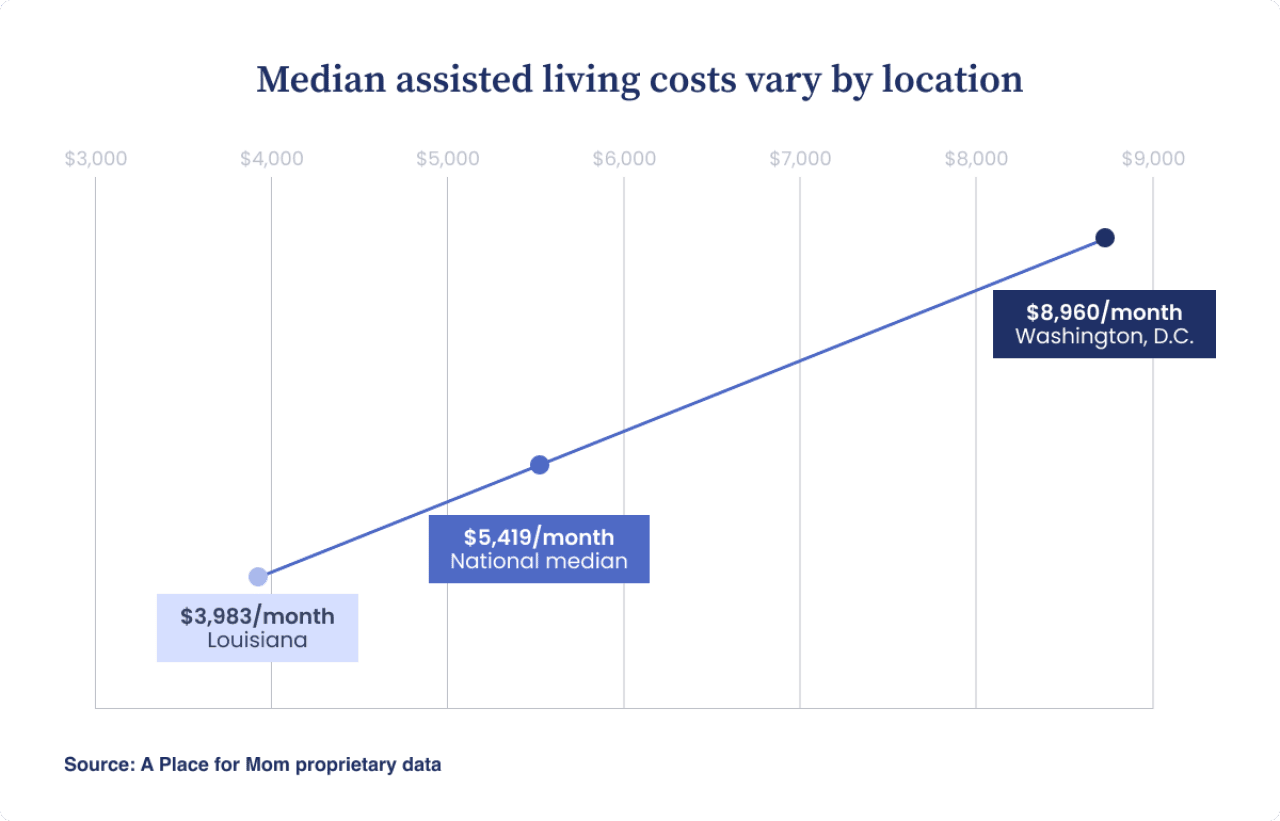
The national median cost of assisted living in the U.S. is $5,419 per month, based on A Place for Mom’s proprietary data.
Actual costs vary depending on factors like location and the level of care a resident requires. For example, Louisiana has the lowest median monthly cost of assisted living at $3,983, while the District of Columbia is the most expensive at $8,960 per month.
Most residents use their personal income and assets to pay for assisted living. Other payment sources may include long-term care insurance, Social Security benefits, and income or proceeds from the rental or sale of a home.
For many older adults, however, affordability remains a concern. Nearly 10% of Americans age 65 and older live in poverty. While an estimated 17% of residential care community residents rely on Medicaid, coverage is limited. In most states, Medicaid offers some coverage of care services provided in assisted living communities, but programs, eligibility requirements, benefits, and availability vary from state to state. Medicaid does not cover room and board in assisted living in any state.
Assisted living demand and industry outlook
Demand for assisted living is expected to grow as the U.S. population continues to age. In 2025, an estimated 63.3 million Americans were age 65 and older, and by 2040 that number is projected to exceed 78 million. Life expectancy is also increasing, contributing to a larger population of older adults who may eventually need long-term care.
Recent data suggests demand is already increasing. Assisted living occupancy reached 87.9% in early 2026, reflecting continued growth in the number of residents moving into communities. Meanwhile, new construction across the broader senior housing sector has slowed, which may limit availability in some markets.
At the same time, most seniors prefer to age in place. About 60% say they would rather remain at home with the help of a caregiver, while 18% say they would consider moving into an assisted living community if they could no longer live independently. Aging in place remains the top preference, yet assisted living is often a next step when care needs become more complex.
This growing demand may place additional pressure on the assisted living workforce. In 2022, the industry employed roughly 455,900 full-time equivalent nursing and social work employees, highlighting the scale of staffing needed to support residents’ care needs. Meeting future demand will depend on both workforce availability and the capacity of existing communities.
FAQs
How many people live in assisted living in the U.S.?
About 1 million people live in assisted living communities and other residential care communities in the United States, according to research conducted by the National Center for Health Statistics.
What is the average age of assisted living residents?
Assisted living residents are typically in their 80s, with more than half (53%) age 85 or older, according to research conducted by the National Center for Health Statistics.
How many assisted living communities are there in the U.S.?
There are about 32,231 assisted living communities and other residential care communities in the United States, according to research conducted by the National Center for Health Statistics.
What level of care do assisted living residents need?
Most residents need help with daily activities, with 62% requiring assistance with three or more activities of daily living, according to research conducted by the National Center for Health Statistics.
This story was produced by A Place for Mom and reviewed and distributed by Stacker.

(0) comments
Welcome to the discussion.
Log In
Keep it Clean. Please avoid obscene, vulgar, lewd, racist or sexually-oriented language.
PLEASE TURN OFF YOUR CAPS LOCK.
Don't Threaten. Threats of harming another person will not be tolerated.
Be Truthful. Don't knowingly lie about anyone or anything.
Be Nice. No racism, sexism or any sort of -ism that is degrading to another person.
Be Proactive. Use the 'Report' link on each comment to let us know of abusive posts.
Share with Us. We'd love to hear eyewitness accounts, the history behind an article.