


(Photo by Kateryna Hliznitsova via Unsplash)
The average woman takes five months to emotionally bounce back from pregnancy, according to new research.
A survey of 2,000 women who have given birth explored how that experience has shifted their confidence and intimacy levels.
Confidence is also affected: While more respondents recall having a harder time bouncing back physically (42%), more than a third said mental recovery was more difficult (35%). Nearly a quarter said it was equally hard either way (23%).
The average woman surveyed needed six months to physically bounce back from pregnancy.
Conducted by Talker Research for Intimina, the survey found that 77% of women said their body has never gone back to how it was before having a child.
Of those respondents, 63% are not sure that it ever will, including moms who have given birth at least three years ago (67%).
Where intimacy is concerned, more women experienced worsened libido than not post-pregnancy.
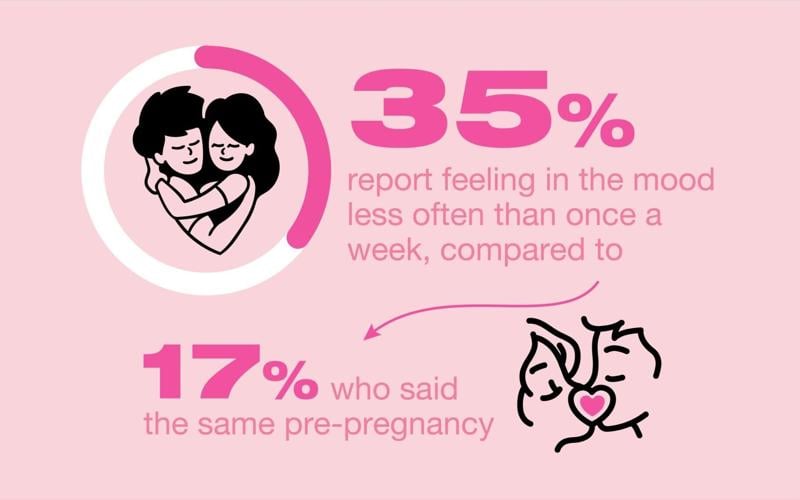
Thirty-five percent report feeling in the mood less often than once a week, compared to 17% who said the same pre-pregnancy.
Beyond sex, women also reported feeling decreased energy levels (39%) and worsened ability to get work done (20%).
“Even though many of us are aware of the postpartum changes women go through, there is still an intense and often silent pressure on them to quickly 'bounce back', both emotionally and physically,” said Dunja Kokotovic, global brand manager for Intimina. “We need to shift the public narrative toward acceptance and self-care instead of chasing unattainable standards. We encourage women to find their own pace during this sensitive recovery period by addressing and understanding the changes and reclaiming their confidence and well-being.”
For many, this journey has felt lonely. On one hand, 39% of women who are still with their partner feel more connected to them after having a child than ever — but 22% experience just the opposite.
Nearly half who experienced changes to their body struggled with talking to a partner about that (46%), and dealt with changes in confidence (53%) and their sense of self (57%) alone, too.







(Talker Research)
Similar percentages expressed difficulty talking to their partner about changes in feeling connected to one another (60%) and their libido (52%).
While doctors often recommend the “six-week postpartum checkup” to be intimate once more, one in six felt pressured to be “ready” by that deadline.
Some of the common negative experiences they’ve had with intimacy postpartum include fatigue (26%), feeling pressured to be in the mood (21%), guilt about not wanting to be intimate (19%), dryness (18%) and emotional disconnect (17%).
It hasn’t all been a negative journey, though. More women experienced improvements in confidence, mental health and feeling connected to themselves than not postpartum.
In their learnings about intimacy, “a good sexual encounter” has changed for postpartum women.
They’ve learned that they now desire more emotional connection (25%), feeling desired as a person and not just as a mother (21%) and feeling appreciated overall (20%).
For others, it’s all about their own experience, feeling more keen on more foreplay (19%) and focusing on their own pleasure (17%).
“Women’s bodies go through a lot, so it’s not surprising that 52% of women find it difficult to discuss changes in libido with their partners,” said Kokotovic. “While the shift in energy levels and desire can feel overwhelming, it's important to know that it doesn't last forever. Kegel exercises are the perfect solution to pregnancy recovery and taking control of pelvic health. It seems that more and more women are aware that strengthening the pelvic floor is necessary for healing, and it can be especially helpful in building back the confidence needed to reconnect with themselves and their partner.”
Research methodology:
Talker Research surveyed 2,000 women who have given birth who have access to the internet; the survey was commissioned by Intimina and administered and conducted online by Talker Research between April 2 and April 9, 2026. A link to the questionnaire can be found here.
To view the complete methodology as part of AAPOR’s Transparency Initiative, please visit the Talker Research Process and Methodology page.

(0) comments
Welcome to the discussion.
Log In
Keep it Clean. Please avoid obscene, vulgar, lewd, racist or sexually-oriented language.
PLEASE TURN OFF YOUR CAPS LOCK.
Don't Threaten. Threats of harming another person will not be tolerated.
Be Truthful. Don't knowingly lie about anyone or anything.
Be Nice. No racism, sexism or any sort of -ism that is degrading to another person.
Be Proactive. Use the 'Report' link on each comment to let us know of abusive posts.
Share with Us. We'd love to hear eyewitness accounts, the history behind an article.