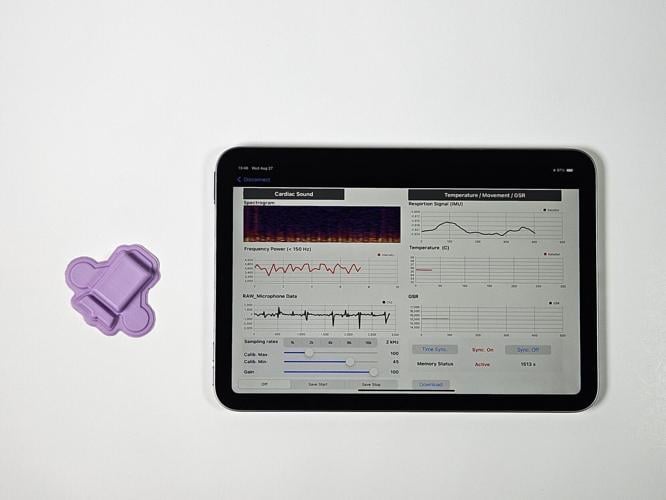

The system wirelessly transmits these synchronized data streams to a smartphone, smart watch or tablet, where machine learning algorithms analyze patterns associated with stress in real time. (John A. Rogers / Northwestern University via SWNS)
By Stephen Beech
A new stress-sensing wireless lie detector can also spot potentially deadly sleep disorders in babies.
The patch monitors physical signs of stress, indicative of lying in interviews, when attached to someone's chest.
But, beyond its capacity as a wearable lie detector, American scientists say the revolutionary device can also spot signs of sleep disorders in tots.
Weighing less than eight grams — the same as eight paperclips — and designed to move naturally with the skin, the device can operate continuously for over 24 hours.
But, unlike polygraphs seen in television crime dramas, the team from Northwestern University, Illinois, explained that their device isn't optimized to detect lies.
Instead, engineers and physicians designed it to sense underlying stress hidden deep within the body.

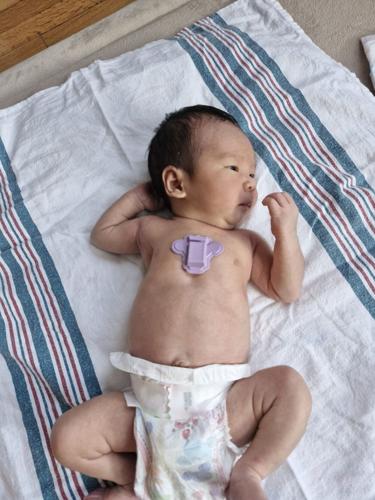
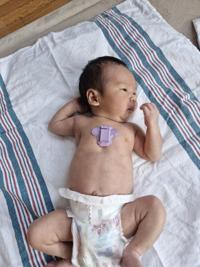
By continuously monitoring physiological signs of stress, the device can detect underlying stress in individuals, including babies, who cannot communicate. (John A. Rogers / Northwestern University via SWNS)
The lightweight, bandage-like patch gently adheres to the chest, where it simultaneously measures heart activity, breathing patterns, sweat response, blood flow and temperature.
Together, the signals capture a real-time, whole-body view of stress.
By continuously tracking multiple physiological signals at once, the research team say the device could help doctors detect stress and potential discomfort in patients — including babies and the elderly — who may be unable to communicate,.
It can also diagnose sleep disorders without cumbersome equipment, monitor mental health over time and even sense early warning signs of medical complications, according to a study published in the journal Science Advances.
Bioelectronics pioneer John Rogers, who led the device development, said: "Sometimes, the body manifests signs of stress before a person is consciously aware of it.
"Even if people don't realize how much pressure they are under, stress is quietly affecting their health.

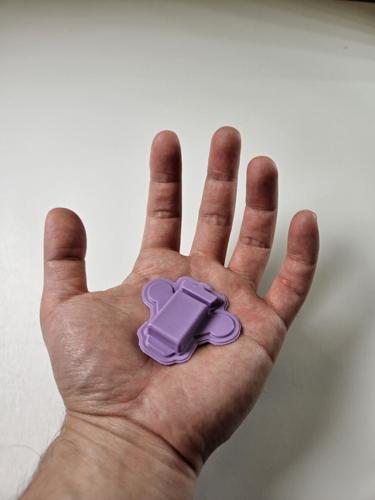
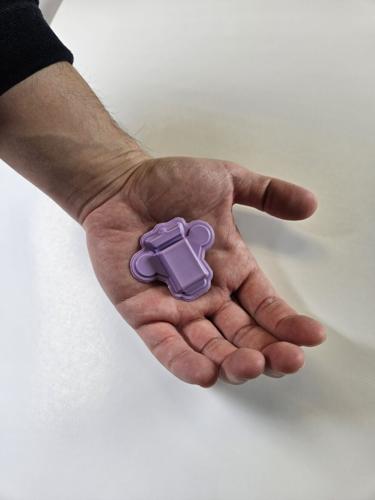
Wearable polygraph device in the palm of a hand for scale. (John A. Rogers / Northwestern University via SWNS)
"Prolonged stress can have adverse consequences, especially for pregnant mothers, children and critically ill patients.
"An ability to track stress based on quantitative measurements could empower people to take stress-relieving actions with direct benefits to their health.
"Importantly, we aimed to design a device, conceptually like a polygraph system, that operates on the basis of biophysical body responses, without requiring access to chemical biomarkers found in body fluids."
Rogers' team has previously developed several wireless, wearable electronics to track vital signs, monitor illness, treat congenital conditions and diagnose disease in babies and children.
Pediatricians in Chicago asked him to create a soft, non-invasive device to detect and continuously track stress levels in babies throughout hospital stays, without measuring stress' biochemical signatures in saliva and blood.
Currently, detecting babies' stress often depends on what medics can see and hear — crying, facial expressions and movement — along with basic vital signs.
But Rogers says those signals can be subtle, inconsistent or even entirely absent.
He said: "Stress is often scored using survey sheets and nursing assessments.
"The entries include things like tonality and volume of crying.
"Infants obviously cannot describe their own pain levels.





"So, unlike with adults, determining stress in babies can be incredibly challenging.
"We wanted to take subjectivity out of these assessments."
Debra Weese-Mayer, who works with Rogers, said: "This new device tracks the body's stress signals around the clock, helping quantify how long someone is stressed each day and how intense that stress is.

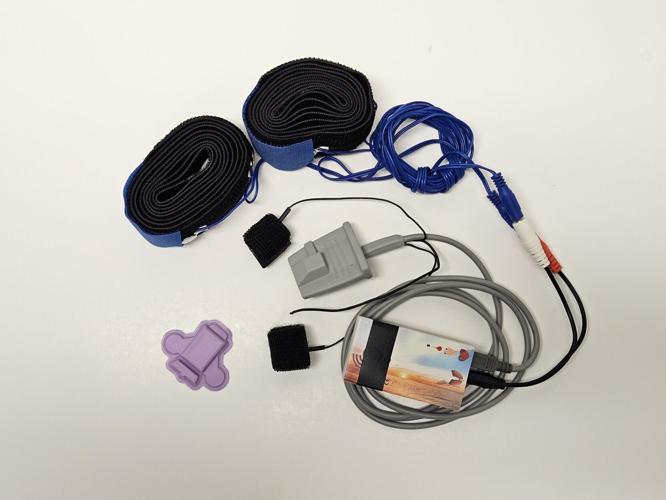
Wearable polygraph system next to a standard polygraph system. (John A. Rogers / Northwestern University via SWNS)
"The beauty of the device is that both individuals and healthcare providers can now identify stress and objectively monitor the effectiveness of interventions to decrease stress and restore a healthy balance, in a completely non-invasive manner."
The team wanted to capture the same physiological signals as traditional polygraphs — and more — in a fully integrated, accurate and wearable form.
The resulting technology combines several tiny sensors into a single, soft device.
Together, the sensors continuously track multiple physiological signals, all of which respond when the body senses stress.
A built-in motion sensor and miniature microphone capture subtle mechanical and acoustic signals from the heart and lungs.
Other sensors detect skin temperature and heat flow associated with near-surface blood circulation.
And another sensor measures changes in the skin's electrical conductivity caused by sweat gland activity — a well-known stress marker.
Rogers said: "Measuring stress is a complex task because it's multi-dimensional.
"It's not possible to reliably determine stress by measuring just one or two, or even three or four, parameters. A broad collection of factors is necessary.

Wearable polygraph device in the palm of a hand for scale. (John A. Rogers / Northwestern University via SWNS)
"So, we crammed as many sensors of physiological processes into this device platform as we could, while maintaining a compact size and lightweight construction and avoiding the need to access biofluids."
The system wirelessly transmits the synchronized data streams to a smartphone, smartwatch or tablet, where machine learning algorithms analyze patterns associated with stress in real time.
During simulated lie-detector tests, the wearable device accurately captured stress responses triggered by sensitive questions and closely matched measurements from commercial polygraph systems.
In one experiment, study participants placed their hands in ice-cold water, and the system recorded coordinated changes across cardiac activity, breathing patterns, sweat responses and temperature signals.
In pediatric sleep studies, the wearable device identified key clinical events, including breathing irregularities and nighttime awakenings, with accuracy comparable to hospital-grade sleep tests but with far fewer disruptions.
And, during sessions with medical students, the device found participants with stronger stress responses tended to perform worse, suggesting stress may impair decision-making in high-pressure situations.
Rogers said: "Ultimately, the device could send an alert to a user or caregiver when stress levels hit a certain limit.
"Many people might not fully appreciate the level of stress they are under and might not realize it's affecting their performance."
The team aims to move its technology beyond validation studies and into broader clinical use by integrating it into hospital and at-home monitoring systems to provide continuous, real-time insight into patient health.
Weese-Mayer added: "We are living in stressful times, without sufficient measures to proactively detect stress.
"By identifying stress — whether environmental or disease-induced — earlier, we can introduce intervention before stress' effects become irreversible."

(0) comments
Welcome to the discussion.
Log In
Keep it Clean. Please avoid obscene, vulgar, lewd, racist or sexually-oriented language.
PLEASE TURN OFF YOUR CAPS LOCK.
Don't Threaten. Threats of harming another person will not be tolerated.
Be Truthful. Don't knowingly lie about anyone or anything.
Be Nice. No racism, sexism or any sort of -ism that is degrading to another person.
Be Proactive. Use the 'Report' link on each comment to let us know of abusive posts.
Share with Us. We'd love to hear eyewitness accounts, the history behind an article.