

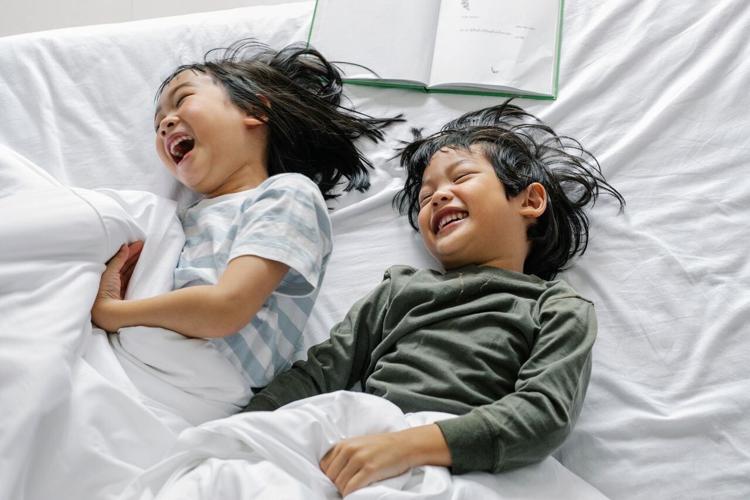





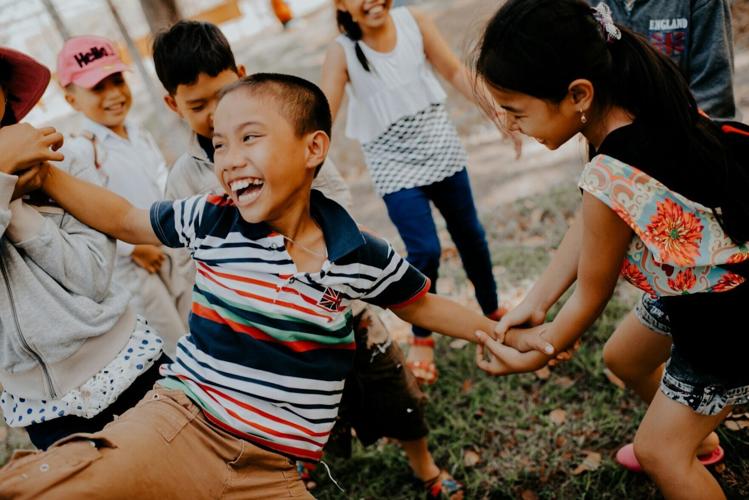


(Photo by Gabriel Frank via Pexels)
By Stephen Beech
Making children laugh can help make their brains more resilient and open to learning, according to new research.
Laughter builds deep emotional connections and soothes youngsters' nervous systems — making them more resilient and open to new ideas, say scientists.
Laughter is the best medicine, according to an old adage.
Now, new research suggests it also helps child development.
Jacqueline Harding conducted extensive studies into how laughter and play contribute to healthy brain growth, emotional well-being and social bonding.

(Photo by Alex Green via Pexels)
Harding, an early childhood expert at Middlesex University in northwest London, argues in her new book "The Brain That Loves to Laugh" that laughter can help children navigate life's challenges and better handle stress.
She said: "Hope and humor, it seems, are not just the seasoning of life, but foundational to a recipe for healthy development.
"When we see children laugh, we witness the brilliance of the brain in action: learning, connecting, and growing."
Harding says laughter is not frivolous, but rather a complex biological phenomenon.
She said it precedes the neural development of speech, yet it engages a distributed network of brain regions, including motor areas and the prefrontal cortex.
Harding says laughter also influences heart rate, respiration and production of antibodies.
She said: "It decreases stress hormones cortisol and epinephrine, and increases 'happiness chemicals' dopamine, serotonin and endorphins.
"It can strengthen the immune system and improve memory.

(Photo by Arjun Adinata via Pexels)
"Neuroimaging studies suggest that laughter plays a significant role in brain activity, as humor is cognitively demanding and engages neuroplasticity.
"It challenges the brain to predict and resolve tension between conflicting ideas, providing a mental workout that enhances creative thought and activates both the working memory and frontal lobes.
"On the other hand, prolonged stress negatively affects both physical and mental development.
"It can impair learning, increase adult stress risk, suppress immune function, and contribute to illness."
She added: "I believe that as we continue to wrestle with humor – this most intriguing human function – we must strive to shake off any dismissal of its frivolous nature and allow its serious contribution to human learning and life in general to shine.
"In parents and their children, laughter can boost the levels of happy chemical oxytocin and enhance neural synchrony during parent-child interactions – in other words, build emotional bonds.






"These bonds are beneficial to the child and even contribute to a reduction in parental burnout and stress."
Research shows that laughter helps develop social skills and emotional intelligence.

Annie Spratt
But Harding says that does not mean moms and dads need to rattle off jokes.
Instead, simple shared play and laughter between parents and children, with eye contact, smiles, close proximity and joint attention on a task can all foster connection.
Harding said: "Creative, happy play does its most brilliant work at a molecular level, especially at a time when the human brain is at its most receptive.
"Spontaneous joyful play is an antidote to stress, as it increases levels of endorphins released by the brain."
As well as nurturing bonds, she suggests that "humor and hope" can improve a child's resilience to stressful events.
Harding said: "The link between co-regulation and self-regulation is now well established.
"Co-regulation means the way in which the baby is guided by a caring and supportive adult early in life, so that they have a working model to draw upon for their own self-regulation as they mature.
"The immune system needs a store of positive experiences from which to draw."

MI PHAM
She says that, in a child's brain, the limbic system — which regulates functions such as emotion, behavior, and long-term memory — develops alongside the brain's executive functions that help us plan, evaluate, and make decisions.
Harding said: "Stated simply, the emotional state of young children directly influences how they navigate their way through the world."
She says that carefully finding gentle ways to introduce joy and hope, and ease the burden on their nervous system, can help youngsters who have already experienced extensive trauma.
Harding advocates integrating humor into educational settings to enhance learning and improve retention of key concepts.
She said: "Humor can reduce the cognitive load, making complex information more digestible and memorable.
"Could it be that hope, humor, and human connection are the missing links we need to refresh the current educational paradigm?"
Harding says that humor encourages human connection and "uplifts" the nervous system, creating a better environment for learning to take place.
She added: "Safe relationships and non-stressful play environments promote learning.
"The curriculum must never be prioritized over those two fundamental factors.
"Maybe, just maybe, one day the value of hope, humor, and human connection will be taken as seriously as it deserves."

(0) comments
Welcome to the discussion.
Log In
Keep it Clean. Please avoid obscene, vulgar, lewd, racist or sexually-oriented language.
PLEASE TURN OFF YOUR CAPS LOCK.
Don't Threaten. Threats of harming another person will not be tolerated.
Be Truthful. Don't knowingly lie about anyone or anything.
Be Nice. No racism, sexism or any sort of -ism that is degrading to another person.
Be Proactive. Use the 'Report' link on each comment to let us know of abusive posts.
Share with Us. We'd love to hear eyewitness accounts, the history behind an article.