


Why social anxiety is rising among remote-first workers
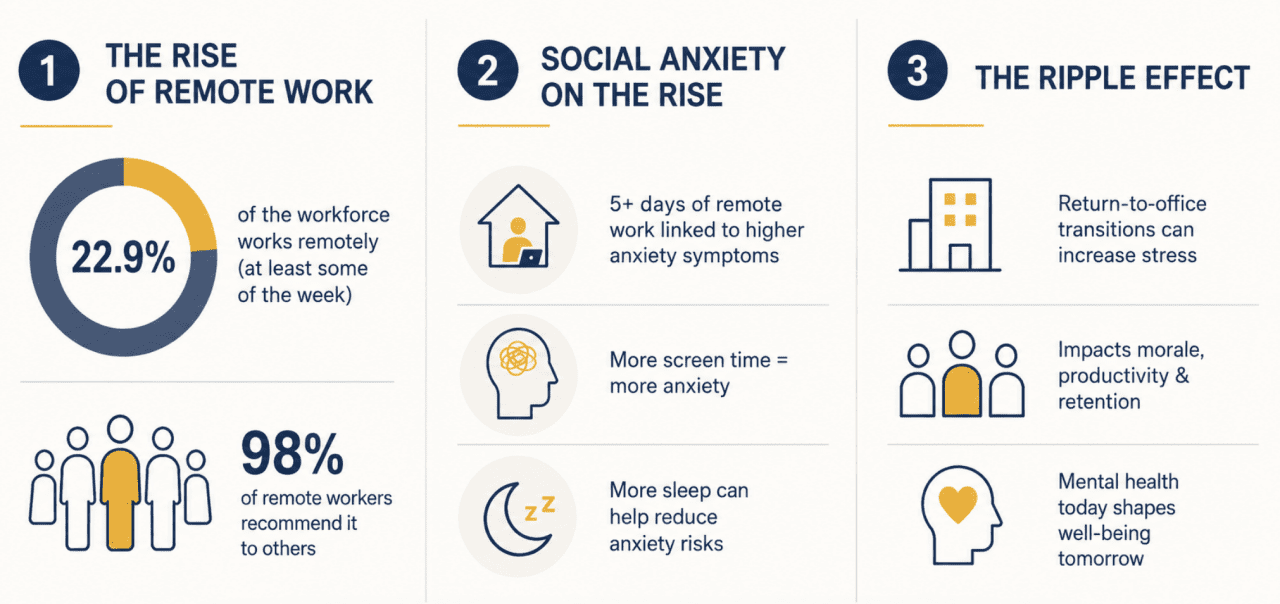
Recent figures from the Bureau of Labor Statistics indicate that nearly a quarter (22.9%) of the workforce has traded the traditional office for a remote setup. While those already embedded in this lifestyle overwhelmingly favor it—with 98% in the 2023 Buffer report suggesting it to others—the data is beginning to tell a more complex story. Specifically, the remote-first shift is revealing a quiet but growing struggle with social anxiety that many didn't anticipate.
This suggests that the choice to work from home is more than an operational decision; it is a fundamental shift in how people experience social interaction, with lasting impacts on mental health that extend far beyond the clock-out time.
The latest BLS data shows that almost a quarter (22.9%) of all employees work remotely, choosing the home office over the company HQ for at least some of the week. Of this group, around half are remote first, meaning they spend the majority of their time off-site.
With tens of millions of people choosing this path, and one report from Buffer suggesting near-universal (98%) recommendations for remote work from those already committed, it is difficult to overlook the potential for unintended psychological consequences. However, emerging longitudinal data reveals specific psychological drawbacks, and one of the lesser discussed among them is the growing prevalence of social anxiety.
This shift suggests that remote work has become a critical social determinant of mental health, with implications that extend far beyond the professional sphere.
Victory Bay, a professional rehab and recovery service, examines research exploring how remote-first work arrangements may affect social interaction, anxiety, and long-term mental health.
Clear Signs of an Emerging Crisis
In the abstract, it seems logical that putting people in remote-first roles will leave them feeling isolated and lonely. Humans thrive on the connections they form with others, and the traditional office provides a kind of community that satisfies this innate need. Take that away, leaving people cloistered at home throughout the working day, increasing the probability of heightened anxiety.
Data cited in a Frontiers meta-analysis supports this. First, those working five or more days a week at home were found to have a higher likelihood of exhibiting symptoms of anxiety than their counterparts who work remotely four or fewer days out of every seven.
The same study singled out a few demographic factors that also increase the likelihood of anxiety and depression, with married men and workers aged over 60 at greater risk than their peers. In short, it establishes remote work as a social determinant of mental health, noting that while it offers flexibility, the lack of spontaneous peer support leads to higher distress levels.






Many remote workers also choose to self-medicate in response to feelings of social anxiety they are not equipped to contend with. In turn, demand for treatment and counseling relating to addiction issues is increasing.
Screen Time as a Digital Buffer
Remote-first work is not the sole cause of rising social anxiety, with a five-year study published in the journal Frontiers in Public Health drawing an unambiguous line between how much time people spend in front of a screen and how anxious they feel.
For every hour of screen time, there’s an associated uptick in anxiousness, and interestingly, this impact is greater among the under-40s than the over-40s. Conversely, getting more sleep counteracts the effects of remote-first work’s anxiety risks, indicating that there’s a way for people to protect themselves from some of the symptoms.
Of course, for many remote employees, the option to cut down on screen time during the workday simply isn’t available. The upshot is that they may need to rethink how they manage their screen use during their downtime, as jumping straight from a work laptop to lounging on the couch with a smartphone to watch TV simultaneously might amplify anxiety.
Return-to-Office Stress
More businesses have implemented return-to-office policies in the past year, showing further rollback of COVID-19 pandemic-inspired policies that once prioritized a remote-first approach. The issue here is that rising social anxiety among those who have been working from home may be exacerbated by increased stress during an enforced reentry into shared workspaces.
These concerns are addressed in an Employee Responsibilities and Rights Journal article, which identifies a combination of social anxiety and psychological detachment from the job. The authors argue that businesses need to be proactive in providing team members with adequate support on their return from a remote-first working arrangement, or else face problems with morale, productivity, and ultimately retention.
The bubble of isolation created by working from home is only one factor in return-to-office stress, of course. The need to commute and the compounding impact of not having spent time around others also come into play.
The Knock-On Impact of Remote-First Anxiety
Businesses and employees are already suffering in light of what remote-first working does from a mental health perspective. And if a generation of people feels more anxious in social situations because they don’t have a job that requires time in a traditional office, this could well create ramifications that go beyond the world of work.
It’s inextricably linked to the broader digitalization of social interactions, often at the expense of face-to-face experiences. No company can solve this on its own, but it makes sense for employers to take some responsibility for how they support team members, particularly when making changes to remote work policies. Sudden shifts in either direction risk undesirable outcomes.
This story was produced by Victory Bay and reviewed and distributed by Stacker.

(0) comments
Welcome to the discussion.
Log In
Keep it Clean. Please avoid obscene, vulgar, lewd, racist or sexually-oriented language.
PLEASE TURN OFF YOUR CAPS LOCK.
Don't Threaten. Threats of harming another person will not be tolerated.
Be Truthful. Don't knowingly lie about anyone or anything.
Be Nice. No racism, sexism or any sort of -ism that is degrading to another person.
Be Proactive. Use the 'Report' link on each comment to let us know of abusive posts.
Share with Us. We'd love to hear eyewitness accounts, the history behind an article.