The House Judiciary Committee Thursday gave a late-session approval to a bill that would expand voting options and create state protections for some voters.
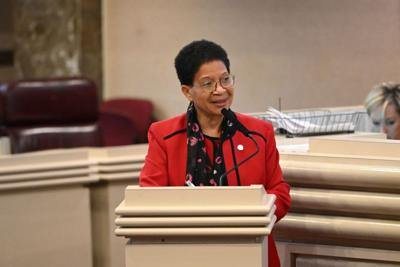
HB 486, sponsored by Rep. Adline Clarke, D-Mobile, would automatically restore the voting rights for people who were convicted of felony offenses; allow for no-excuse absentee voting; let people vote prior to Election Day and create an Alabama Voting Rights Commission to review rules changes for voting and preclear actions related to voting related to voting that could discriminate against protected classes of voters.
“This bill would modernize Alabama elections by expanding ballot access, strengthening voter protections and improving election administration,” Clarke told the committee.
The legislation also reflects several bills sponsored by Democrats over the last several years aimed at making voting easier.
It also requires the Secretary of State’s Office to maintain a statewide voter database; assist local elections offices administering elections and publish information to help voters better understand the state’s election laws.
Secretary of State Wes Allen said in a statement that he wants the election to take place within a day and opposes the legislation.
“No excuse absentee voting, mass mail ballots, and early voting causes the confusion that we see in other states, and we, as Alabamians, do not want that impeding the integrity of our elections,” he said.
Allen also said he opposes automatic voter restoration.
“There is no reason that people who lost their voting rights as a result of criminal activity should get preferential treatment when it comes to restoration,” he also said. “I am proud of the steps my Office has taken to strengthen the security of our elections. This legislation would put Alabama on the same chaotic elections footing that many blue states currently have.”
There are just three days left in the session, and the bill is unlikely to pass in a Republican-controlled Legislature.
A message was left with Clarke on Monday seeking additional comment.
Among other steps, the bill would reverse 2024’s SB 1, sponsored by now-Senate President Pro Tem Garlan Gudger, R-Cullman, which made it a Class C felony, punishable by up to 10 years in prison, for those who knowingly receive payment for “distributing, ordering, requesting, collecting, completing, prefilling, obtaining or delivering” an absentee application.
It also made it a Class B felony, punishable by up to 20 years in prison, for voters who offer a gift “third party to distribute, order, request, collect, prefill, complete, obtain or deliver” absentee ballot applications.
A federal district court later ruled the law violated parts of the 1965 Voting Rights Act for blind and disabled voters.






Clarke’s bill would allow voters cast an absentee ballot without needing an excuse, such as illness or absence on Election Day. It would also allow a voter to receive assistance to complete an application and to designate someone to deliver or mail it to the election manager in their respective county. It also allows those who are either blind or disabled to designate someone to either deliver or mail the ballot itself once they filled it out.
The legislation also authorizes the absentee election manager of the county to inspect an absentee ballot to review it for defects and allow the voter to correct defects up until Election Day.
HB 486 would also automatically restore voting rights for those convicted of felonies who have completed their sentences and been released or been pardoned or paroled, but not necessarily have paid all their fines, fees and restitution.
The bill also authorizes probate judges to offer early voting in one precinct on the fourth Monday before the primary or general election, and the second Monday before the second primary election. The polling locations would remain open until the Friday before Election Day, and would be open on the second and third Saturdays before a primary, second primary, or general election. Counties could also vote to extend voting hours.
Voting rights groups spoke in favor of the bill.
“This is not at all about partisanship,” said Jerome Dees, policy director for the Southern Poverty Law Center, during the public hearing. “This is about whether every eligible Alabamian has a fair, and equal, opportunity to participate in our democracy.”
Kim Bailey, president of the League of Women Voters in the state, said the bill would help with protecting access to the ballot box.
“As it stands, Alabama is among the most difficult states in which to cast a ballot,” she said at the public hearing. “Voting is limited primarily to in-person participation on a single day. Absentee voting is complicated, especially for voters with disabilities.”
Sen. Kirk Hatcher, D-Montgomery, filed legislation last year that would also allow for no excuse absentee voting and create a voting rights commission.
Rep. Laura Hall, D-Huntsville, and Sen. Linda Coleman-Madison, D-Birmingham, filed multiple bills to make the process easier for people who were convicted of crimes of moral turpitude to have their voting rights restored.
Rep. Thomas Jackson, D-Thomasville, filed legislation in 2024 to allow for early voting. Alabama is one of only three states, along with Mississippi and New Hampshire, that does not allow voters to cast a ballot prior to election day.
Rep. Kenyatté Hassell, D-Montgomery, filed legislation to allow absentee voters to cure their ballots.
Alabama has one of the lowest voter participation rates in the country. About 59% of the eligible voting age population cast a ballot in the 2024 general election, which placed the state in the bottom 10 for that category.

(0) comments
Welcome to the discussion.
Log In
Keep it Clean. Please avoid obscene, vulgar, lewd, racist or sexually-oriented language.
PLEASE TURN OFF YOUR CAPS LOCK.
Don't Threaten. Threats of harming another person will not be tolerated.
Be Truthful. Don't knowingly lie about anyone or anything.
Be Nice. No racism, sexism or any sort of -ism that is degrading to another person.
Be Proactive. Use the 'Report' link on each comment to let us know of abusive posts.
Share with Us. We'd love to hear eyewitness accounts, the history behind an article.