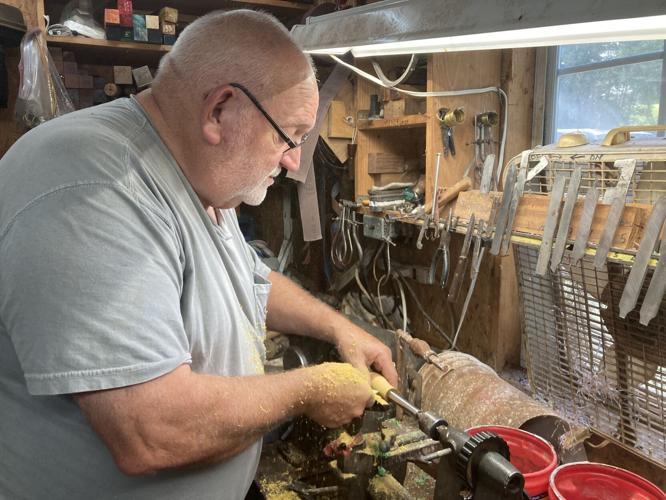

Like so many young boys, David Gaston liked to make things for himself. So, when he started duck hunting, it wasn’t long before he decided to make his own duck calls.
His do-it-yourself devotion led him to start Gaston Custom Calls, a company that has become known all over the world for making some of the highest quality, most highly sought-after duck calls available. And he makes them in a little shop in back of his home in Thomasville in Clarke County.
Gaston custom calls have been shipped to many of the 50 United States. They have also flown around the globe. “I’ve sent calls to France, England, Spain, Ukraine, Ireland, Australia - I really can’t remember everywhere I sent them,” Gaston said. “Those are just the places I remember.”
Gaston said he is way behind in filling orders. One reason is the high demand for his calls, but he said even though he is mostly retired from his regular job in the construction industry, “I don’t get to spend as much time in the shop as I want to. My wife requires a certain amount of my time being handicapped, and so does the garden which feeds us.”
When he is in his shop, he makes handmade works of art. He uses three staple woods to make duck calls.
“This is Alabama Black Belt Hedge,” Gaston said, holding up one of his calls. “Hedge is what it’s commonly called in the world of duck calling. It’s also called Osage Orange, Bow Wood, Mock Orange, Hedge Apple, Horse Apple. It’s a lighter color than these two.
Cocobolo is a more red-colored wood. The other is African Blackwood.Cocobolo is found in the Pacific regions of Central America from Panama to Mexico, and African Blackwood grows in the dry regions of Africa, mainly in the western countries and in South Africa.
Both Cocobolo and African Blackwood are used for making musical instruments, Gaston said, because of their ability to produce a superior tone. That superior tone quality is also why they make good duck calls.
“In essence, a duck call is a musical instrument,” Gaston said. But even with the high quality of these exotic woods, “from a musical standpoint, they are no better than our Hedge. I take great pride in making a duck call from Hedge because it is from the Black Belt of Alabama.”
Gaston said Hedge “is hard as a woodpecker's lips and is extremely hard to turn (shape on the lathe), but it makes and exceptionally good call.”
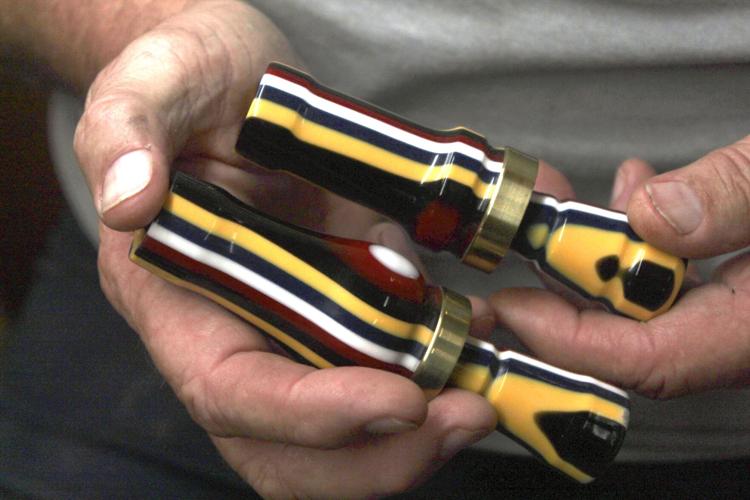
Gaston also makes duck calls out of acrylic, which comes in many different colors. Some are multi colored and some even transparent.
There are three main parts to the calls, Gaston said, the insert, the reed and the barrel. The insert contains the reed, which vibrates to make the sound. The barrel resonates the sound. And regardless of whether it is an acrylic or wood call, the process of making the call is the same. The blanks for both the barrel and insert are turned on a lathe to get their final shape.
Gaston said getting the reed correct is imperative. “I punch my own reeds,” he said. “Then I cut them to length. The reed is not perfectly straight. The reed flexes. It’s going to flex to the weak side; it curves. When you put it in the duck call, you have to be sure you put it in curving away, or it may lock up.” Tuning the reed is extremely important, he explained, because that will affect the way it vibrates and ultimately affect the sound it produces.
Since the reed moves, it can wear out, so the insert is removable, and a new reed and cork can be installed. Gaston warned that you must be careful if you are installing a new cork and reed.
“The cork holds the reed in place,” he said. “Once your cork is in, if you see the cork protruding past the cork slot, when you get it bottomed out in the back of the cork slot and you continue to press on it, you will swell the cork, and it will break the cork slot. It happens every year.” He said that cannot be repaired.
Gaston said he started with turkey calls. “Mr. William Harrison of Possum Bend taught me,” Gaston said. “I say,‘taught me.’ I saw him do it, and if I see you do it, I have enough sense to do it myself! But I made my own turkey yeppers and made some little scratch boxes.”
He said he no longer makes turkey calls because “the big names out there have that market, and they can have it.”
When Gaston decided to focus on duck calls, he looked to experts to teach him the art. He started by learning from Gordon Hartley, owner of Southland Duck Calls. Hartley spent an afternoon talking with Gaston about the art of call making. Although he didn’t reveal much, he advised Gaston to get some tools and some wood and start making calls, so he did. Call makers have certain secrets they do not like to divulge, mostly about how to produce the perfect sound. Gaston said much is revealed on YouTube, but many call makers still guard their secrets, including himself.
It did not take long for Gaston to realize turning a call was much easier than perfecting the sound. Eventually Gaston met legendary call maker Alvin Taylor of Clarendon, Arkansas. Although Taylor was not forthcoming with his secrets of duck call making at first, over the next 18 years, the two of them became very close friends. Taylor shared his years of experience, teaching Gaston what it took to produce a duck call “that any hunter would be proud to hang on his or her lanyard.”
Gaston soon began making calls and taking them to Taylor for inspection and approval. In August of 2000, Gaston went to Taylor’s shop, and they made the last call they would make together. Taylor told Gaston, “You don’t need me anymore.” Taylor passed away in September of 2000, and shortly thereafter, Gaston Custom Duck Calls was born.
The secret to using the call is how you blow it, according to Gaston.“It makes it a little more difficult to teach someone to blow a call if they have been blowing them for three of four years or however long and they have developed a bunch of bad habits,” Gaston said.
It’s best to start early. “I made a pink duck call for a little girl,” Gaston said. “She sat on the stool, and we went over how to do a call. In less than 10 minutes that little girl could do a basic mallard call proficiently because she didn’t have any bad habits.”
Gaston likes for people to call and talk to him when they order a call. “I personally like to talk to the people to get an idea of their calling expertise and what they’re looking for in a call and where they hunt,” Gaston said.“All those things have to do with the sound we’re looking for in a call.”
To order, call or text Gaston at 251-769-2744 or email gastoncalls@gmail.com. You can order directly at the website for Gaston Custom Calls,www.gastoncustomcalls.com.
This story originally ran in the Black Belt Outdoors special section in Fall 2022.

(0) comments
Welcome to the discussion.
Log In
Keep it Clean. Please avoid obscene, vulgar, lewd, racist or sexually-oriented language.
PLEASE TURN OFF YOUR CAPS LOCK.
Don't Threaten. Threats of harming another person will not be tolerated.
Be Truthful. Don't knowingly lie about anyone or anything.
Be Nice. No racism, sexism or any sort of -ism that is degrading to another person.
Be Proactive. Use the 'Report' link on each comment to let us know of abusive posts.
Share with Us. We'd love to hear eyewitness accounts, the history behind an article.