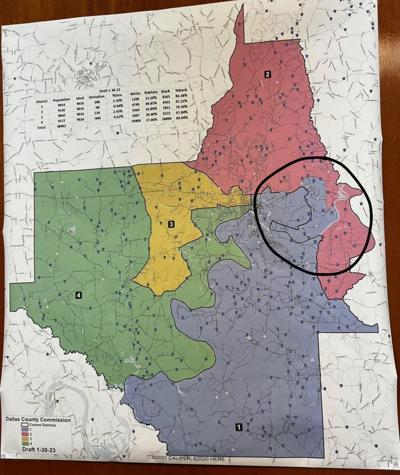
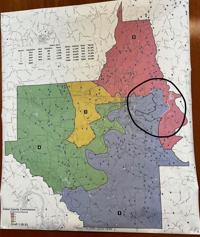

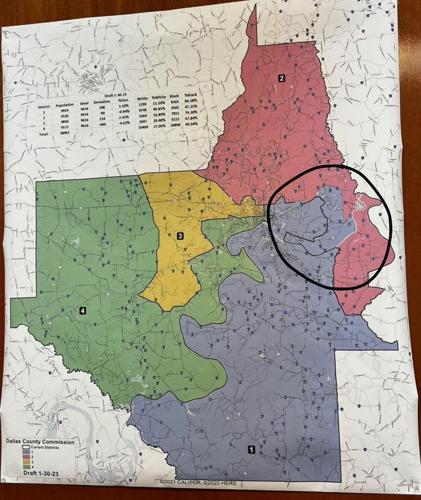
The Dallas County Commission passed new district lines for the county Monday night that change representation for the northeast portion of the county.
But the redistricting measure barely passed.
Commissioners were split on the decision to redistrict, with Commissioners Connel Towns and Vivian Rogers voting yes and Jan Justice and Curtis Williams voting no. Commission Chairman Jimmy Nunn broke the tie by voting yes, making the new district lines law.
By law, county voting districts must be assessed after each census and adjusted to evenly distribute the population among the districts. The 2020 census determined that population in Districts 1 and 2 were uneven, so the new lines move a portion of those who were in Rogers’ District 2 into Towns’ District 1. And those commissioners were OK with that, voting yes to the reshuffle.
The new district lines had to be made at least six months before the next election, which for Dallas County will be the March 2024 primaries.
The commission held a public hearing on the district lines during the March 13 meeting, where several citizens told the commission they were not happy with new districts. Some said they were not happy with the way they were drawn 10 years ago.





Attendees noted the difference in the size of the districts in terms of land mass. Some cited the number of roads in each district and noted that it’s unfair for districts to get the same funding when some districts have more roads than other districts. They complained about the condition of the roads as well.
Nunn reiterated that the public hearing was solely about the district lines and not about roads and repaving. Nunn, the Commissioners and Dallas County Attorney John Kelly explained multiple times that the only factors the law considers in determining where the district lines are drawn are population and minority representation.
Kelly said the lines were “prepared in large part in connection with Alabama State University. They have a center that does this kind of work. And a decade ago they prepared the plan I guess we are using now. They do this for a lot of counties.” Kelly said the commissioners were part of the process with ASU.
The 2020 census indicated that District 2 was 10% out of proportion to the other districts, about twice the variance allowed by law. “What ASU did was adjust the lines to accommodate the population shift to bring those districts into the 5% (variance) and to keep the minority representation the same,” Kelly said.
The lines were redrawn to move a small area in the southern part of District 2 into the northeastern part of District 1. Otherwise, according to Nunn and Kelly, the map is the same as the one the Commission accepted 10 years ago.
During the Commission meeting that immediately followed the public hearing, the district lines came up for a vote. District 1 Commissioner Towns moved to pass the plan as drawn, and District 2 Commissioner Rogers seconded the motion. During the discussion Commissioner Jan Justice, who represents District 4 said, “My only discussion is that we just held a public hearing where some information has been shared, and I feel like we could have come up with a little bit better plan.”


(0) comments
Welcome to the discussion.
Log In
Keep it Clean. Please avoid obscene, vulgar, lewd, racist or sexually-oriented language.
PLEASE TURN OFF YOUR CAPS LOCK.
Don't Threaten. Threats of harming another person will not be tolerated.
Be Truthful. Don't knowingly lie about anyone or anything.
Be Nice. No racism, sexism or any sort of -ism that is degrading to another person.
Be Proactive. Use the 'Report' link on each comment to let us know of abusive posts.
Share with Us. We'd love to hear eyewitness accounts, the history behind an article.